The Enterprise AI Conversation Is Changing
For much of the last decade, Enterprise AI has been associated with automation, analytics, and prediction. Organizations invested heavily in technologies that could automate repetitive work, forecast business outcomes, and generate insights from vast amounts of operational data.
These investments yielded substantial returns. Decision-making became more data-driven, businesses grew faster, and reporting became more complex.
However, as organizations gained greater visibility into their operations, a new challenge emerged. Knowing what is happening across the business is no longer enough. Leaders now need confidence that operational standards are being followed consistently across every location, every shift, and every process.
This shift is pushing operational compliance into the spotlight as the next major focus area for Enterprise AI.
Why Traditional Compliance Models Are Under Pressure
Most enterprises already have documented procedures, compliance frameworks, and operational guidelines. The challenge is not creating standards—it is ensuring consistent execution.
As businesses expand across multiple sites, maintaining oversight becomes increasingly difficult. Compliance teams often rely on periodic audits, inspections, supervisor observations, and manual reporting to evaluate performance.
While these methods remain important, they face several limitations.
Growing Operational Complexity
A modern enterprise may operate:
- Multiple facilities or branches
- Hundreds of employees
- Different shifts and teams
- Diverse operational processes
- Industry-specific compliance requirements
The larger the operation becomes, the harder it is to verify that standards are being followed consistently.
The Limits of Periodic Audits
Conventional audits offer performance snapshots rather than ongoing visibility. Issues may remain undetected until the next scheduled review, creating a gap between operational reality and compliance reporting.
The Challenge of Consistency
Many operational failures occur not because policies are missing, but because execution varies between locations, teams, or shifts.
From Compliance Management to Compliance Intelligence
A significant shift is taking place across industries.
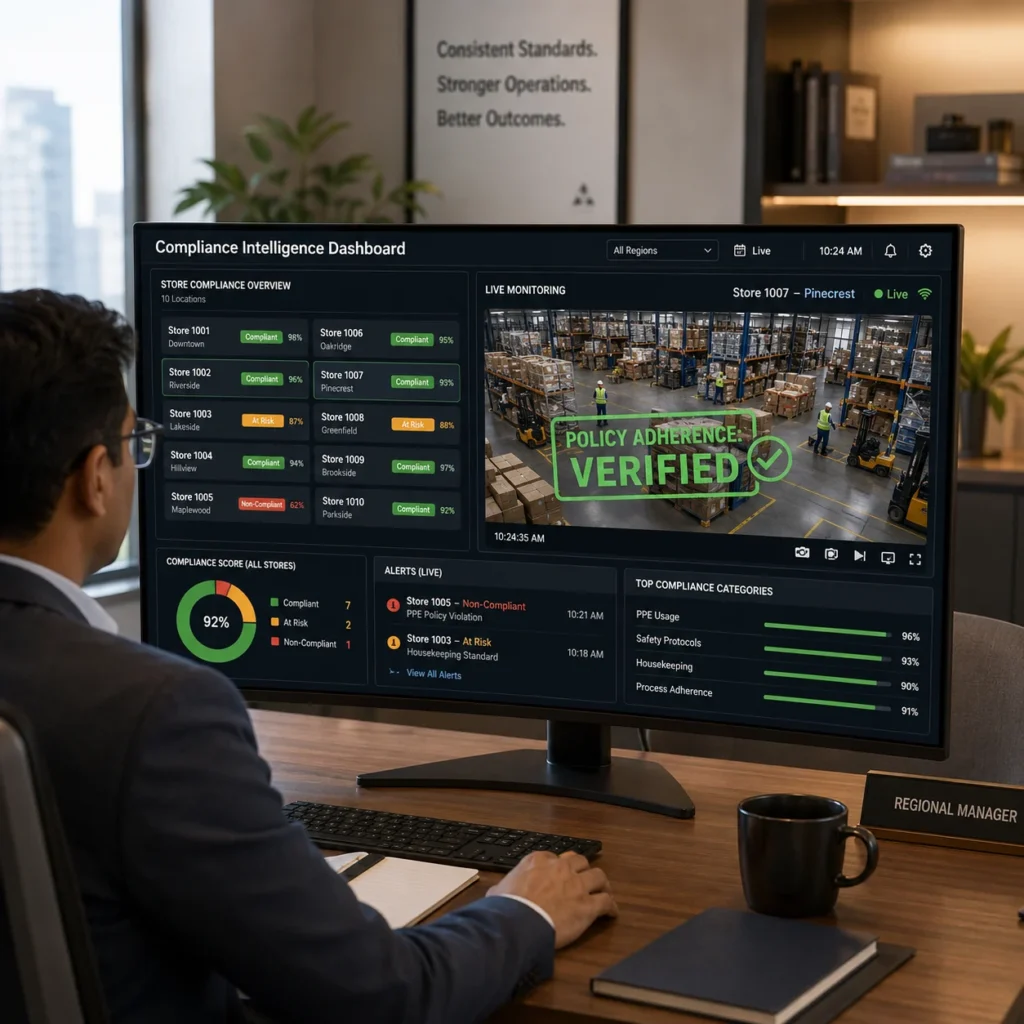
Organizations are moving beyond compliance management and toward what can be described as compliance intelligence—the ability to continuously understand how operational standards are being executed in real-world environments.
Instead of asking:
“Did we pass the audit?”
Organizations are increasingly asking:
“Are we operating according to standards right now?”
This change transforms compliance from a periodic activity into an ongoing operational capability.
Traditional Compliance vs Compliance Intelligence
Traditional Compliance | Compliance Intelligence |
Periodic audits | Continuous visibility |
Manual inspections | Automated verification |
Reactive issue discovery | Early deviation detection |
Historical reporting | Real-time awareness |
Sample-based reviews | Broader operational coverage |
The objective is not to replace compliance teams. It is to provide them with better information and faster visibility into operational risks.
How AI Is Transforming Operational Compliance
AI is uniquely positioned to address one of compliance’s biggest challenges: scale.
Human supervisors cannot observe every activity. Auditors cannot inspect every process. Managers cannot review every hour of operational footage generated across multiple facilities.
AI helps bridge this gap by continuously analyzing operational environments and highlighting activities that require attention.
Some common applications include:
Process Compliance Verification
AI can help identify whether critical workflows and operational procedures are being followed as intended.
Safety Compliance Monitoring
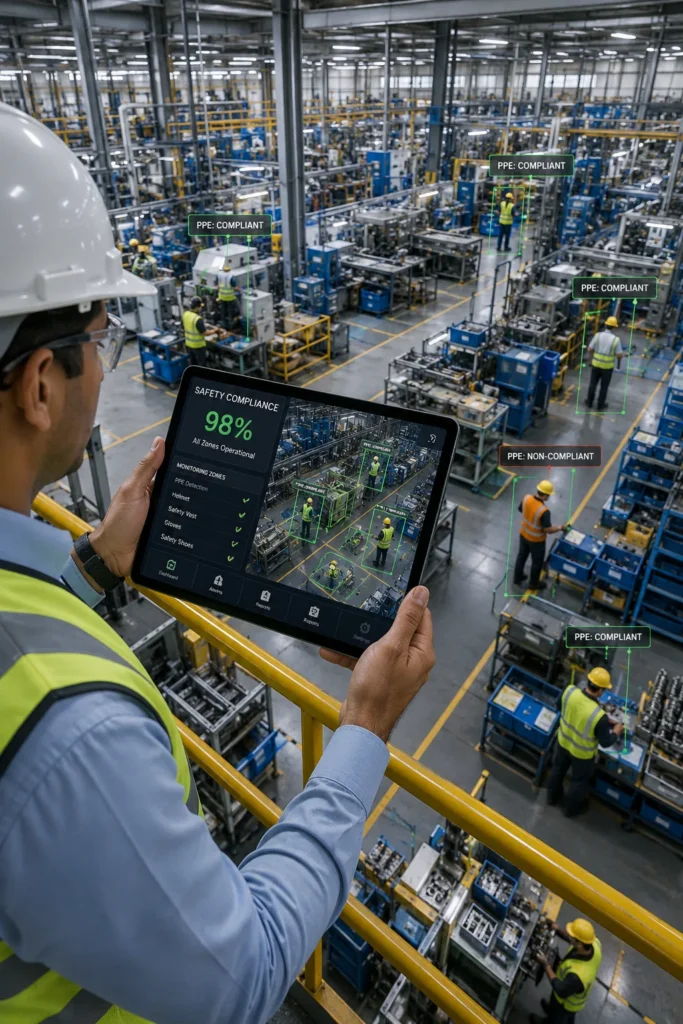
Organizations can gain greater visibility into safety practices, PPE usage, and adherence to workplace protocols.
Operational Standard Enforcement
AI can support consistency by helping organizations verify that standards are being maintained across locations and shifts.
Exception-Based Management
Rather than reviewing routine activities, teams can focus on specific deviations that require investigation or corrective action.
Why This Matters for Enterprise Performance
Operational compliance is increasingly becoming a business performance issue rather than solely a regulatory concern.
When standards are followed consistently:
- Operational variability decreases
- Process quality improves
- Safety risks are reduced
- Customer experiences become more consistent
- Corrective actions can be initiated faster
This is why many enterprises are beginning to view compliance as a strategic operational capability.
CAPASai supports this evolution through AI-powered video analytics, real-time alerts, and remote monitoring capabilities. By leveraging existing CCTV infrastructure, CAPASai helps organizations improve process adherence, identify compliance deviations, and gain greater visibility into operational execution across multiple locations.
Operational compliance is becoming the next field where intelligent solutions can produce quantifiable business value as enterprise AI develops.