Why Corporate Governance Is Expanding Beyond Reports and Policies
Corporate governance has traditionally focused on establishing accountability, ensuring regulatory compliance, managing risk, and maintaining transparency across an organization. To achieve these objectives, leadership teams have historically relied on reports, audits, policy reviews, performance metrics, and management updates.
While these tools remain essential, they often provide a retrospective view of operations. Executives and board members typically receive information after activities have already occurred, creating a natural gap between governance decisions and operational realities.
As organizations become larger, more distributed, and increasingly complex, leaders face a growing challenge: how to maintain meaningful oversight without becoming disconnected from day-to-day execution.
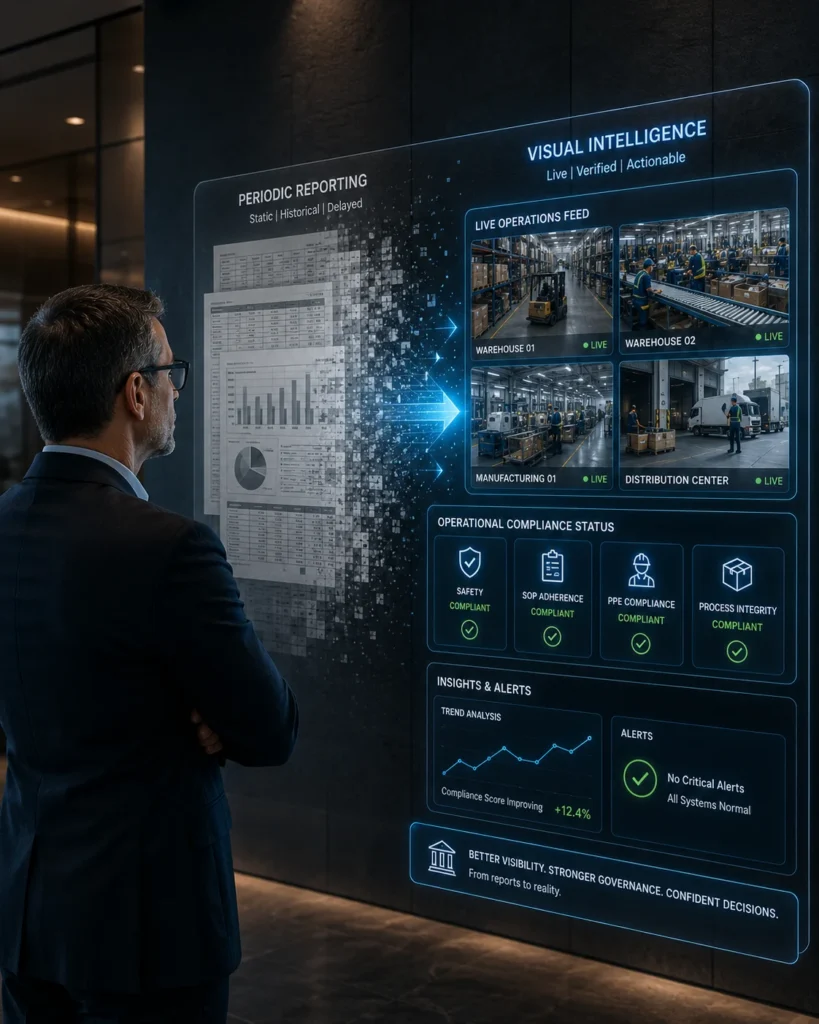
This challenge is driving interest in a concept known as visual compliance—a governance approach that uses operational visibility to strengthen accountability, improve decision-making, and provide greater confidence in how organizational standards are being executed.

The Governance Visibility Gap
Most governance frameworks are designed around documentation. Policies define expectations, reports summarize performance, and audits validate compliance.
However, documentation alone cannot always reveal how processes are actually being executed across multiple facilities, teams, and operational environments.
As a result, leadership teams may have strong visibility into outcomes while having limited visibility into the activities that produce those outcomes.
Understanding the Role of Visual Compliance
Visual compliance introduces an additional layer of operational insight by helping organizations connect governance objectives with real-world execution.
Rather than relying exclusively on periodic reporting cycles, organizations gain access to information that reflects operational activities as they occur.
Moving Beyond Outcome-Based Governance
Traditional governance models often focus on measuring results.
Questions such as these are common:
- Did the organization meet compliance targets?
- Were audit findings reduced?
- Did safety performance improve?
- Were operational goals achieved?
While these metrics are important, they do not always explain why results occurred.
Visual compliance helps organizations understand the operational behaviors and process execution that contribute to those outcomes.
Strengthening Organizational Accountability
Accountability improves when expectations are clearly defined and execution can be validated.
By creating greater visibility into operational activities, organizations can establish stronger links between governance requirements and day-to-day performance.
This helps leaders move from assumption-based oversight to evidence-informed decision-making.
How Visual Compliance Supports Modern Governance Frameworks
As enterprises expand across multiple facilities and business units, maintaining consistent oversight becomes increasingly difficult.
Visual compliance can support governance objectives in several key areas.
Risk Management
Operational risks often emerge long before they appear in reports or audits.
Greater visibility helps organizations identify developing issues earlier and respond before they become larger governance concerns.
Operational Consistency
Organizations frequently invest significant resources in creating standardized procedures.
Visual compliance can help leaders understand whether those standards are being executed consistently across locations and teams.
Transparency and Trust
Strong governance depends on trust in organizational reporting.
When operational activities become more visible and verifiable, confidence in reported performance naturally increases.
Governance Objective | How Visual Compliance Supports It |
Accountability | Greater visibility into execution |
Risk Management | Earlier identification of operational issues |
Transparency | Improved confidence in reported performance |
Consistency | Better alignment across locations |
Oversight | Enhanced awareness of operational activities |
This does not replace governance processes. Instead, it strengthens the information available to support them.
The Evolution From Governance by Reports to Governance by Visibility
For many years, governance has been driven primarily by documents, summaries, and periodic reviews. While these mechanisms remain important, organizations increasingly recognize the value of supplementing them with operational visibility.
Visual compliance represents a shift toward governance models that combine traditional controls with greater awareness of real-world execution.
Rather than waiting for information to move through reporting chains, leadership teams can gain a clearer understanding of how policies, standards, and procedures are being implemented across the organization.
This approach enables governance to become more proactive, more informed, and more closely connected to operational reality.

A Strategic Advantage for Enterprise Leaders
Organizations that strengthen visibility often gain benefits beyond compliance. They improve accountability, reduce information gaps, accelerate issue resolution, and create greater alignment between strategic objectives and operational execution.
As governance expectations continue to evolve, visibility is becoming an increasingly important component of effective leadership.
CAPASai supports this transformation through AI-powered video analytics, intelligent monitoring, and operational visibility solutions. By leveraging existing CCTV infrastructure, CAPASai helps organizations strengthen governance oversight, improve transparency, and gain deeper insight into how operational standards are executed across multiple locations.