Why Safety Performance Directly Impacts Business Performance
Safety is often viewed as a compliance requirement, but for many organizations it is also a significant operational and financial consideration. Workplace incidents can affect production schedules, workforce availability, product quality, customer commitments, insurance costs, and regulatory standing.
In industrial facilities, warehouses, construction projects, and logistics operations, daily activities involve constant interaction between people, equipment, vehicles, and processes. Even when safety procedures are well documented, maintaining consistent adherence across every shift and location can be difficult.
As organizations seek to improve operational reliability, many are evaluating how technology can help reduce preventable risks while supporting business objectives.
The Hidden Costs Of Workplace Safety Incidents
The direct cost of an incident is often only a small part of the overall impact.
Organizations may also experience:
- Production downtime
- Delayed customer deliveries
- Equipment damage
- Investigation expenses
- Additional training requirements
- Regulatory scrutiny
- Increased insurance premiums
- Workforce morale challenges
For enterprises operating across multiple facilities, even small safety issues can accumulate into significant operational costs over time.
Why Manual Safety Oversight Struggles To Scale
Traditional safety programs typically rely on a combination of supervisors, inspections, audits, safety committees, and employee reporting.
While these approaches remain important, they face growing challenges in modern operational environments.
Consider a manufacturing facility operating 24 hours a day across multiple production lines. Supervisors cannot observe every workstation continuously. Similarly, warehouse managers cannot monitor every forklift interaction, pedestrian movement, or loading operation throughout an entire shift.
As facilities become larger and operations become more complex, maintaining consistent oversight becomes increasingly resource-intensive.
The Shift From Incident Investigation To Risk Prevention
Historically, many organizations focused on understanding what happened after an incident occurred.
Today, the conversation is changing.
Business leaders increasingly want answers to questions such as:
- Which unsafe behaviors occur most frequently?
- Where are recurring compliance gaps appearing?
- Which operational areas carry the highest risk exposure?
- What early warning signs exist before incidents occur?
- How can corrective action be taken faster?
Answering these questions requires a continuous stream of operational insight rather than periodic observations.
How AI Driven Safety Monitoring Supports Better Outcomes
AI-driven safety monitoring uses computer vision and video analytics to analyze workplace activities and identify conditions that may require attention.
Examples include:
PPE Compliance Verification
Monitoring whether required protective equipment is being used in designated operational areas.
Restricted Zone Detection
Identifying unauthorized entry into controlled or hazardous locations.
Worker And Equipment Separation
Monitoring interactions between personnel, forklifts, vehicles, and machinery.
Process Compliance Observation
Detecting deviations from approved workflows and operational procedures.
Hazard Recognition
Identifying obstructions, unsafe conditions, or unusual activity patterns that may increase risk exposure.
Compare Conventional Safety Reviews With AI Driven Monitoring
Conventional Safety Reviews | AI Driven Safety Monitoring |
Periodic inspections | Ongoing observation |
Manual reporting | Automated event detection |
Incident-focused analysis | Prevention-focused insights |
Limited operational coverage | Broad facility coverage |
Human-dependent observations | Consistent rule-based analysis |
Delayed awareness | Faster issue identification |
This comparison highlights why organizations are increasingly incorporating intelligent monitoring into broader safety and operational excellence programs.
Quantifying The Business Value
The business case for AI-driven safety monitoring extends beyond safety metrics.
Potential areas of value include:
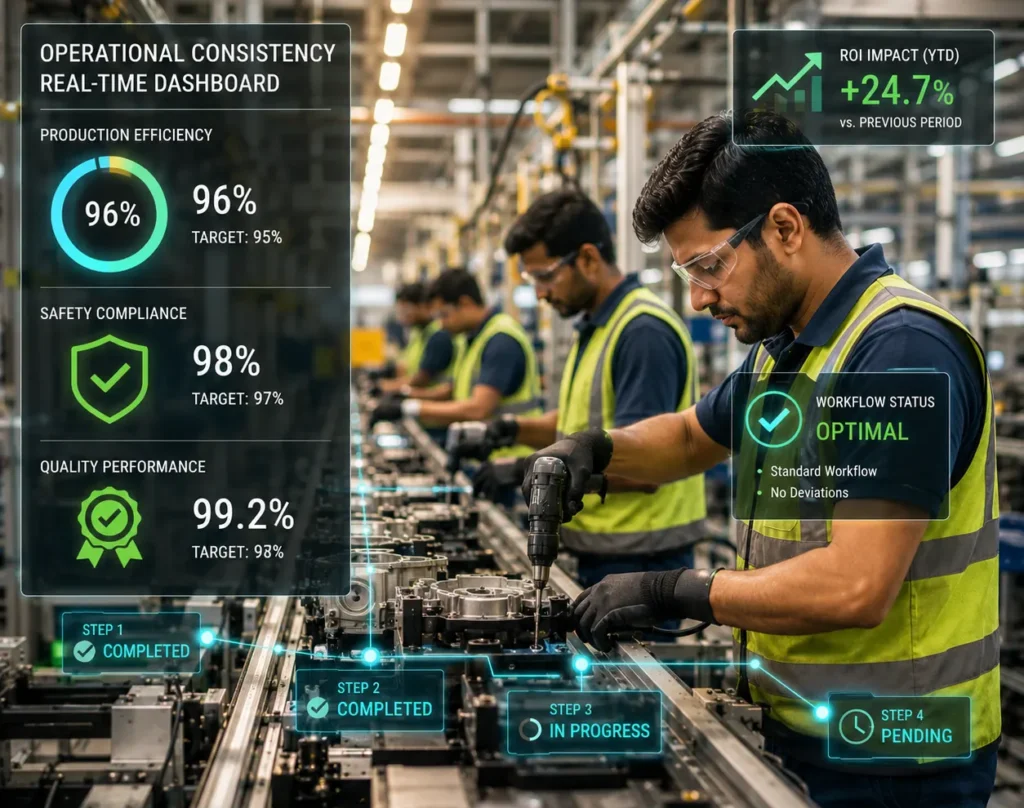
Reduced Downtime
Earlier identification of unsafe conditions can help prevent disruptions that affect production or service delivery.
Lower Risk Exposure
Organizations can address recurring safety concerns before they contribute to larger incidents.
Improved Workforce Consistency
Clear visibility into operational practices helps reinforce expected behaviors and procedures.
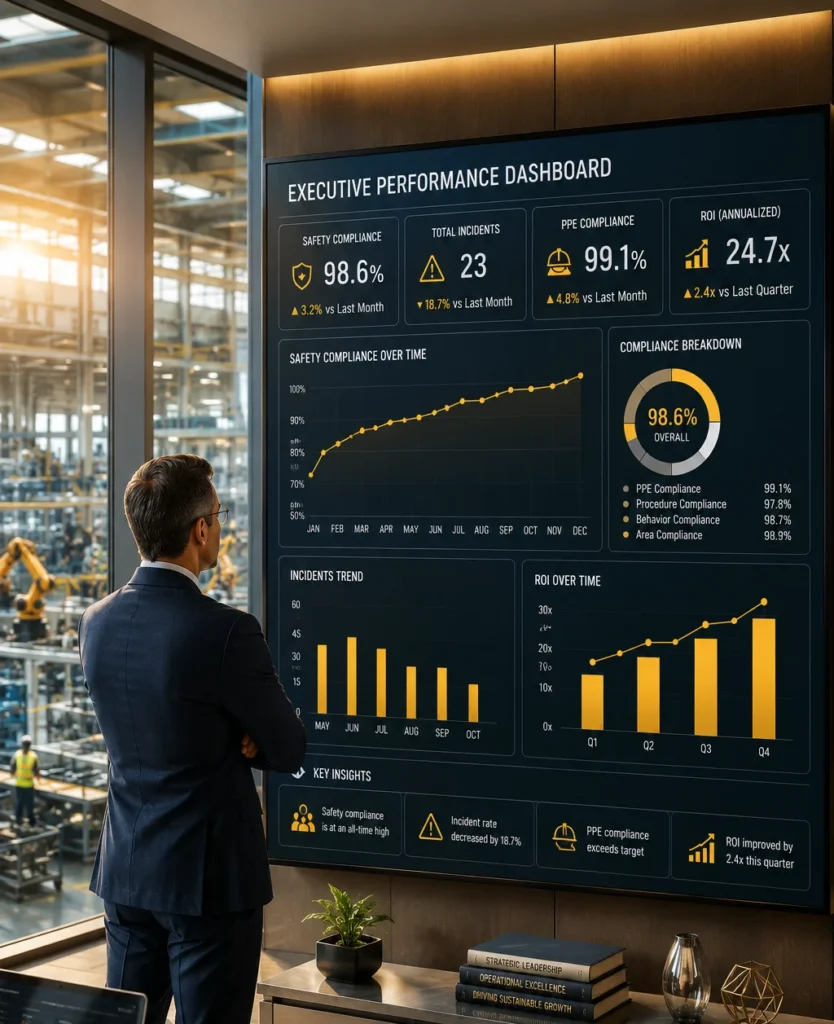
Stronger Governance
Safety leaders gain access to objective data that supports informed decision-making and performance measurement.
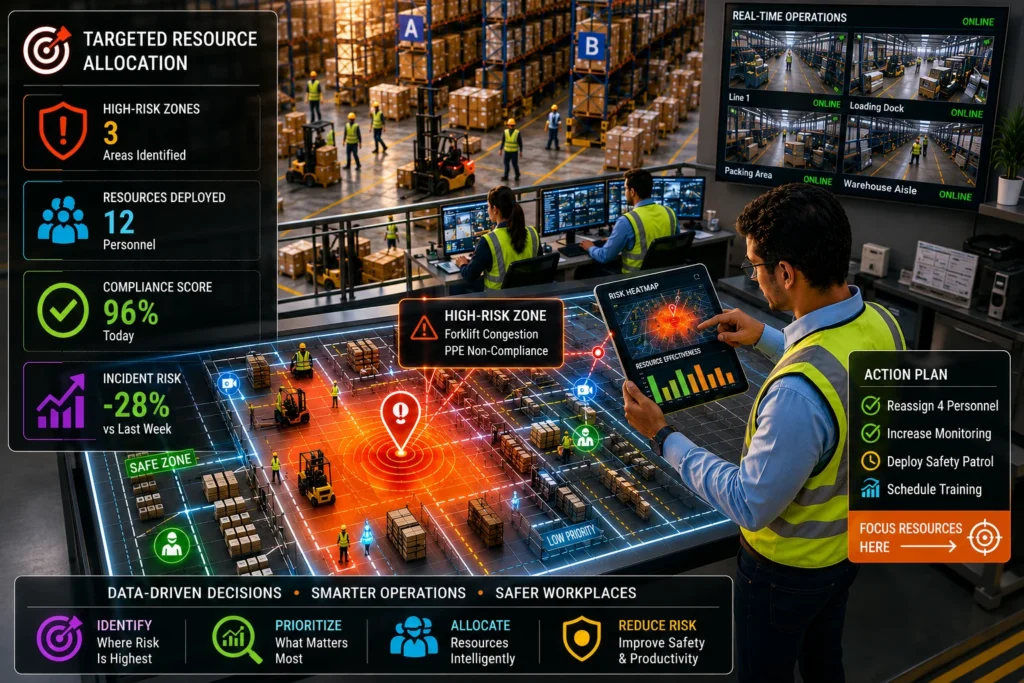
Better Resource Allocation
Teams can focus their attention on areas with the greatest operational impact rather than relying solely on routine inspections.
How CAPASai Supports Enterprise Safety Objectives
CAPASai helps organizations enhance workplace safety through AI-powered video analytics and intelligent operational oversight.
By analyzing workplace activities, equipment interactions, PPE adherence, restricted-area access, and workflow execution, CAPASai helps enterprises identify potential risks earlier and gain greater awareness of day-to-day operations.
This enables safety teams, plant managers, and operational leaders to make more informed decisions while supporting compliance requirements and operational consistency across multiple facilities.
Why Forward-Looking Organizations Are Investing In Prevention
The strongest safety programs are no longer measured solely by how effectively they respond to incidents. Increasingly, they are evaluated by how successfully they prevent incidents from occurring in the first place.
AI-driven safety monitoring provides organizations with additional visibility into workplace activities, helping transform safety management from a reactive function into a proactive business capability that supports productivity, governance, and long-term operational performance.