Introduction
Standard Operating Procedures (SOPs) are the backbone of any scalable business.
They define:
- How tasks should be performed
- How quality should be maintained
- How risks should be minimized
But here’s the real challenge:
👉 SOPs don’t fail on paper—they fail in execution
For businesses operating across multiple locations—retail stores, warehouses, QSR chains, pharma units—ensuring consistent SOP compliance is one of the hardest operational problems.
Despite clear guidelines, businesses struggle with:
- Inconsistent execution
- Lack of monitoring
- Human dependency
- Delayed audits
The result?
- Revenue leakage
- Compliance risks
- Poor customer experience
- Brand inconsistency
In this blog, we break down how to ensure SOP compliance at scale using AI-driven monitoring—and how platforms like CAPASai make it practical, real-time, and scalable.
Why SOP Compliance Breaks Down
Even well-designed SOPs fail when execution is manual and decentralized.
- Lack of Real-Time Monitoring
Most businesses rely on:
- Periodic audits
- Manager supervision
👉 These methods are reactive, not preventive
- Human Dependency
Compliance depends heavily on:
- Store managers
- Supervisors
- Staff discipline
👉 Human inconsistency leads to gaps
- No Accountability
When violations occur:
- There is no proof
- Responsibility is unclear
👉 Issues are ignored or repeated
- Delayed Detection
Problems are often identified:
- Hours or days later
- After damage is done
- Scale Challenges
What works for 5 stores fails at 50 or 100 locations.
👉 More locations = less control
What Does Effective SOP Compliance Look Like?
To truly enforce SOPs, businesses need:
- Real-time visibility
- Automated detection of violations
- Instant alerts
- Centralized control
- Data-backed accountability
This is where AI video analytics changes everything.
How AI Ensures SOP Compliance Across Locations
AI-powered monitoring platforms like CAPASai transform SOP compliance from a manual task into an automated system.
- Continuous Monitoring (24/7)
AI monitors:
- Every camera
- Every location
- Every activity
👉 No fatigue. No missed events.
- Automated SOP Violation Detection
AI can detect:
- Staff not following procedures
- Improper handling of goods
- Hygiene violations
- Safety breaches
👉 Issues are identified instantly
- Real-Time Alerts
When a violation occurs:
- Alerts are triggered immediately
- Notifications are sent to relevant teams
👉 Action happens in real time—not after the fact
- Video Evidence for Accountability
Every violation includes:
- Time-stamped video clips
- Clear visual proof
👉 No disputes. No ambiguity.
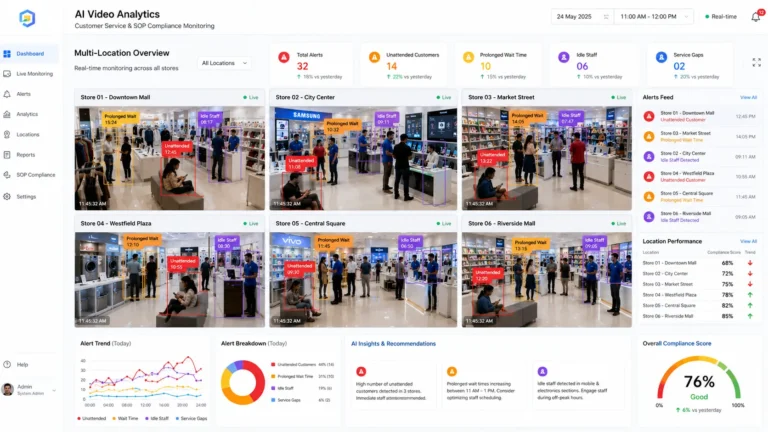
- Centralized Monitoring Dashboard
Manage all locations from:
👉 Leadership gets full visibility
Industry-Specific SOP Compliance Examples
Retail Chains
Common SOP Violations:
- Staff not attending customers
- Billing errors
- Unauthorized discounts
AI Impact:
- Monitor customer interaction
- Detect suspicious billing behavior
- Track staff activity
👉 Result: Improved service + reduced losses
Warehouses & Dark Stores
Violations:
- Improper handling of goods
- Picking errors
- Safety non-compliance
AI Impact:
- Detect mishandling
- Monitor workflow efficiency
- Ensure safety protocols
👉 Result: Reduced damage + higher efficiency
QSR & Food Chains
Violations:
- Hygiene lapses
- Food handling errors
- Service delays
AI Impact:
- Monitor kitchen hygiene
- Track preparation processes
- Measure service time
👉 Result: Consistent quality across outlets
Pharma & Manufacturing
Violations:
- GMP non-compliance
- PPE violations
- Unauthorized access
AI Impact:
- Ensure cleanroom compliance
- Monitor staff behavior
- Track process adherence
👉 Result: Audit readiness + risk reduction
Step-by-Step: How to Implement SOP Compliance Monitoring
Step 1: Define Critical SOPs
Identify high-impact processes:
- Safety procedures
- Operational workflows
- Customer service standards
👉 Focus on what affects revenue and risk
Step 2: Map SOPs to AI Use Cases
Translate SOPs into detectable events:
- “Staff must wear gloves” → PPE detection
- “No idle time at counters” → inactivity detection
Step 3: Integrate CCTV with AI Platform
- Connect existing cameras
- Enable AI modules
👉 No hardware overhaul required
Step 4: Configure Alerts & Rules
Set triggers such as:
- SOP violation alerts
- Threshold-based notifications
Step 5: Deploy Centralized Dashboard
- Monitor all locations
- Track compliance in real time
Step 6: Train Teams & Act on Alerts
Ensure:
- Managers respond to alerts
- Teams understand accountability
Before vs After SOP Compliance with AI
Before
- Manual audits
- Delayed detection
- No proof of violations
- High dependency on managers
- Inconsistent execution
After
- Real-time monitoring
- Instant alerts
- Video evidence
- Automated tracking
- Standardized operations
Measuring SOP Compliance Success
Key metrics to track:
✔ Compliance Rate
Percentage of SOP adherence
✔ Incident Frequency
Number of violations per location
✔ Response Time
Time taken to act on alerts
✔ Store Performance Score
Comparative performance across locations
ROI of SOP Compliance Automation
- Reduced Losses
- Prevent operational errors
- Avoid compliance penalties
- Lower Monitoring Costs
- Reduced need for supervisors
- Centralized control
- Improved Productivity
- Staff accountability increases
- Processes become efficient
- Better Customer Experience
- Consistent service quality
- Faster operations
Common Mistakes to Avoid
❌ Overloading with Too Many SOPs
Start with critical ones first
❌ Ignoring Alerts
Alerts are only useful if acted upon
❌ No Central Monitoring
Decentralized systems reduce effectiveness
❌ Lack of Training
Teams must understand the system
Best Practices for Long-Term Success
✔ Start Small, Scale Fast
Pilot in key locations, then expand
✔ Use Data for Decisions
Leverage insights from dashboards
✔ Regularly Update SOPs
Adapt to changing business needs
✔ Integrate with Business Operations
Make compliance part of daily workflows
The Future of SOP Compliance
AI is moving toward:
- Predictive compliance
- Automated decision-making
- Fully autonomous monitoring
Businesses adopting early will:
- Reduce costs
- Improve consistency
- Gain competitive advantage
Key takeaway
Ensuring SOP compliance across multiple locations is no longer a manual challenge.
With AI-powered platforms like CAPASai, businesses can:
- Monitor every location in real time
- Detect violations instantly
- Enforce accountability
- Scale operations without losing control
The shift is clear:
👉 From reactive audits to proactive, automated compliance
High-Conversion CTA
Ensure 100% SOP compliance across all your locations
- Real-time monitoring
- Instant alerts
- Centralized control
👉 Book a Free Demo Today