
The manufacturing industry is undergoing a significant transformation driven by automation, artificial intelligence, connected systems, and data-driven decision-making. Modern factories are becoming smarter, faster, and more efficient than ever before. However, despite advances in machinery and automation, many organizations still struggle with a critical challenge: understanding what is actually happening across the shop floor in real time.
Production delays, process deviations, quality issues, safety risks, and operational inefficiencies often originate within physical environments that traditional systems cannot fully observe. As manufacturing operations become more complex, organizations need a new level of visibility that extends beyond machine data and production reports.
This is where visual intelligence is becoming an essential component of smart manufacturing.
Why Traditional Factory Visibility Is No Longer Enough
Many manufacturing facilities rely on machine sensors, production reports, and manual supervision to monitor operations.
While these methods remain valuable, they often leave important operational blind spots.
Common challenges include:
Limited Visibility Into Physical Processes
Many operational activities occur outside traditional enterprise systems and machine monitoring platforms.
Delayed Problem Detection
Issues are often discovered after they have already affected production performance or product quality.
Inconsistent Process Execution
Variations in workflow execution can occur across shifts, teams, and production lines.
Reactive Management
Organizations frequently respond to operational issues after they occur rather than preventing them beforehand.
These limitations make it difficult to achieve the responsiveness required in modern manufacturing.
What Is Visual Intelligence?
Visual intelligence refers to the ability to analyze and understand operational activities through visual data captured from cameras and monitoring systems.
Powered by Artificial Intelligence (AI) and computer vision, visual intelligence transforms video streams into actionable operational insights.
Rather than simply recording events, intelligent systems can continuously observe, analyze, and interpret activities occurring throughout the manufacturing environment.
This enables organizations to gain a deeper understanding of operations in real time.
Why Smart Factories Need Smart Eyes
A smart factory is not simply a collection of automated machines. It is an intelligent environment capable of continuously understanding and improving its operations.
Visual intelligence provides the “eyes” that help factories achieve this capability.
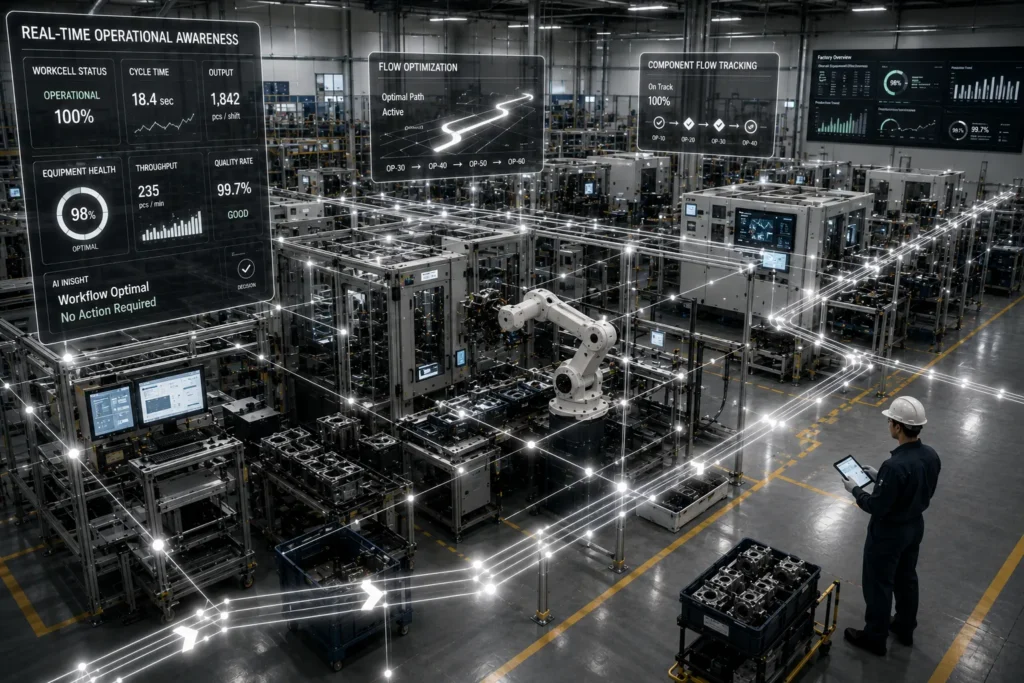
Real-Time Operational Awareness
Manufacturers gain continuous visibility into activities occurring across the facility.
Process Adherence Monitoring
AI systems can verify whether operational procedures are being followed consistently.
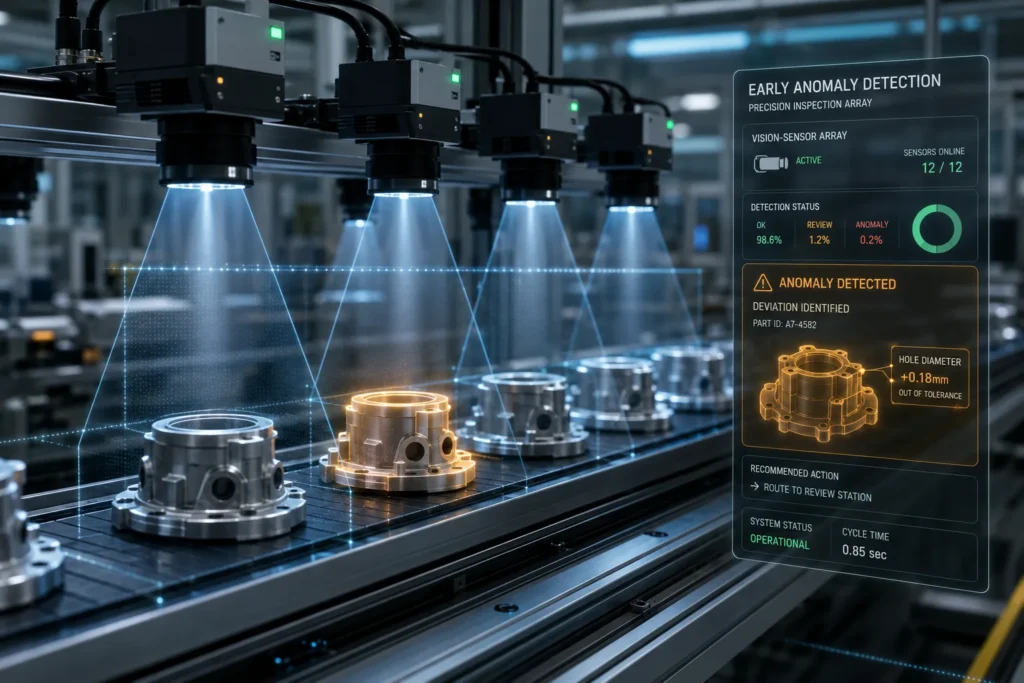
Early Anomaly Detection
Unusual activities and process deviations can be identified before they create larger operational problems.
Enhanced Quality Assurance
Visual intelligence helps organizations monitor production processes and identify quality risks earlier.
Improved Safety Oversight
Manufacturers can strengthen workplace safety through continuous observation and risk detection.
Compare Traditional Monitoring And Visual Intelligence
Traditional Monitoring | Visual Intelligence |
Manual observations | Continuous AI monitoring |
Periodic inspections | Real-time visibility |
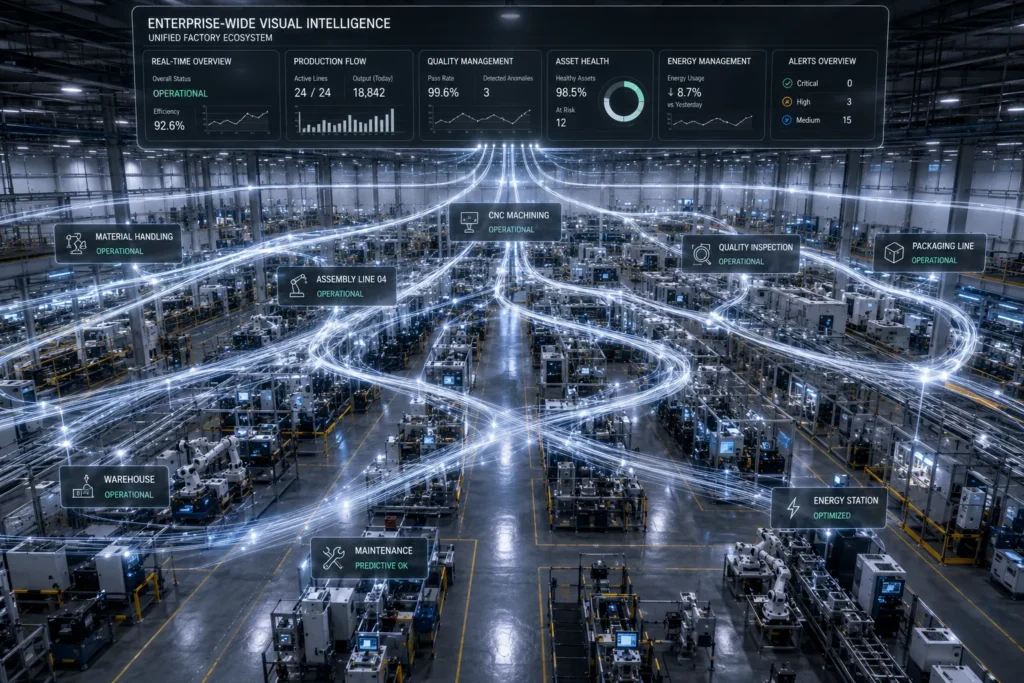
Limited operational awareness | Facility-wide intelligence |
Reactive issue detection | Early anomaly identification |
Historical reporting | Live operational insights |
Human-dependent oversight | Scalable enterprise monitoring |
This shift is helping manufacturers move toward more proactive and intelligent operations.
The Role Of Computer Vision In Smart Factories
Computer vision is the technology that enables visual intelligence.
By analyzing visual information from cameras, computer vision can help manufacturers:
- Monitor production activities
- Verify process compliance
- Detect operational deviations
- Identify bottlenecks
- Improve quality control
- Support safety initiatives
- Generate operational insights
This allows organizations to transform ordinary video feeds into valuable business intelligence.
Building The Next Generation Of Smart Factories
The future of manufacturing will depend on more than automation alone. Organizations must also be able to understand what is happening across their operations in real time.
Visual intelligence provides the missing layer of awareness that enables factories to become truly intelligent. By continuously observing activities, identifying opportunities for improvement, and supporting faster decision-making, visual intelligence helps manufacturers create more responsive, efficient, and resilient operations.
As smart manufacturing continues to evolve, factories that combine automation with visual intelligence will be better positioned to achieve operational excellence and long-term success.
Benefits Of Visual Intelligence In Manufacturing
Organizations adopting visual intelligence can achieve several important benefits.
These include:
- Increased operational visibility
- Improved production consistency
- Faster issue resolution
- Better quality outcomes
- Enhanced safety performance
- Reduced operational risk
- Stronger process discipline
These advantages contribute directly to improved productivity and competitiveness.
How CAPASai Delivers Visual Intelligence
CAPASai helps manufacturers transform existing camera infrastructure into powerful operational intelligence systems through AI-powered video analytics, real-time monitoring, intelligent alerts, and operational visibility. By converting visual activities into actionable insights, CAPASai enables organizations to improve process adherence, strengthen quality control, enhance safety monitoring, and gain deeper visibility