Organizations across manufacturing, retail, healthcare, logistics, banking, and other industries depend on standardized processes to maintain quality, efficiency, compliance, and operational performance. However, even well-designed workflows can experience process deviations that disrupt operations and create unnecessary costs.
Process Deviation Monitoring plays a critical role in identifying and managing these variations before they escalate into larger operational challenges. A process deviation occurs when activities differ from approved procedures, expected workflows, or operational standards. While some deviations may appear minor, they can gradually lead to quality issues, compliance failures, production delays, customer dissatisfaction, and financial losses if left unaddressed.
Effective process deviation monitoring enables organizations to detect anomalies in real time, understand root causes, and implement corrective actions quickly. By leveraging AI-powered analytics and continuous operational visibility, businesses can reduce risks, improve compliance, enhance quality control, and maintain consistent performance across critical processes.
As operations become more complex, businesses are increasingly turning to Artificial Intelligence (AI) to identify process deviations early and support proactive decision-making before problems escalate.
Why Traditional Detection Methods Often Fall Short
Many organizations rely on audits, inspections, supervisor observations, and incident reporting to identify process deviations.
While these methods remain valuable, they often face several limitations:
Limited Visibility
Managers cannot continuously observe every operational activity across multiple departments or locations.
Delayed Detection
Issues are frequently discovered only after they have already affected productivity, quality, or compliance.
Human Dependency
Manual monitoring relies heavily on individual observation, which can vary based on experience, workload, and operational complexity.
Reactive Investigations
Organizations often begin investigating only after a problem has occurred, making corrective actions more expensive and time-consuming.
What Are Process Deviations?
Process deviations are variations from established procedures or expected operational behavior.
Common examples include:
- Skipped workflow steps
- Delayed operational activities
- Process sequence violations
- Inconsistent task execution
- Quality control failures
- Safety procedure violations
- Unauthorized operational changes
These deviations can occur in manufacturing facilities, retail stores, healthcare environments, logistics operations, financial institutions, and many other industries.
How AI Detects Process Deviations
AI enhances Process Deviation Monitoring by continuously analyzing operational activities and identifying unusual patterns that may indicate emerging issues.
Instead of relying solely on periodic reviews, AI-powered Process Deviation Monitoring enables organizations to monitor operations in real time.
Continuous Monitoring
AI systems can observe operational activities around the clock, providing ongoing visibility into workflows and process execution.
This helps identify deviations as they occur rather than after problems have already developed.
Pattern Recognition
AI can analyze large volumes of operational data and identify patterns that may be difficult for human observers to detect.
Small inconsistencies that might otherwise go unnoticed can be recognized and flagged for review.
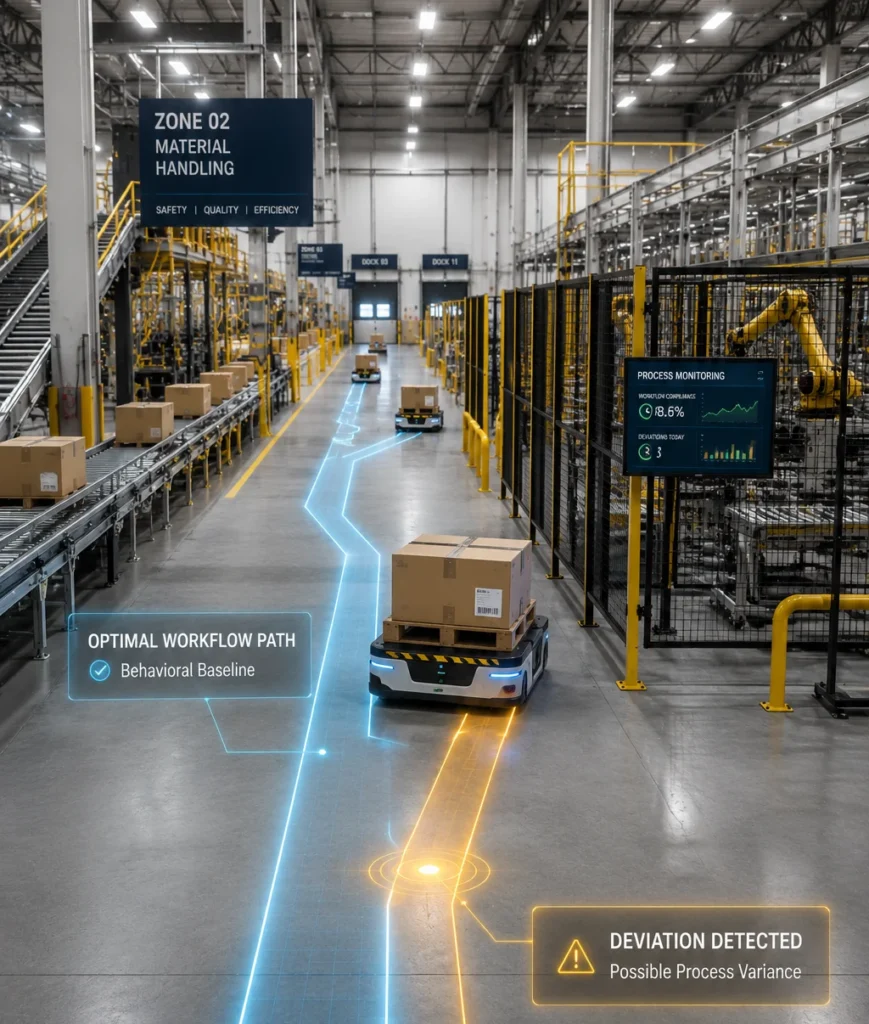
Behavioral Baselines
AI establishes a baseline of normal operational behavior.
When activities begin to differ from expected patterns, the system can automatically identify potential deviations and generate alerts.
Real-Time Alerts
Organizations can receive immediate notifications when process deviations occur, enabling faster intervention and corrective action.
This reduces the likelihood of small issues becoming major operational disruptions.
The Business Impact Of Undetected Deviations
When deviations go unnoticed, the consequences can extend throughout the organization.
Potential impacts include:
- Increased operational costs
- Product quality issues
- Compliance violations
- Production downtime
- Resource waste
- Customer complaints
- Safety incidents
- Reduced operational efficiency
Early detection plays a critical role in preventing these outcomes and maintaining operational stability.
Compare Traditional Monitoring And AI-Powered Monitoring
Traditional Monitoring | AI-Powered Monitoring |
Periodic inspections | Continuous monitoring |
Reactive issue detection | Proactive deviation detection |
Manual observations | Automated analysis |
Limited visibility | Real-time operational awareness |
Historical reporting | Immediate alerts and insights |
Delayed response | Faster corrective action |
This comparison highlights why many organizations are adopting AI-powered monitoring as part of their operational improvement strategies.
The Role Of Computer Vision In Process Monitoring
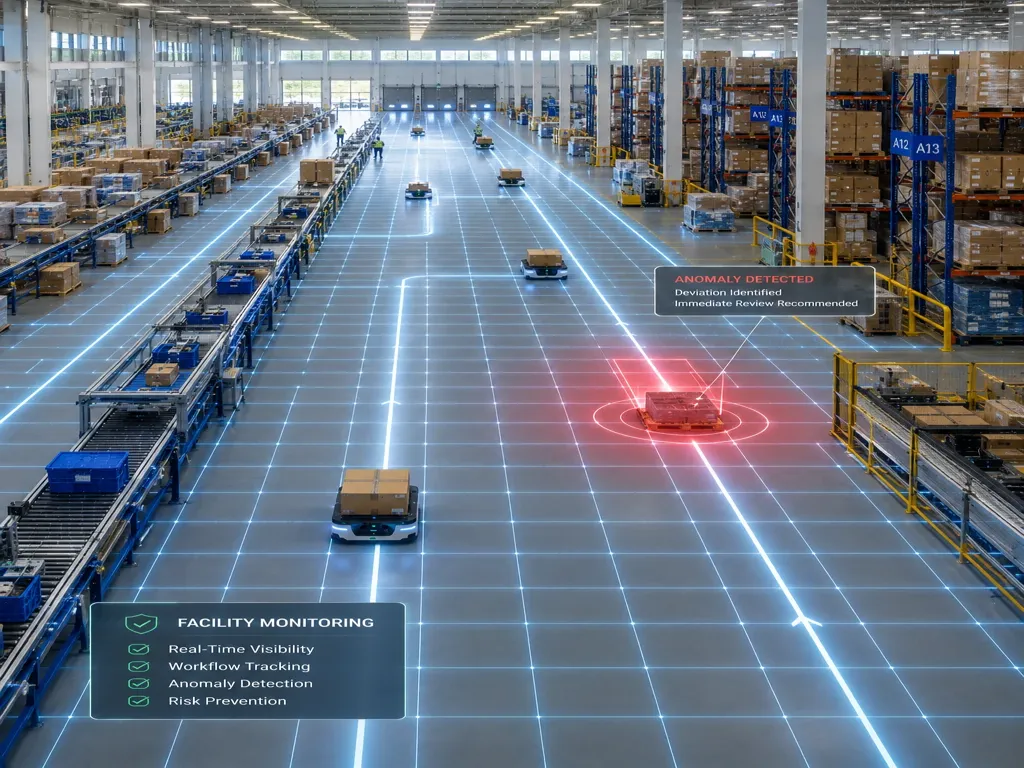
Many process deviations occur within physical environments where traditional software systems provide limited visibility.
Computer vision helps bridge this gap by analyzing visual activities in real time.
Organizations can use computer vision to:
- Verify process adherence
- Monitor workflow execution
- Detect procedural violations
- Identify operational bottlenecks
- Support compliance initiatives
- Improve operational consistency
By transforming visual information into actionable intelligence, organizations gain deeper insight into day-to-day operations.
Supporting Proactive Operational Management
AI not only helps identify deviations but also supports more proactive operational management.
Organizations can:
- Detect risks earlier
- Investigate issues faster
- Improve process discipline
- Strengthen compliance efforts
- Reduce operational losses
- Enhance accountability
This proactive approach helps create more resilient and efficient operations.
Turning Early Detection Into Operational Advantage
The ability to detect process deviations before they become costly is becoming an important competitive advantage. Organizations that can identify issues early are better positioned to protect quality, maintain compliance, improve efficiency, and reduce operational risk.
By combining continuous monitoring, intelligent analytics, and computer vision capabilities, AI provides the visibility needed to detect deviations quickly and support timely corrective actions. As businesses continue to pursue operational excellence, early deviation detection will play an increasingly important role in maintaining consistent and reliable performance.
How CAPASai Helps Detect Process Deviations
CAPASai helps organizations identify process deviations through AI-powered video analytics, remote monitoring, intelligent alerts, and real-time operational visibility. By continuously monitoring workflows and operational activities, CAPASai enables businesses to detect anomalies early, improve process adherence, strengthen compliance, and reduce the operational impact of deviations across multiple locations.