Manganese Ore India Limited (MOIL) operates underground and opencast mines across Maharashtra and Madhya Pradesh, producing different grades of manganese ore for applications including ferro-manganese, silico-manganese, hot metal, and chemical industries. Heavy machinery, subterranean operations, material transportation, ventilation systems, and numerous safety-critical tasks are all part of the mining environment.
For MOIL, AI-based SOP analytics and video analytics can provide a practical way to strengthen safety monitoring without depending entirely on manual observation. Because MOIL is currently making investments in digital technologies, equipment safety systems, and CCTV infrastructure throughout its mines, the opportunity is especially pertinent. Recent procurement records include CCTV systems for Ukwa and Munsar mines, as well as equipment-related safety devices such as seat-belt reminders and dump-body lifting warning systems.
Making Mining Operations More Observable
Mining activities generate a continuous stream of visual information. Workers move through designated areas, heavy earth-moving machinery operates around personnel, vehicles follow defined routes, and access to certain zones must be controlled.
Conventional CCTV can record these activities, but reviewing every feed manually is difficult. Video analytics can add an automated interpretation layer by identifying predefined events and notifying the appropriate personnel.
For MOIL, potential applications include:
- PPE detection in designated work areas
- Restricted-area entry detection
- Worker and vehicle proximity monitoring
- Unsafe movement around heavy equipment
- Vehicle access and route monitoring
- Obstruction detection in selected areas
- Monitoring of critical mine infrastructure
- Event-based searching of recorded footage
Linking SOPs With What Happens At The Mine
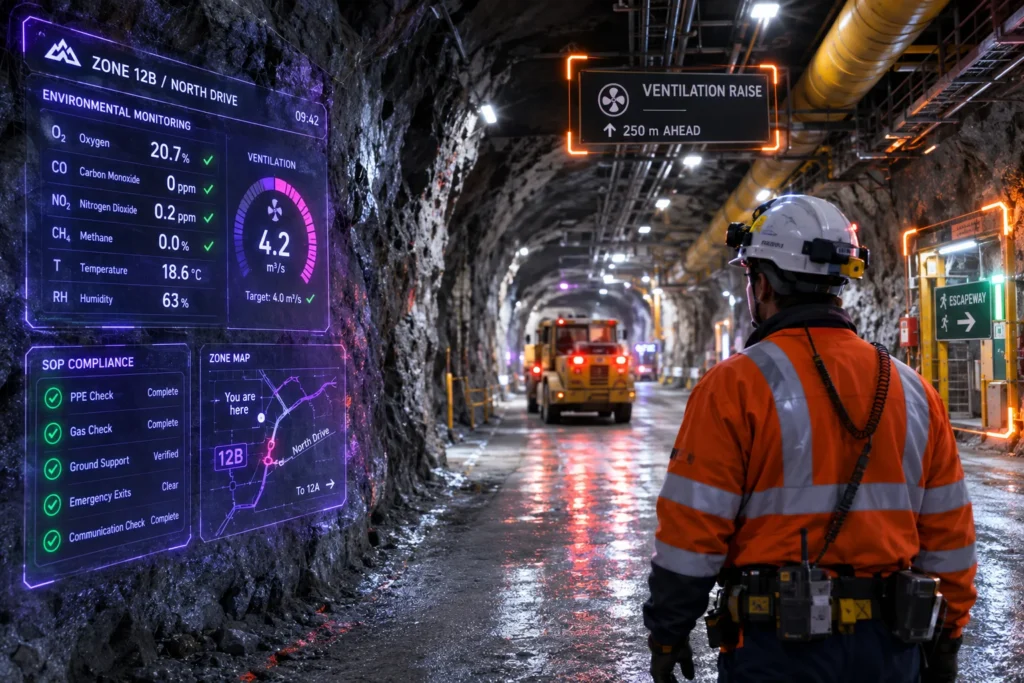
An SOP describes how an activity should be performed. AI-based SOP analytics can help determine whether selected, visually observable requirements are being followed.
For example, if a particular mining activity requires workers to remain outside a defined equipment operating zone, a computer-vision system can monitor that area and generate an alert when a person enters it.
Potential SOP Analytics Applications
Safety Requirement | AI-Based Observation | Potential Benefit |
PPE compliance | Detect required protective equipment | Faster corrective action |
Equipment exclusion zones | Identify personnel inside protected areas | Reduce exposure to moving machinery |
Vehicle movement | Monitor defined routes and zones | Support traffic safety |
Restricted access | Detect people entering controlled areas | Improve access discipline |
Maintenance safety | Monitor selected work zones | Support procedural compliance |
Housekeeping | Detect defined obstructions | Improve workplace conditions |
A Different Role For Video Analytics At MOIL
MOIL’s mining portfolio includes both underground and opencast operations, meaning video analytics can be adapted to different operating conditions.
Underground Operations
In underground mines, AI can potentially monitor selected access points, equipment areas, loading locations, shaft-related zones, and other locations where camera coverage is technically feasible.
The focus can be on worker presence, restricted access, PPE, equipment interaction, and other clearly observable conditions.
Opencast Mining
Opencast areas provide opportunities for monitoring haul roads, loading points, excavation zones, dump areas, workshops, and vehicle movement.
AI can identify predefined interactions between people and heavy machinery, helping supervisors focus on locations where a potential safety condition has emerged.
Surface Infrastructure
CCTV analytics can also support monitoring around workshops, substations, stores, access gates, conveyor or material-handling areas, and other critical infrastructure.
Building On MOIL’s Existing Safety Investments
MOIL’s recent procurement activity shows continued attention to surveillance and equipment safety. The company has initiated CCTV-related work at Ukwa and Munsar mines and has procured or proposed safety-related systems for mining equipment, including seat-belt reminders and dump-body lifting warning devices.
Connecting Video With Other Mine Data
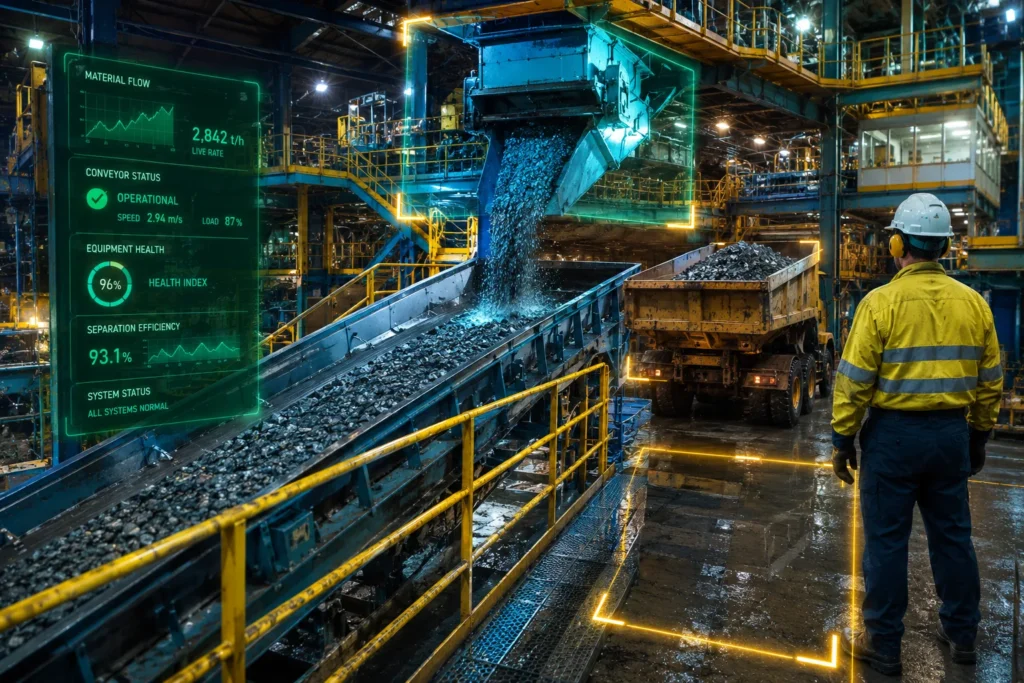
Video analytics becomes more useful when visual information is combined with other operational data.
A future architecture could connect:
- CCTV and IP cameras
- Equipment telemetry
- Access-control systems
- Mine monitoring systems
- Maintenance records
- Safety reporting platforms
- Sensor data
- Central dashboards
For example, if a camera detects a person approaching operating equipment, equipment-status data could help determine whether the machinery is active. This additional context can help prioritise alerts and reduce unnecessary notifications.
A Focused Implementation Model
MOIL can begin with a small number of high-risk scenarios instead of attempting to analyse every camera feed.
Identify Critical Activities
Select SOPs where deviations are both important and visually detectable.
Evaluate Camera Readiness
Review camera positioning, resolution, network connectivity, lighting, storage, and environmental conditions.
Pilot At Selected Mines
Test the analytics under actual underground and opencast conditions. Dust, low light, glare, vibration, equipment obstruction, and changing weather can affect computer-vision performance.
Connect Alerts To People
Every important alert should have a defined response owner, escalation process, and corrective-action workflow.
Scale Proven Applications
Once accuracy, false-alert rates, and operational value are established, successful applications can be extended to comparable mines.
Measuring The Value Of AI Analytics
The effectiveness of the programme should be measured through safety and operational outcomes rather than technology deployment numbers.
MOIL could track:
- Reduction in repeated SOP deviations
- Safety-alert response time
- PPE compliance
- Restricted-zone violations
- Worker-equipment proximity events
- False-positive rates
- Incident investigation time
- Corrective-action closure time
- Manual surveillance workload
Frequently Asked Questions
It is an AI-enabled system that compares selected observable workplace activities with predefined safety or operating procedures and identifies potential deviations.
It can continuously monitor selected areas for PPE issues, restricted access, unsafe worker-equipment interactions, vehicle movement, and other predefined conditions.
Potentially. Existing cameras may be suitable if their resolution, positioning, connectivity, lighting, and field of view support the selected analytics applications. MOIL's recent CCTV procurements provide an opportunity to consider analytics capabilities during system upgrades.
Yes, where suitable camera coverage and environmental conditions are available. Underground applications should be selected according to visibility, connectivity, lighting, equipment movement, and the specific safety requirement.