Operational excellence has traditionally been associated with efficiency, standardization, and process control. Organizations invested in technologies, management systems, and performance frameworks to improve productivity while maintaining consistency across facilities. While these objectives remain important, the operational landscape is becoming increasingly complex.
Enterprises today manage distributed workforces, multi-site operations, evolving compliance requirements, supply chain uncertainty, and growing customer expectations. In this environment, efficiency alone is no longer enough. Organizations must also be capable of adapting quickly, responding intelligently, and maintaining visibility across dynamic operational environments.
This shift is giving rise to a new operating model: intelligent operations.
As Industry 5.0 gains momentum, intelligent operations are emerging as a critical capability that combines human expertise, operational data, and advanced technologies to support smarter decision-making and greater organizational resilience.
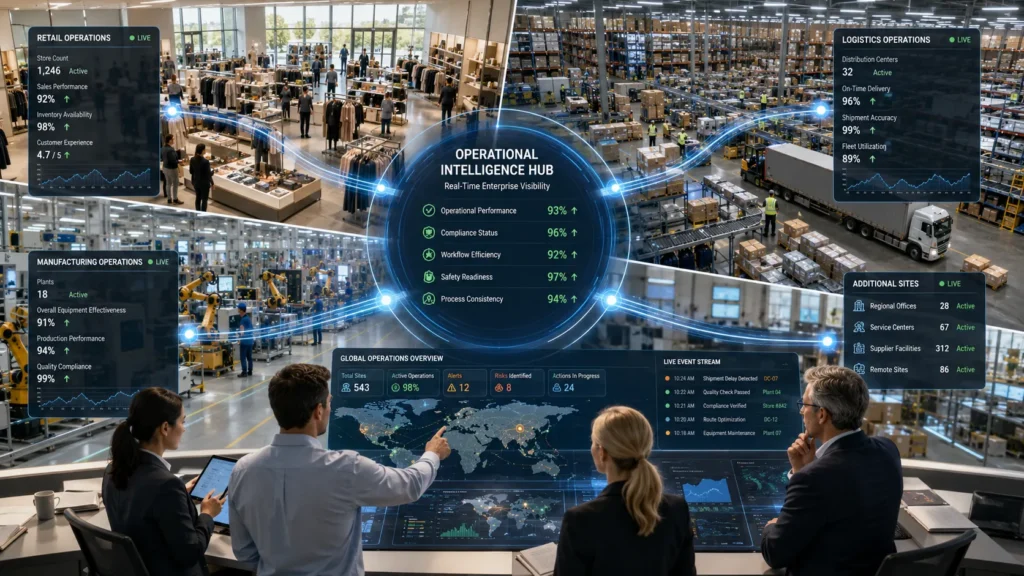
Why Traditional Operating Models Are Reaching Their Limits
Most organizations have spent years optimizing workflows, reducing costs, and improving operational efficiency. However, many operational challenges remain difficult to address using traditional management approaches alone.
Common challenges include:
- Limited visibility across multiple locations
- Delayed identification of operational issues
- Inconsistent process execution
- Workforce coordination challenges
- Compliance monitoring complexity
- Reactive decision-making
These issues often arise because operational leaders are forced to make decisions based on historical reports rather than real-time operational conditions.
The need for greater agility is driving enterprises toward more intelligent operating models.
Defining Intelligent Operations In The Industry 5.0 Era
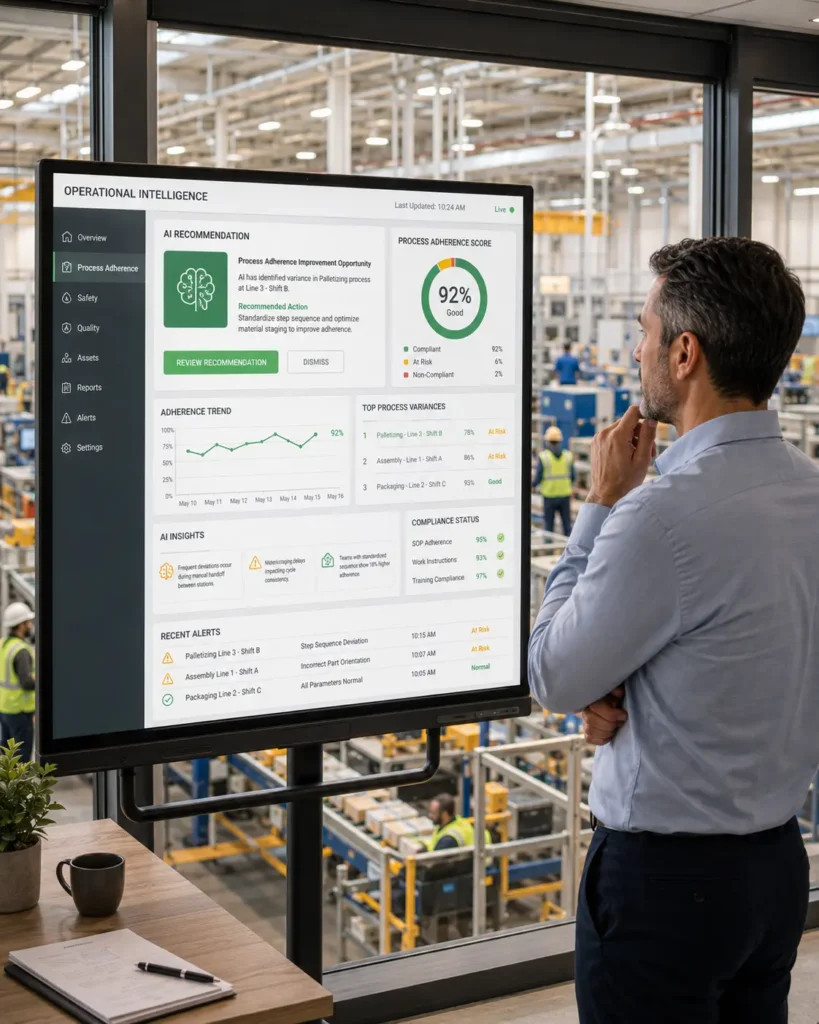
Intelligent operations refer to the ability of an organization to continuously observe, analyze, and respond to operational conditions using a combination of human expertise and intelligent technologies.
Unlike traditional automation initiatives that focus primarily on task execution, intelligent operations focus on operational awareness and decision support.
Key characteristics include:
Continuous Visibility
Organizations gain real-time insight into activities occurring across facilities, processes, and operational environments.
Data-Driven Decision Support
Leaders have access to timely intelligence that supports faster and more informed decisions.
Human-AI Collaboration
Technology assists employees and managers while preserving human judgment and accountability.
Adaptive Operations
Processes can respond more effectively to changing operational conditions.
These capabilities align closely with the human-centric principles of Industry 5.0.
Compare Traditional Operations And Intelligent Operations
Operational Area | Traditional Operations | Intelligent Operations |
Visibility | Periodic Reporting | Continuous Awareness |
Decision-Making | Historical Analysis | Real-Time Intelligence |
Issue Detection | Reactive | Proactive |
Compliance Oversight | Manual Verification | Continuous Monitoring |
Operational Response | Fixed Processes | Adaptive Actions |
Organizations increasingly compare these approaches as complementary stages in operational maturity rather than competing strategies.
The Technologies Enabling Intelligent Operations
The emergence of intelligent operations is supported by several technological advancements.
Artificial Intelligence
AI helps analyze large volumes of operational data, identify patterns, and generate actionable insights.
Computer Vision
Visual intelligence enables organizations to monitor operational activities, process adherence, safety conditions, and workflow performance.
Advanced Analytics
Organizations gain deeper understanding of operational trends, risks, and improvement opportunities.
Real-Time Monitoring
Continuous visibility allows leaders to respond more quickly to emerging situations.
Together, these technologies transform operational data into meaningful intelligence
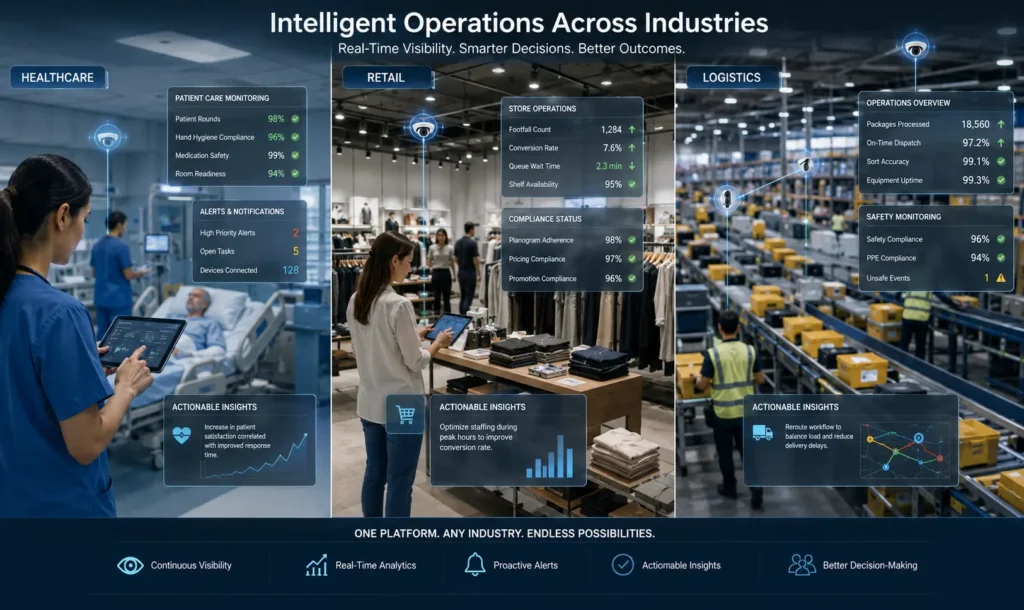
Intelligent Operations Across Industries
The concept of intelligent operations extends beyond manufacturing and industrial environments.
Retail
Organizations improve store execution, compliance, and customer experience visibility.
Logistics And Supply Chain
Companies gain greater awareness of workflow efficiency, asset movement, and operational bottlenecks.
Healthcare
Healthcare providers improve operational coordination and process consistency.
Banking And Financial Services
Institutions strengthen compliance oversight and operational governance.
Smart Infrastructure
Public and private organizations enhance visibility into complex operational environments.
Regardless of industry, the objective remains the same: improve decision-making through greater operational intelligence.
Why Human Expertise Remains Essential
A common misconception is that intelligent operations are primarily about automation. Industry 5.0 promotes a different perspective.
Technology can identify patterns, monitor activities, and provide recommendations. However, interpreting context, balancing priorities, and making strategic decisions remain human responsibilities.
The most effective intelligent operations combine:
- Human judgment
- Operational experience
- Real-time intelligence
- Automated insights
- Collaborative decision-making
This balance allows organizations to benefit from technology without losing the value of human expertise.
From Operational Efficiency To Operational Intelligence
The emergence of intelligent operations represents a significant evolution in enterprise management. Rather than focusing solely on efficiency improvements, organizations are increasingly prioritizing visibility, adaptability, resilience, and informed decision-making.
Industry 5.0 accelerates this shift by encouraging enterprises to build environments where people and intelligent technologies work together to achieve better outcomes. As operational complexity continues to increase, organizations that develop stronger operational intelligence capabilities will be better positioned to navigate change, improve governance, and maintain long-term competitiveness.
How CAPASai Supports Intelligent Operations
CAPASai supports intelligent operations through AI-powered video analytics, remote monitoring, real-time alerts, and operational intelligence capabilities. By transforming visual information into actionable insights, CAPASai helps organizations improve visibility, strengthen compliance oversight, identify operational risks, and support faster decision-making across distributed environments.