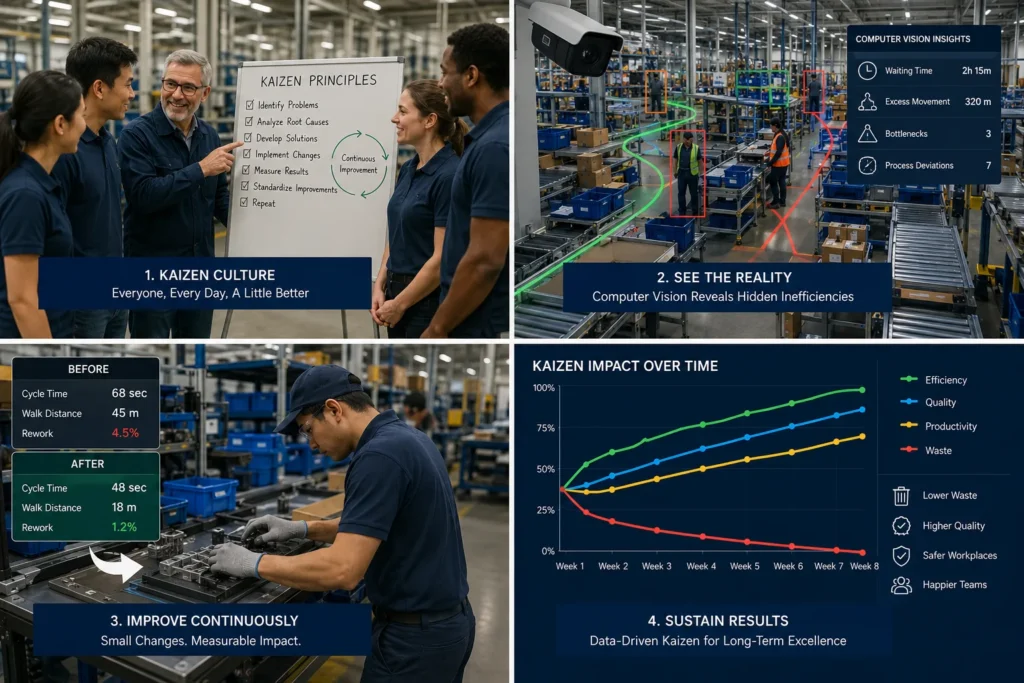
Continuous improvement rarely succeeds because of a single breakthrough. More often, lasting operational gains come from hundreds of small improvements implemented consistently over time. This philosophy has shaped operational excellence programs across manufacturing, logistics, retail, healthcare, and numerous other industries for decades.
Yet many organizations pursuing Kaizen initiatives encounter a common challenge. Teams are encouraged to identify inefficiencies, eliminate waste, improve consistency, and optimize workflows, but obtaining objective visibility into day-to-day operations remains difficult. Improvement opportunities often depend on observations, audits, employee feedback, and periodic reviews, creating gaps between what leaders believe is happening and what actually occurs on the operational floor.As enterprises seek more data-driven approaches to continuous improvement, computer vision is emerging as a valuable tool for strengthening Kaizen programs.
The Search For Hidden Operational Waste
A core objective of Kaizen is identifying and eliminating activities that do not contribute value.
Many forms of operational waste remain difficult to detect through traditional reporting systems alone.
Waiting Time
Employees, equipment, or materials may spend unnecessary time idle between process steps.
Excess Movement
Workers may travel longer distances than necessary to complete routine tasks.
Process Variability
Teams may perform the same task differently, creating inconsistencies in quality and productivity.
Rework Activities
Errors and deviations can generate additional work that affects efficiency and costs.
Workflow Congestion
Bottlenecks may develop at specific stations, slowing overall operational performance.
Computer vision provides a new way to observe these operational realities continuously rather than periodically.
Why Continuous Improvement Efforts Often Lose Momentum
Most Kaizen initiatives begin with enthusiasm. Teams identify process improvements, implement corrective actions, and establish performance goals. However, sustaining improvement over time can become challenging when visibility into operational execution is limited.
Common obstacles include:
- Difficulty identifying recurring inefficiencies
- Limited visibility into workflow variations
- Inconsistent process execution across shifts
- Delayed detection of operational bottlenecks
- Dependence on manual observations
- Challenges measuring improvement impact
Without reliable operational evidence, organizations may struggle to determine whether improvements are delivering meaningful results.
Seeing Improvement Opportunities As They Happen
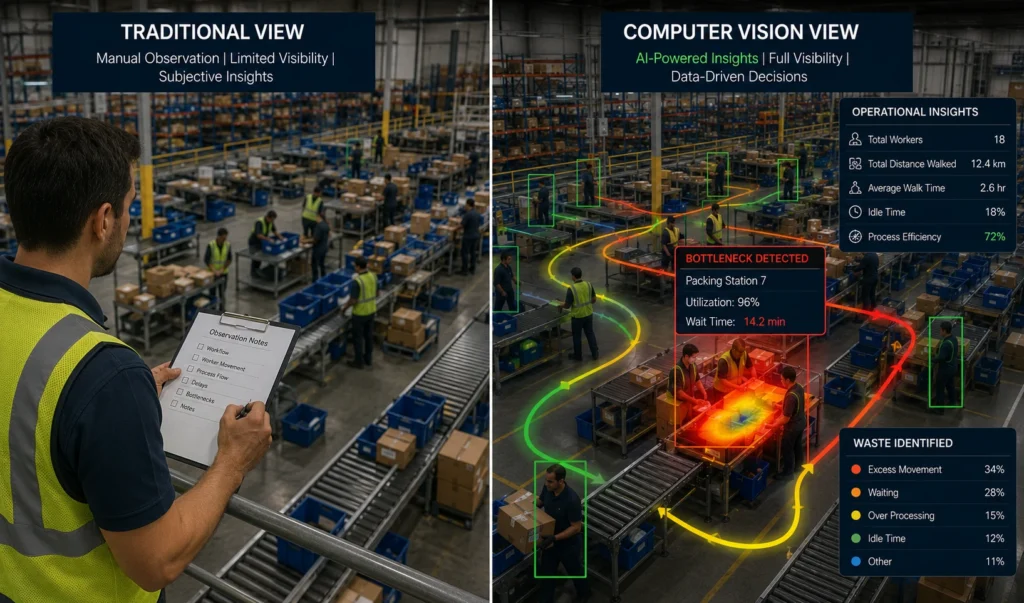
Traditional analytics often measures outcomes after events occur. Computer vision adds another layer by helping organizations understand the activities that influence those outcomes.
Using visual analysis, organizations can gain insight into:
- Workflow patterns
- Process adherence
- Material movement
- Station utilization
- Safety compliance
- Operational interruptions
These observations help teams identify opportunities for improvement that might otherwise remain unnoticed.
Instead of relying solely on assumptions, improvement efforts can be supported by objective operational evidence.
Compare Traditional Kaizen Assessments And Computer Vision Insights
Improvement Activity | Traditional Approach | Computer Vision Support |
Process Observation | Manual Walkthroughs | Continuous Visibility |
Bottleneck Detection | Periodic Reviews | Real-Time Identification |
Workflow Analysis | Sample Observations | Ongoing Monitoring |
Improvement Verification | Historical Reports | Continuous Measurement |
Multi-Site Benchmarking | Difficult To Scale | Centralized Insights |
Organizations increasingly compare these approaches as complementary methods. Human expertise remains essential, while computer vision expands the amount of operational information available for decision-making.
.
Creating More Effective Kaizen Events
Kaizen workshops often focus on identifying process inefficiencies and developing corrective actions. The quality of these discussions depends heavily on the accuracy of available information.
Computer vision can strengthen improvement events by providing evidence-based insights into operational performance.
Understanding Current-State Conditions
Teams can evaluate how processes actually operate rather than relying solely on assumptions or recollections.
Identifying Root Causes Faster
Visual data can help reveal workflow disruptions, process deviations, and recurring operational challenges.
Measuring Improvement Outcomes
Organizations can track whether implemented changes reduce delays, improve consistency, or enhance productivity.
Supporting Cross-Functional Collaboration
Operations, quality, safety, and compliance teams can review a shared source of operational evidence.
Beyond Manufacturing: Kaizen Across Industries
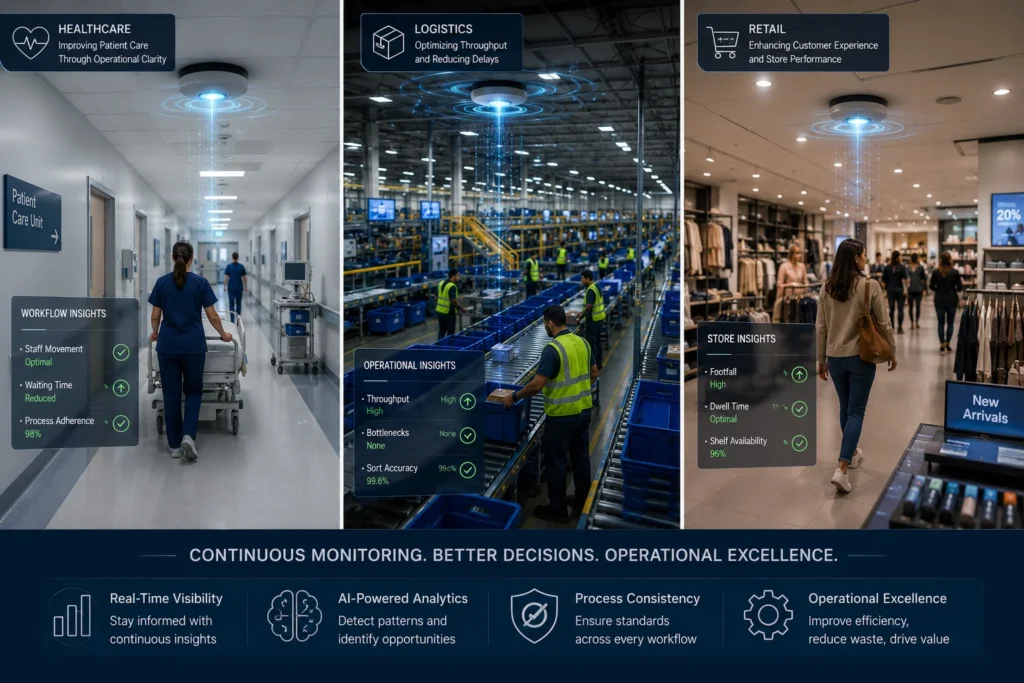
While Kaizen is often associated with manufacturing, continuous improvement principles apply across many sectors.
Logistics And Warehousing
Organizations use operational visibility to reduce congestion, improve throughput, and optimize material flow.
Retail Operations
Businesses seek greater consistency in store execution, inventory management, and customer service processes.
Healthcare Facilities
Healthcare providers focus on improving workflows, reducing delays, and supporting patient care efficiency.
Hospitality And Service Organizations
Teams work to improve service quality, operational consistency, and resource utilization.
Education And Public Infrastructure
Institutions use continuous improvement principles to enhance service delivery and operational effectiveness.
Building A Culture Of Evidence-Based Improvement
Successful Kaizen programs depend on more than tools and technology. They require a culture that values learning, observation, accountability, and continuous refinement.
Computer vision supports this culture by helping organizations move beyond subjective assessments toward measurable operational insights. Teams gain a clearer understanding of how work is performed, where inefficiencies occur, and which improvements generate meaningful outcomes.
Rather than waiting for problems to become visible through performance reports, organizations can identify opportunities earlier and act with greater confidence.
How CAPASai Supports Continuous Improvement Programs
Organizations pursuing Kaizen initiatives increasingly require technologies that provide deeper operational visibility. CAPASai supports continuous improvement efforts through AI-powered video analytics, remote monitoring, and real-time alerting capabilities that help enterprises identify workflow inefficiencies, monitor process adherence, and strengthen operational consistency. By converting everyday activities into actionable insights, organizations can support more effective improvement programs while maintaining focus on operational excellence.