The Growing Need for Smarter Video Monitoring
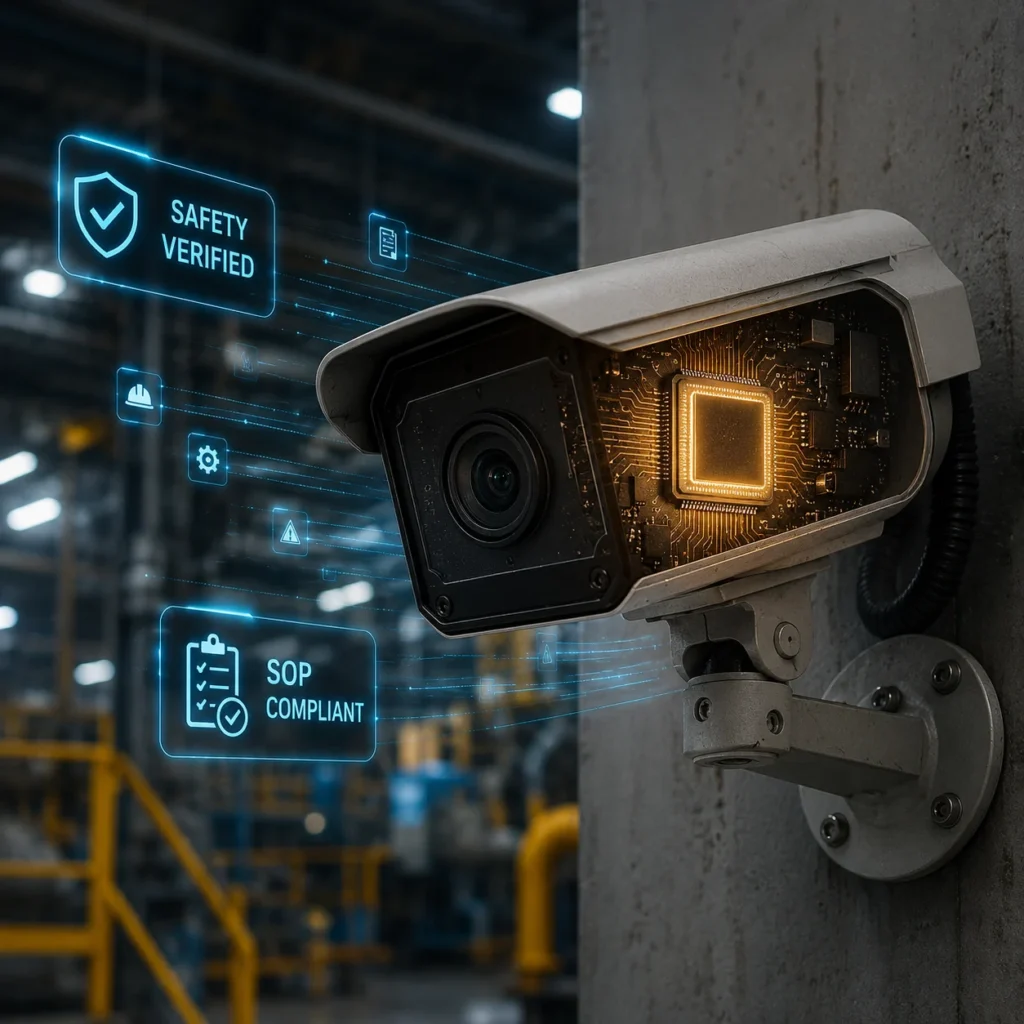
Organizations today generate enormous volumes of video data through CCTV systems installed across offices, manufacturing facilities, retail stores, warehouses, hospitals, banks, educational campuses, and public infrastructure. While surveillance cameras capture valuable information, extracting actionable insights from continuous video streams remains a significant challenge.
As enterprises expand across multiple locations, they need faster incident detection, better operational visibility, improved compliance monitoring, and more efficient security management. This has led many organizations to adopt AI-powered video analytics to transform CCTV footage into meaningful intelligence rather than simply storing recordings for future review.
Challenges Enterprises Face When Managing Video Data
Traditional monitoring approaches often struggle to keep pace with modern operational requirements. Security teams may be responsible for monitoring hundreds of cameras simultaneously, making it difficult to identify critical events in real time.
Common challenges include:
- Delayed incident detection
- High volumes of video footage
- Limited monitoring resources
- Multi-site visibility issues
- Slow investigation processes
- Network and storage constraints
- Increasing compliance requirements
As a result, enterprises are evaluating different AI deployment models to determine which approach best supports their business objectives
Comprehending Cloud and Edge AI in Video Analytics
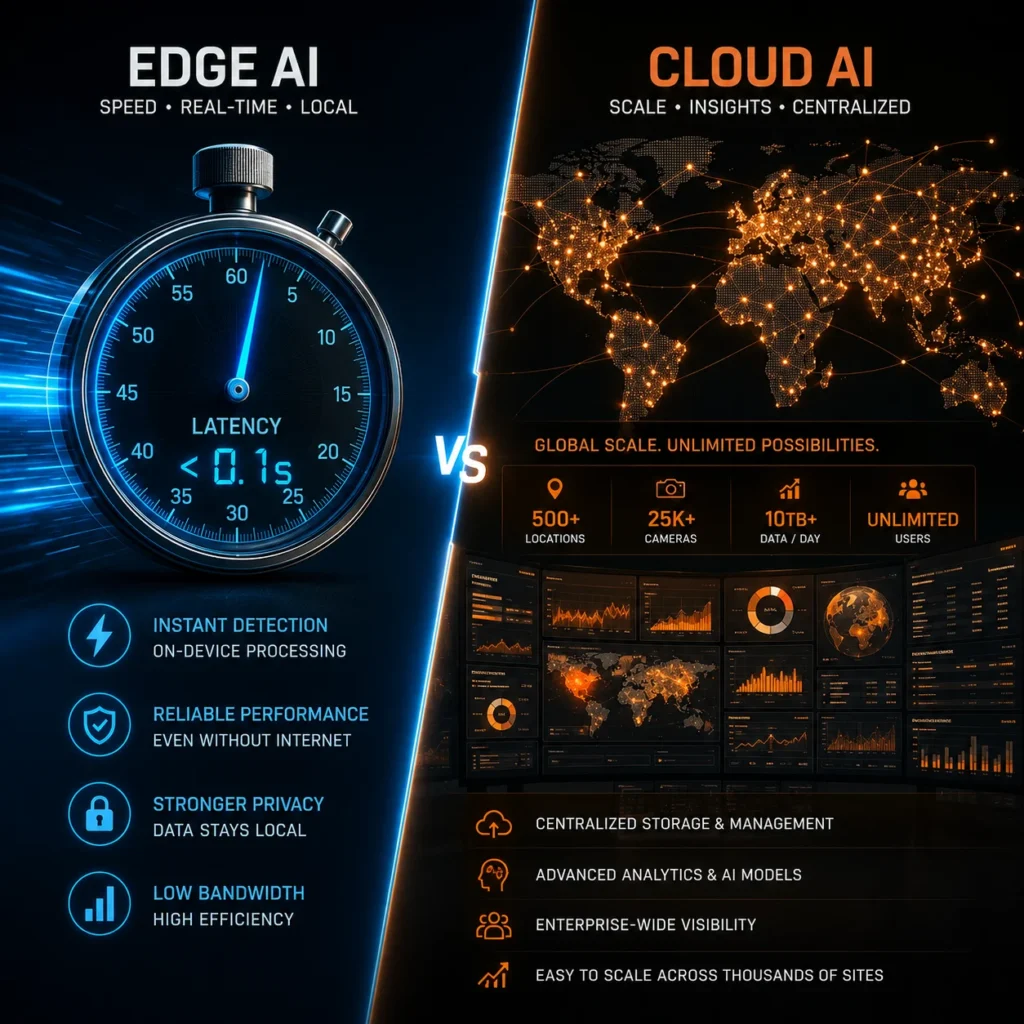
Both Edge AI and Cloud AI use artificial intelligence to analyze CCTV footage, detect events, and generate alerts. The primary difference lies in where the video processing takes place.
Edge AI processes video data directly at or near the camera using local computing devices. Analysis occurs on-site before data is transmitted elsewhere.
Cloud AI sends video streams to centralized cloud infrastructure where AI models process the data and generate insights.
Both approaches can improve security and operational monitoring, but their strengths differ depending on enterprise requirements.
Compare Edge AI vs Cloud AI for Enterprise Video Analytics
Feature | Edge AI | Cloud AI |
Processing Location | Near the camera | Centralized cloud platform |
Alert Speed | Very fast | Dependent on network connectivity |
Bandwidth Usage | Lower | Higher |
Internet Dependency | Minimal | Significant |
Scalability | Site-based expansion | Highly scalable |
Centralized Management | Moderate | Strong |
Data Storage | Local or hybrid | Cloud-based |
Remote Accessibility | Limited without integration | Easily accessible |
The choice often depends on factors such as infrastructure, connectivity, compliance requirements, scalability goals, and operational priorities.
Compare Key Benefits of Edge AI and Cloud AI
Advantages of Edge AI
Edge AI is often preferred when immediate response and low latency are critical.
Benefits include:
- Faster event detection
- Reduced bandwidth consumption
- Lower dependence on internet connectivity
- Improved resilience during network disruptions
- Enhanced privacy for sensitive environments
Advantages of Cloud AI
Cloud-based analytics can provide broader visibility and easier management across large enterprise networks.
Benefits include:
- Centralized monitoring
- Simplified software updates
- Greater scalability
- Enterprise-wide reporting
- Easier integration across multiple locations
- Flexible storage capabilities
Many organizations are increasingly adopting hybrid approaches that combine the strengths of both deployment models.
How CAPASai Supports Intelligent Video Analytics
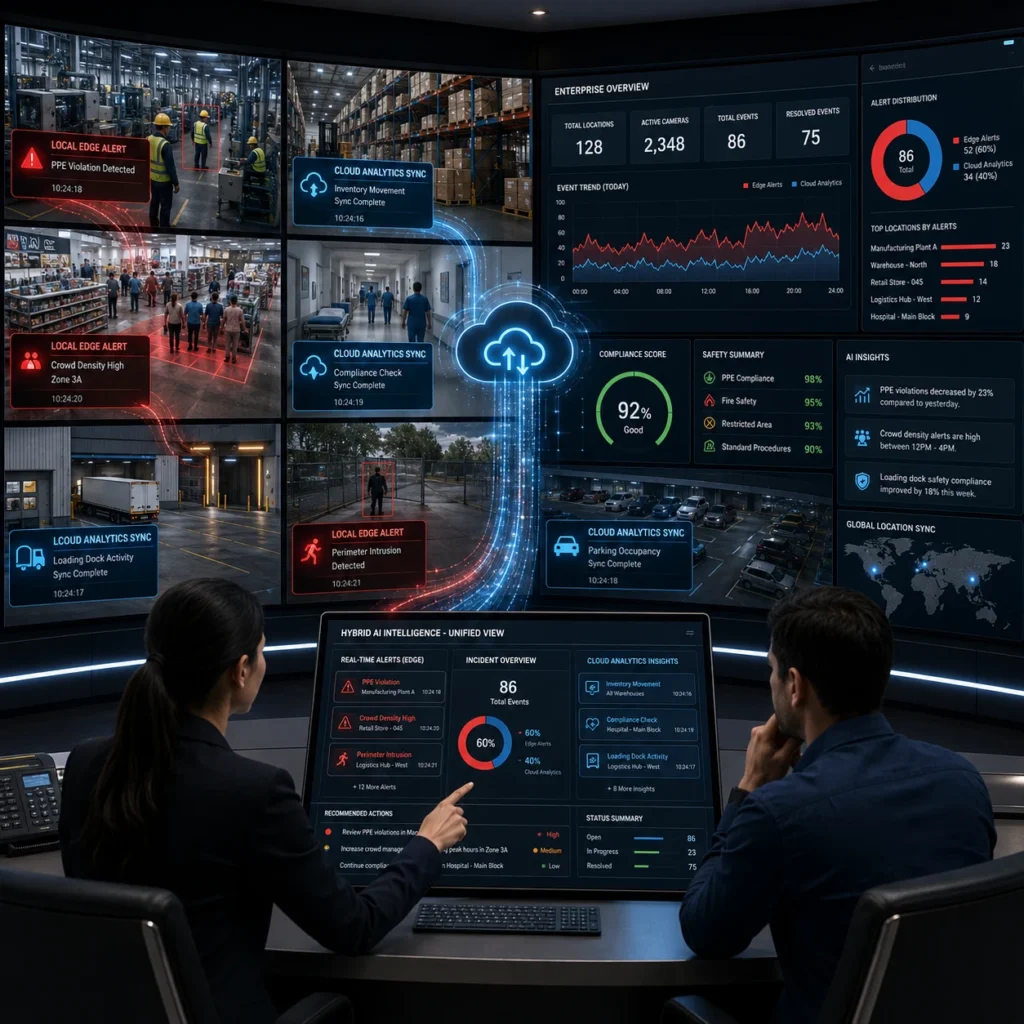
Choosing between Edge AI and Cloud AI is only one part of a successful video analytics strategy. Organizations also require accurate detection capabilities, centralized visibility, automated workflows, and real-time notifications.
CAPASai enhances CCTV monitoring through AI-powered video analytics, remote monitoring capabilities, and instant alerts that help organizations respond quickly to operational, safety, and security events.
By transforming video streams into actionable insights, CAPASai helps enterprises improve visibility across distributed operations while supporting proactive decision-making.
Enterprise Use Cases for AI-Powered Video Analytics
Manufacturing Facilities
Monitor safety compliance, restricted areas, equipment movement, and operational activities.
Retail Chains
Boost consumer flow analysis, queue monitoring, loss prevention, and store compliance.
Banking and Financial Services
Enhance branch security, ATM monitoring, and risk management operations.
Healthcare Facilities
Support patient safety, visitor monitoring, and access control management.
Logistics and Fulfillment Centers
Improve warehouse visibility, loading dock monitoring, and asset protection.
Smart Cities and Public Infrastructure
Enable large-scale monitoring of public spaces and critical infrastructure assets.
Choosing the Right AI Architecture for Enterprise Surveillance
There is no single deployment model that fits every organization. Enterprises with strict latency requirements, limited connectivity, or privacy concerns may benefit from Edge AI, while organizations seeking centralized visibility and large-scale management may prefer Cloud AI. In many cases, a hybrid strategy delivers the best balance between performance, scalability, and operational control. Evaluating business objectives, infrastructure capabilities, and monitoring requirements is the most effective way to determine which approach will deliver the greatest long-term value