Why Connectivity Challenges Are Limiting Industrial Video Monitoring
Industrial operations increasingly rely on CCTV systems to improve safety, security, compliance, and operational visibility. However, many facilities operate in environments where network infrastructure is limited or inconsistent. Manufacturing plants, mining sites, utility facilities, warehouses, construction projects, transportation hubs, agricultural operations, and remote processing facilities often face bandwidth constraints that make traditional cloud-dependent video monitoring difficult.
As organizations expand monitoring coverage, transmitting large volumes of video data across limited networks can create delays, increase costs, and reduce the effectiveness of real-time surveillance. Businesses need a way to gain intelligent insights from CCTV systems without overwhelming their network infrastructure.
Growing interest in Edge AI video analytics is being driven by this difficulty.
The Problems with Sending Every Video Stream to the Cloud
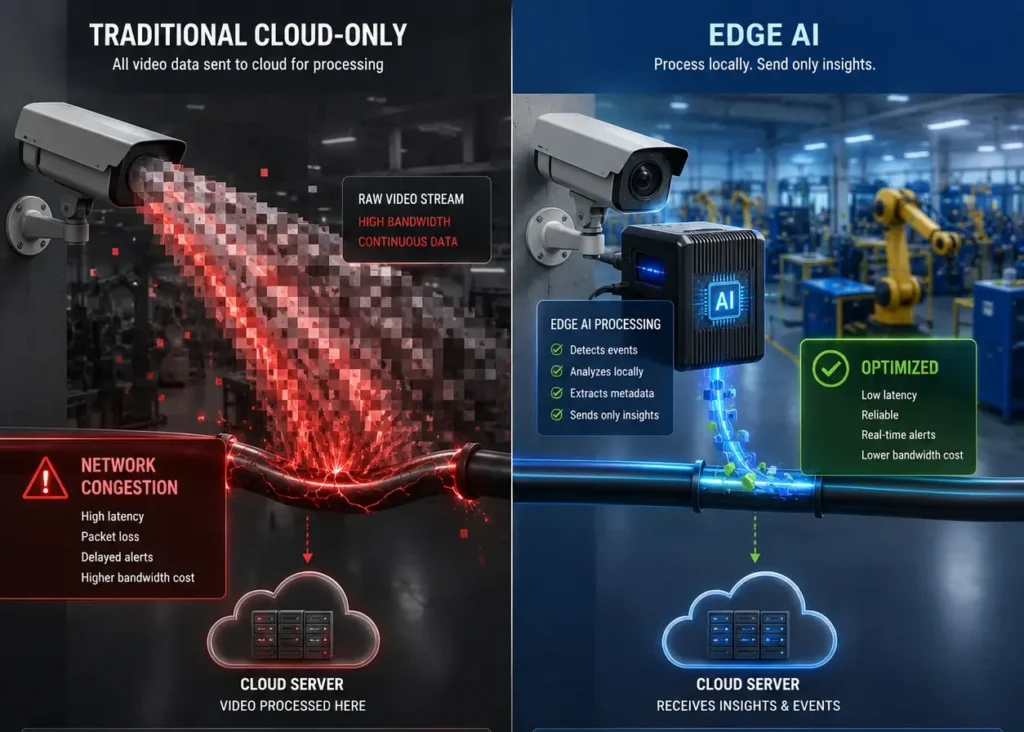
Many conventional video analytics systems depend on continuously transferring footage to centralized servers for processing. In low-bandwidth environments, this approach can create several operational issues.
Common challenges include:
- Network congestion
- Delayed incident alerts
- Higher bandwidth costs
- Increased latency
- Limited visibility during connectivity disruptions
- Reduced scalability across remote sites
- Slower compliance monitoring
- Delayed operational decision-making
For industrial facilities where safety and operational continuity are critical, waiting for video to travel across networks before analysis can create unnecessary risks.
How CAPASai Uses Edge AI for Industrial Monitoring
CAPASai combines AI-powered video analytics, remote monitoring, and real-time alerting to help organizations monitor operations even in bandwidth-constrained environments.
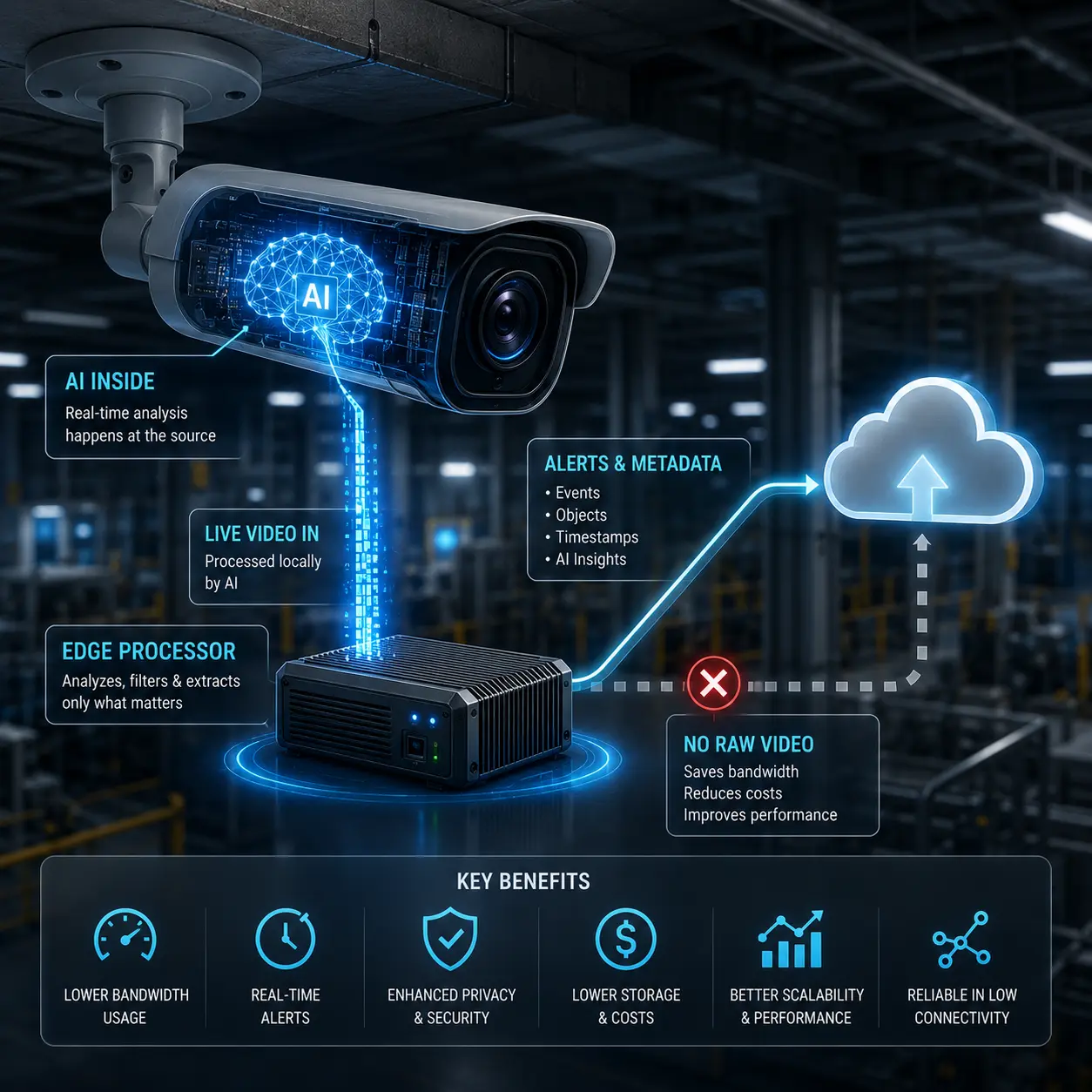
Using Edge AI technology, CAPASai processes video closer to the camera source, allowing events to be analyzed locally before only relevant alerts, metadata, or critical footage are transmitted.
This approach helps organizations:
- Reduce bandwidth consumption
- Improve real-time incident detection
- Monitor remote facilities efficiently
- Strengthen compliance oversight
- Support CAPA investigations
- Improve operational visibility
- Reduce dependence on continuous high-speed connectivity
CAPASai supports industries including manufacturing, pharmaceutical production, energy & utilities, transportation, warehousing, agriculture, dairy processing, meat processing, construction, healthcare, banking, retail chains, and smart infrastructure operations.
What Is Edge AI Video Analytics?
Edge AI refers to the ability to perform video analysis directly on cameras or nearby edge devices rather than relying entirely on centralized cloud processing.
Rather than transmitting each frame to a distant server:
- CCTV captures operational activity.
- AI analyzes video locally.
- Deviations and incidents are identified instantly.
- Relevant alerts are generated.
- Only necessary information is transmitted.
This significantly reduces network requirements while maintaining operational visibility.
Why Edge AI Works Better in Low-Bandwidth Environments
Reduced Data Transmission
Only important events, alerts, and metadata need to travel across the network rather than continuous video streams.
Faster Incident Detection
Local processing eliminates delays associated with sending footage to remote servers.
Improved Reliability
Monitoring continues even during temporary network interruptions.
Better Scalability
Organizations can deploy AI monitoring across multiple facilities without dramatically increasing bandwidth requirements.
Enhanced Operational Continuity
Critical monitoring functions remain active regardless of network conditions.
Edge AI vs Cloud-Only Analytics
Capability | Cloud-Only Analytics | Edge AI Analytics |
Bandwidth Consumption | Higher | Lower |
Alert Speed | Network dependent | Near real-time |
Remote Site Performance | Variable | Strong |
Connectivity Dependence | High | Reduced |
Scalability for Distributed Sites | Moderate | High |
Operational Resilience | Limited during outages | Improved |
For industrial environments with constrained connectivity, Edge AI often provides a more practical deployment model.
Industry Applications
Manufacturing Plants
Monitor PPE compliance, machine operations, restricted areas, and workplace safety without excessive network usage.
Utilities & Energy Facilities
Support remote infrastructure monitoring where connectivity may be limited.
Warehousing & Logistics
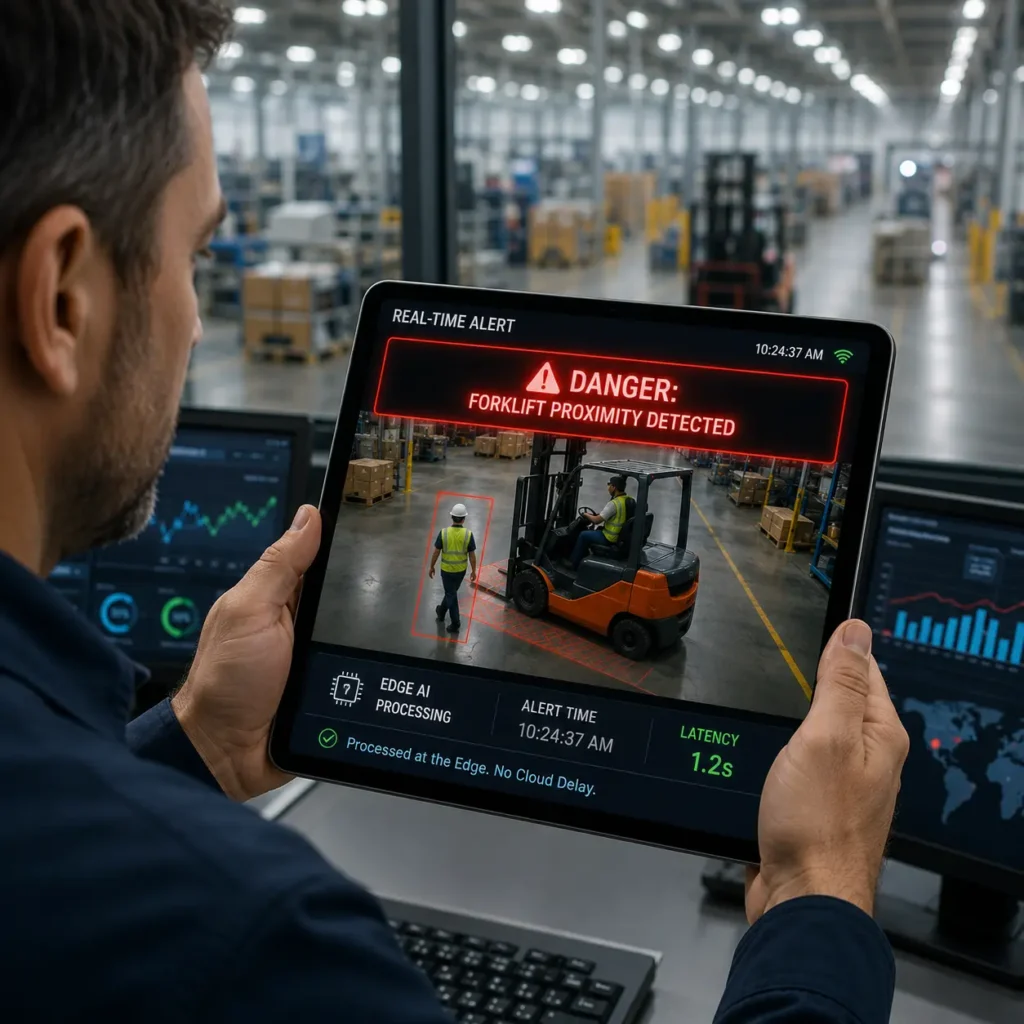
Track forklift safety, loading operations, and access control across large facilities.
Construction Sites
Enable safety monitoring and operational oversight in temporary or remote locations.
Agriculture & Food Processing
Monitor production processes, worker safety, and compliance across geographically dispersed facilities.
Why Industrial Organizations Are Investing in Edge AI
Organizations increasingly need intelligent monitoring solutions that function reliably regardless of network limitations.
Edge AI helps businesses:
- Improve workplace safety
- Accelerate incident response
- Reduce bandwidth costs
- Strengthen compliance programs
- Improve remote site visibility
- Support operational excellence initiatives
- Scale video analytics efficiently
As industrial operations become more distributed, local intelligence at the edge is becoming a key component of modern video analytics strategies.