Why Monitoring Large-Scale Operations Is Becoming More Difficult
Large enterprises often operate across multiple facilities, including manufacturing plants, warehouses, retail stores, corporate campuses, healthcare facilities, logistics centers, and critical infrastructure sites. Managing security, safety, compliance, and operational efficiency across these locations requires continuous visibility into daily activities.
Traditionally, organizations have relied heavily on security personnel to monitor premises, conduct patrols, observe CCTV feeds, and respond to incidents. While this approach remains important, growing facility sizes, increasing camera deployments, and expanding operational complexity are creating new challenges. Enterprises today need monitoring solutions that can provide faster awareness, broader coverage, and more consistent oversight without proportionally increasing operational costs.
As a result, many organizations are evaluating how intelligent monitoring technologies can complement or enhance traditional security operations.
Challenges of Scaling Security Guard Monitoring
Security guards play a critical role in maintaining physical security and responding to incidents. However, monitoring large-scale operations entirely through human resources can become increasingly difficult as organizations expand.
Common challenges include:
- Limited ability to watch multiple camera feeds simultaneously
- Monitoring fatigue during long shifts
- Inconsistent observation quality
- Delayed identification of incidents
- Rising labor and staffing costs
- Difficulties maintaining 24/7 coverage across locations
- Resource-intensive expansion as operations grow
These challenges do not reduce the value of security personnel, but they often highlight the need for additional tools that improve visibility and efficiency.
Understanding AI Video Analytics Using CCTV
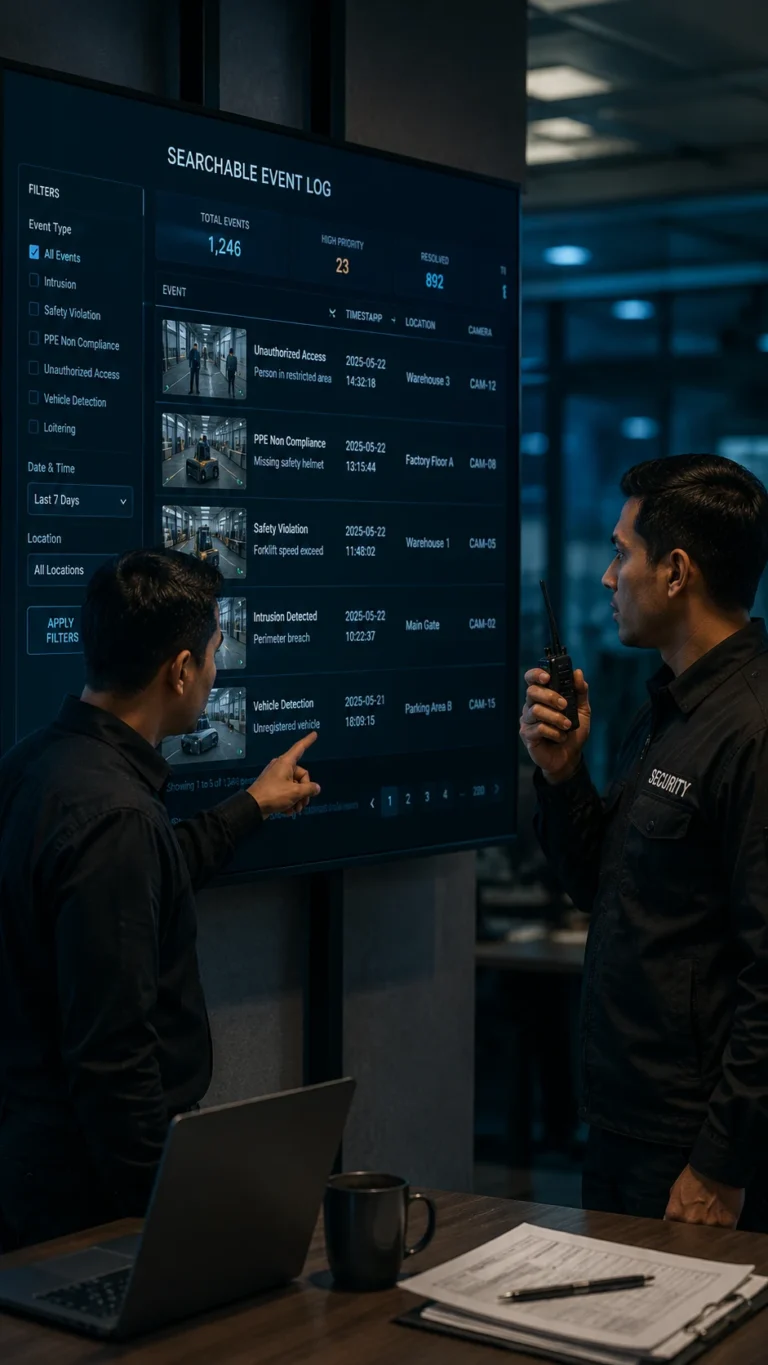
AI video analytics uses artificial intelligence to analyze CCTV footage continuously and identify predefined activities, events, and anomalies in real time. Modern CCTV video analytics software eliminates the need to rely solely on personnel to monitor every screen by automatically detecting conditions that require attention and generating instant alerts for relevant teams. This intelligent approach improves security, operational efficiency, and response times while enabling organizations to maximize the value of their existing CCTV infrastructure.
This enables organizations to focus human resources on investigation, decision-making, and incident response rather than continuous observation.
Many enterprises compare AI-powered monitoring with traditional guard-based surveillance when seeking to improve operational effectiveness and scalability.
Compare AI Video Analytics Using CCTV vs Security Guard Monitoring for Large Enterprises
Both approaches contribute to security operations, but they differ significantly in how monitoring activities are performed.
Feature | Security Guard Monitoring | AI Video Analytics Using CCTV |
Monitoring Method | Human observation | Automated video analysis |
Coverage Capacity | Limited by personnel | Multiple cameras simultaneously |
Monitoring Consistency | Varies by individual | Rule-based consistency |
Alert Generation | Manual identification | Automated notifications |
Scalability | Additional staffing required | Easily scalable |
Availability | Shift-dependent | Continuous operation |
Investigation Support | Human observation | Event-based evidence |
Operational Visibility | Resource dependent | Broad visibility |
The key distinction is that security guards provide human judgment and physical response capabilities, while AI analytics provides continuous monitoring and automated detection.
Compare Monitoring Efficiency Across Large Enterprise Environments
Enterprise operations generate enormous amounts of activity each day. Monitoring every location, facility, and camera feed manually can be difficult even for large security teams.
AI-powered analytics can support monitoring activities by helping identify:
- Unauthorized access attempts
- Restricted-area violations
- Safety compliance concerns
- Suspicious activities
- Perimeter breaches
- Occupancy anomalies
- Operational deviations
- Security-related events
This allows security personnel to focus attention on events that genuinely require intervention rather than continuously scanning video feeds.
How CAPASai Enhances Enterprise Monitoring Operations
CAPASai transforms CCTV infrastructure into an intelligent monitoring platform through AI-powered video analytics, remote monitoring, and real-time alerts.
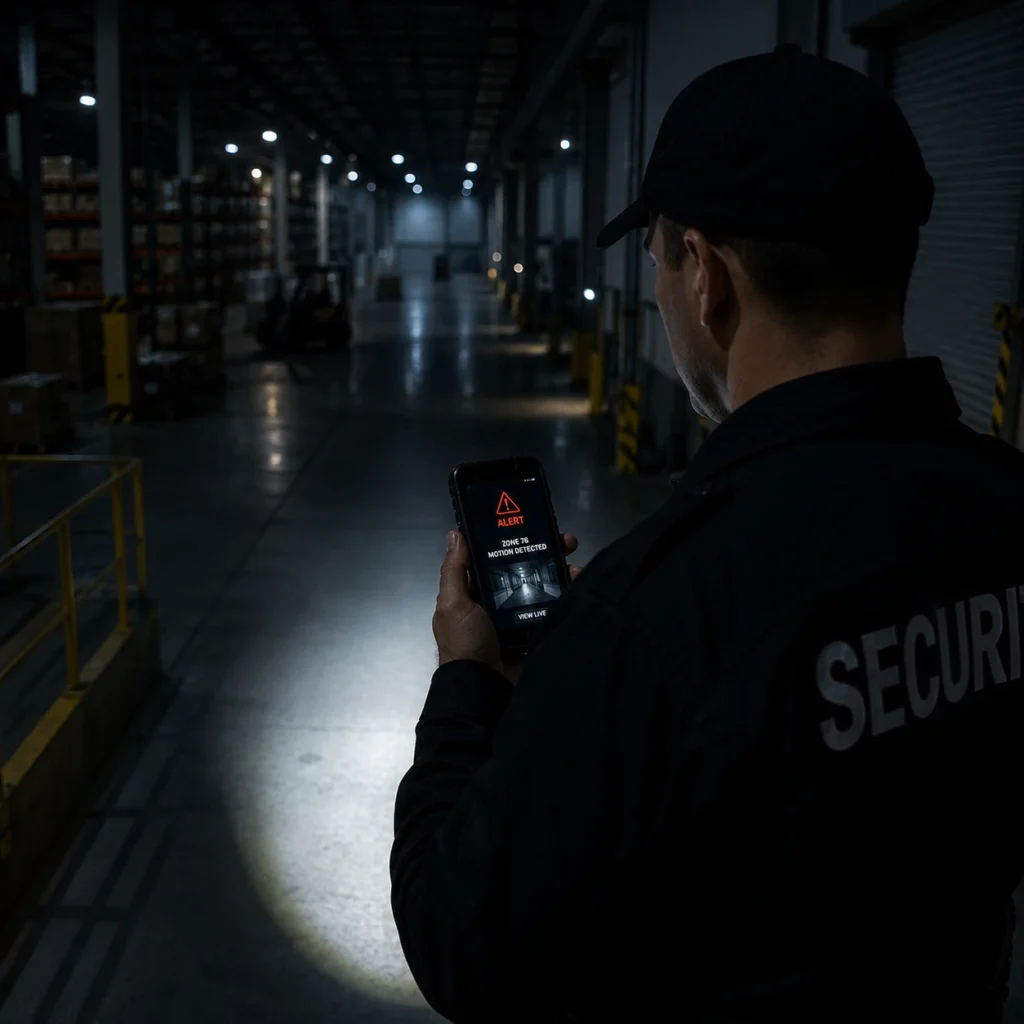
Rather than replacing security teams, CAPASai helps improve operational visibility by automatically analyzing video streams and identifying predefined events that require attention. Relevant personnel can receive immediate alerts, enabling faster response and more efficient use of resources.
Key capabilities include:
- Intelligent video analytics
- Real-time event detection
- Automated alerts and notifications
- Remote monitoring across facilities
- Compliance monitoring support
- Safety and risk visibility
- Multi-site operational oversight
- Centralized monitoring capabilities
This approach helps organizations strengthen monitoring operations while maximizing the value of existing surveillance investments.

Security Teams and AI Analytics Can Work Together
The discussion is often framed as technology versus personnel, but many enterprises achieve the best results by combining both approaches.
Security personnel contribute:
- Decision-making capabilities
- Physical response
- Incident investigation
- Situational judgment
- Visitor interaction
- Emergency management
AI video analytics contributes:
- Continuous monitoring
- Automated detection
- Faster event awareness
- Broad camera coverage
- Consistent rule-based analysis
- Real-time notifications
Organizations frequently compare these approaches not to eliminate one or the other, but to determine how they can create a more efficient and effective monitoring strategy.
.
Benefits of AI-Assisted Enterprise Monitoring
Organizations that integrate intelligent analytics into security operations often achieve:
- Faster incident identification
- Improved operational visibility
- Better utilization of security resources
- Enhanced compliance oversight
- Reduced monitoring fatigue
- Increased situational awareness
- Stronger multi-site management
- Improved response coordination
These benefits support both security objectives and broader operational goals.
Compare the Future of Enterprise Monitoring and Traditional Security Operations
As enterprises continue to expand across multiple facilities and manage increasingly complex operations, monitoring requirements are becoming more demanding. Security personnel remain essential for response, judgment, and incident management, but continuous observation of growing camera networks can be difficult to scale efficiently. CCTV video analytics software powered by AI helps address this challenge by providing automated detection, broader visibility, and real-time awareness across enterprise environments. For many large organizations, the future of monitoring lies in combining human expertise with intelligent technology to create a more responsive, efficient, and scalable security operation. By leveraging advanced CCTV video analytics software, enterprises can improve incident detection, reduce monitoring fatigue, and strengthen overall operational and security performance.