Why Effective CAPA Management Matters
Corrective and Preventive Action (CAPA) programs play a critical role in helping organizations identify problems, investigate root causes, implement corrective measures, and prevent recurring incidents. Across manufacturing plants, pharmaceutical facilities, retail chains, healthcare organizations, logistics centers, food processing units, and other enterprise environments, CAPA processes are essential for maintaining compliance, improving quality, and reducing operational risks.
However, many organizations struggle with delayed incident reporting, incomplete evidence collection, inconsistent follow-up procedures, and limited visibility into recurring issues. These challenges often slow down CAPA implementation and reduce its effectiveness.
As enterprises seek faster and more proactive approaches to risk management, AI video analytics using CCTV is emerging as a valuable tool for strengthening CAPA programs.
Common Challenges in Traditional CAPA Processes
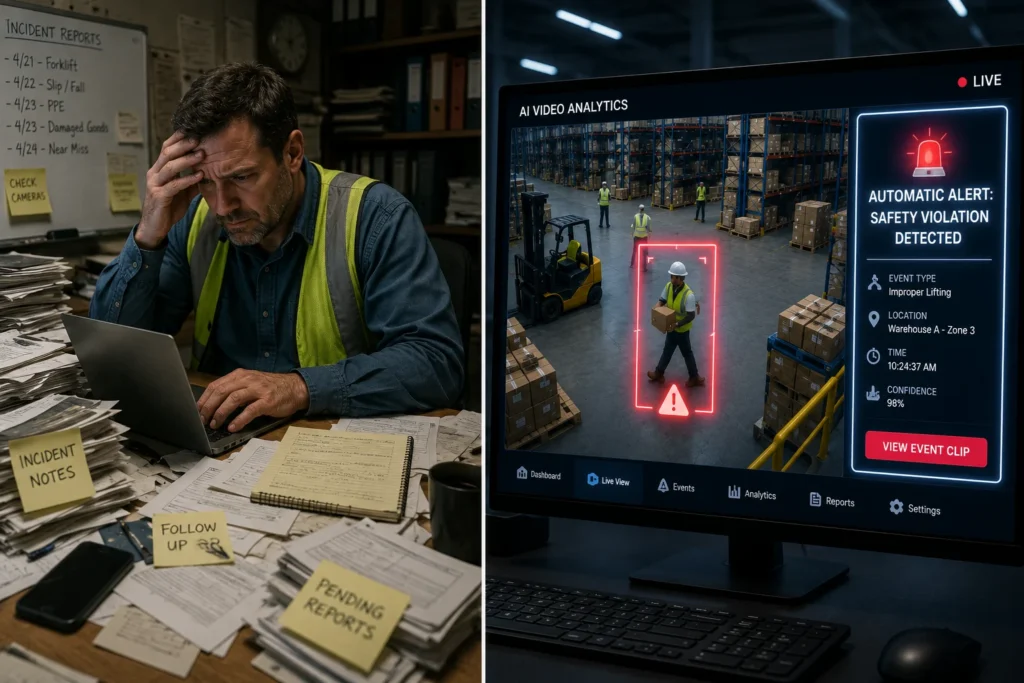
To start CAPA actions, many organisations still rely on manual reporting, audits, staff observations, and incident investigations.
Common challenges include:
- Delayed identification of incidents
- Incomplete incident documentation
- Human reporting inconsistencies
- Limited visibility across multiple sites
- Slow root cause investigations
- Difficulty tracking recurring issues
- Delayed corrective actions
- Reactive problem management
Because incidents are often discovered after they occur, organizations may lose valuable time before corrective measures are implemented.
How AI Video Analytics Supports CAPA Programs
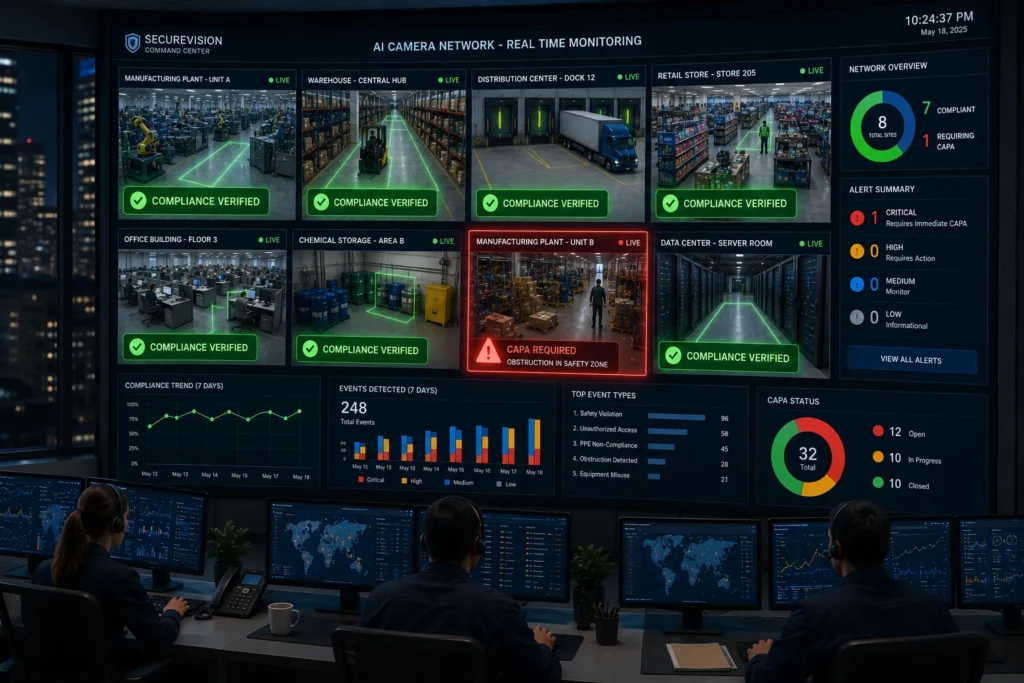
AI video analytics transforms existing CCTV systems into intelligent monitoring platforms capable of detecting operational events, safety violations, compliance deviations, and security incidents in real time.
Instead of waiting for manual reporting, organizations can automatically identify issues as they occur and initiate CAPA workflows much faster.
By continuously monitoring operational environments, AI-powered systems help enterprises strengthen both corrective and preventive action processes.
Key Ways AI Video Analytics Improves CAPA Implementation
Faster Incident Detection
AI analytics continuously monitors activities and identifies predefined events immediately.
Examples include:
- Safety violations
- Unauthorized access
- Process deviations
- PPE non-compliance
- Equipment misuse
- Restricted area entry
Early detection enables faster CAPA initiation.
Improved Root Cause Analysis
Video evidence provides objective records of events, helping teams investigate incidents more effectively.
Organizations can:
- Review actual incident footage
- Verify contributing factors
- Identify procedural failures
- Understand operational conditions
This improves root cause accuracy and reduces investigation time.
Automated Evidence Collection
One of the biggest challenges in CAPA investigations is gathering reliable evidence.
AI-powered monitoring provides:
- Time-stamped video records
- Event-based alerts
- Activity tracking
- Visual verification
This creates stronger documentation for corrective action reviews.
Better Preventive Action Planning
By identifying recurring patterns and operational risks, AI analytics helps organizations move beyond corrective actions and focus on prevention.
Teams can detect:
- Repeated safety violations
- Frequent process deviations
- Recurring compliance failures
- Operational bottlenecks
These insights support more effective preventive action strategies.
Compare Traditional CAPA Monitoring vs AI-Powered CAPA Support
Feature | Traditional CAPA Process | AI Video Analytics Support |
Incident Identification | Manual reporting | Automated detection |
Investigation Speed | Often delayed | Near real-time |
Evidence Collection | Manual gathering | Automated video records |
Root Cause Analysis | Limited visibility | Visual verification |
Multi-Site Monitoring | Resource intensive | Centralized visibility |
Preventive Insights | Limited | Pattern detection |
Response Time | Reactive | Proactive |
When organizations compare these approaches, AI analytics significantly improves the speed and effectiveness of CAPA implementation.
Industry Applications of AI-Driven CAPA Monitoring
Manufacturing Facilities
Detect safety violations, production process deviations, and operational risks.
Pharmaceutical Operations
Monitor compliance procedures and support quality management initiatives.
Retail Chains
Identify operational non-compliance, customer service issues, and loss prevention events.
Warehousing and Logistics
Monitor loading operations, material handling activities, and workplace safety practices.
Healthcare Organizations
Support operational compliance and patient safety initiatives.
How CAPASai Enhances Enterprise CAPA Programs
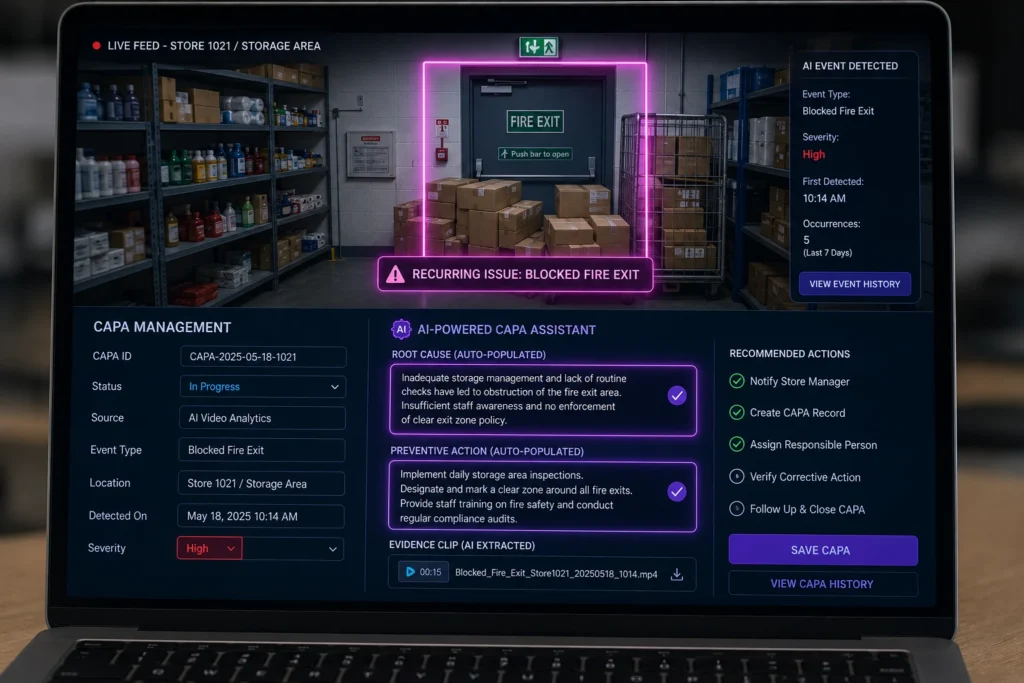
CAPASai combines AI-powered video analytics, remote monitoring, and real-time alerts to help organizations strengthen corrective and preventive action management.
The platform helps enterprises:
- Detect incidents automatically
- Generate real-time alerts
- Improve root cause investigations
- Support evidence-based CAPA workflows
- Monitor compliance continuously
- Identify recurring operational risks
- Improve preventive action planning
By converting CCTV footage into actionable intelligence, CAPASai enables organizations to accelerate CAPA implementation and improve operational performance across multiple locations.
Building a More Proactive CAPA Culture
Successful CAPA programs depend on timely detection, accurate investigations, and effective preventive actions. Organizations that leverage AI video analytics using CCTV gain real-time visibility into operational risks, helping them identify issues earlier and respond more effectively. With solutions like CAPASai, enterprises can transform traditional CAPA processes into proactive, data-driven programs that improve compliance, safety, quality, and operational excellence.