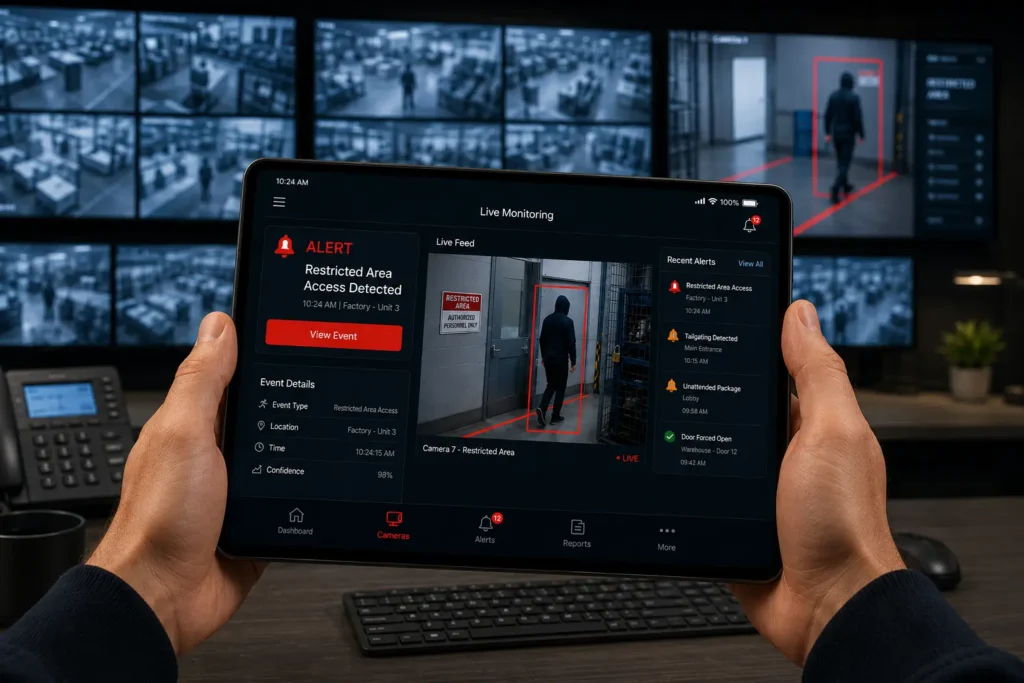
Why Organizations Are Re-Evaluating Monitoring Strategies
Organizations today face growing pressure to improve security, safety, compliance, and operational performance while controlling costs. CCTV systems have become standard across industries such as retail, manufacturing, healthcare, banking, logistics, hospitality, education, and public infrastructure. However, installing cameras is only one part of the equation. The real challenge lies in effectively monitoring what those cameras capture.
For many years, businesses have relied on security personnel and monitoring teams to watch live video feeds, review footage, and respond to incidents. While human monitoring remains an important component of security operations, increasing camera counts and expanding facilities have made continuous surveillance more difficult and expensive.
As a result, organizations are exploring technology-driven approaches that can improve visibility while optimizing operational costs.
The Hidden Costs of Human Monitoring
Human monitoring provides judgment, experience, and decision-making capabilities that technology alone cannot fully replicate. However, maintaining continuous surveillance across multiple cameras often requires significant resources.
Some common challenges include:
- Monitoring fatigue during long shifts
- Difficulty watching multiple screens simultaneously
- Rising labor costs
- Limited scalability as camera networks grow
- Inconsistent incident detection
- Delayed response to overlooked events
- High staffing requirements for 24/7 operations
When organizations expand across multiple sites, these challenges can increase significantly, making efficient monitoring more difficult to sustain.
Understanding AI Video Analytics in CCTV Monitoring
AI video analytics uses artificial intelligence to automatically analyze CCTV footage and identify predefined events, anomalies, and operational risks. Rather than depending solely on personnel to observe every camera feed, the system continuously scans video streams and generates alerts when attention is required.
This allows organizations to focus human resources on investigation, decision-making, and response activities rather than continuous observation.
Many enterprises now compare automated monitoring technologies with traditional human-led surveillance models to determine the most efficient long-term approach.
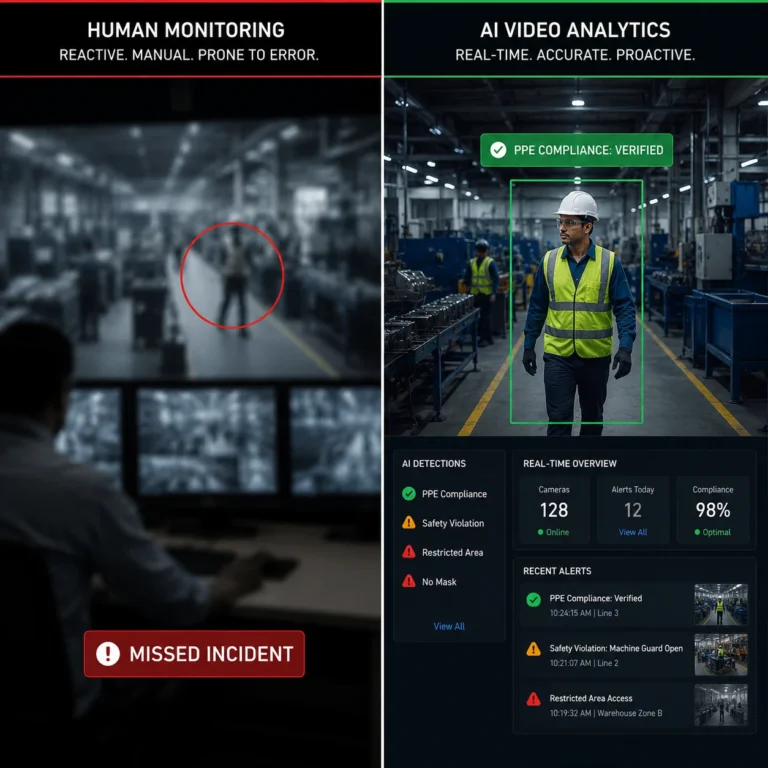
Compare AI Video Analytics Using CCTV vs Human Monitoring
While both approaches support surveillance operations, they differ significantly in terms of efficiency, scalability, and resource requirements.
Feature | Human Monitoring | AI Video Analytics Using CCTV |
Monitoring Method | Continuous human observation | Automated video analysis |
Detection Consistency | Varies by operator | Consistent rule-based detection |
Coverage Capacity | Limited by personnel | Multiple cameras simultaneously |
Alert Generation | Manual identification | Automated alerts |
Scalability | Additional staff required | Easily scalable |
Operating Costs | Ongoing labor expenses | Technology-driven efficiency |
Response Support | Human decision-making | Real-time event notification |
Monitoring Availability | Shift-dependent | 24/7 operation |
The most significant difference is that AI can monitor numerous video feeds simultaneously without fatigue, while human teams are naturally limited by attention span and workload.
Compare How Issues Are Detected and Investigated
One of the biggest differences between these approaches lies in the availability of objective operational data.
Traditional investigations often depend on:
- Employee statements
- Audit observations
- Manual reports
- Inspection records
- Historical documentation
AI-powered monitoring adds another layer by providing visual evidence and automated event detection. This can improve investigation quality by helping teams understand exactly when, where, and how a deviation occurred.
Organizations frequently compare these approaches when seeking ways to reduce investigation time and improve root-cause analysis effectiveness.
Compare Cost Efficiency and Resource Utilization
When evaluating monitoring strategies, organizations often focus on total operational efficiency rather than direct labor replacement.
Human monitoring typically involves:
- Staffing costs
- Shift management
- Training requirements
- Supervision expenses
- Coverage planning
- Overtime and replacement costs
AI-powered monitoring can help reduce the burden of repetitive observation by automatically identifying events that require attention.
This enables organizations to allocate personnel toward higher-value responsibilities such as investigations, incident response, compliance management, and operational decision-making
How CAPASai Enhances Monitoring Efficiency
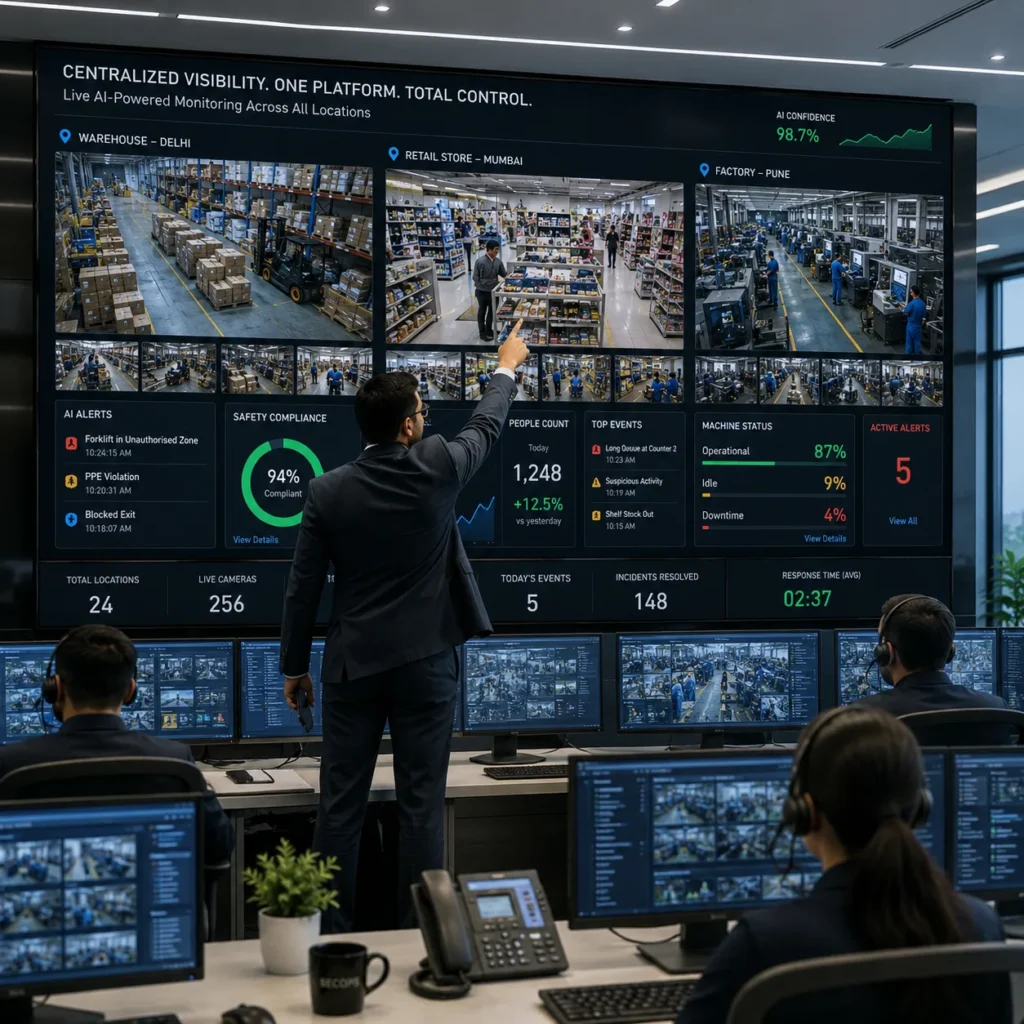
CAPASai combines AI-powered video analytics, remote monitoring, and real-time alerts to help organizations improve visibility across facilities and operations.
Instead of requiring teams to continuously watch multiple screens, CAPASai automatically analyzes video streams and identifies predefined events, safety violations, security risks, and operational anomalies.
Key capabilities include:
- Intelligent video analytics
- Real-time alert generation
- Remote monitoring across locations
- Automated event detection
- Compliance monitoring support
- Operational visibility enhancement
- Centralized monitoring capabilities
Monitoring Requirements Vary Across Industries
The balance between human oversight and automated monitoring often depends on operational needs.
A manufacturing facility may prioritize workplace safety and restricted-area monitoring. Retail businesses may focus on loss prevention and customer flow visibility. Healthcare environments often require patient-sensitive monitoring, while logistics operations seek visibility into warehouse activities and asset movement.
Intelligent analytics can assist staff by identifying situations that call for more research or action, rather than taking the place of human expertise
Benefits of Combining Human Expertise and AI Analytics
Many organizations achieve the best results through a hybrid approach that combines human judgment with automated monitoring.
Potential benefits include:
- Faster incident identification
- Improved operational efficiency
- Reduced monitoring fatigue
- Better resource allocation
- Enhanced situational awareness
- Greater visibility across facilities
- Improved compliance oversight
- More effective incident response
With this method, teams can concentrate on important choices while technology takes care of ongoing monitoring.