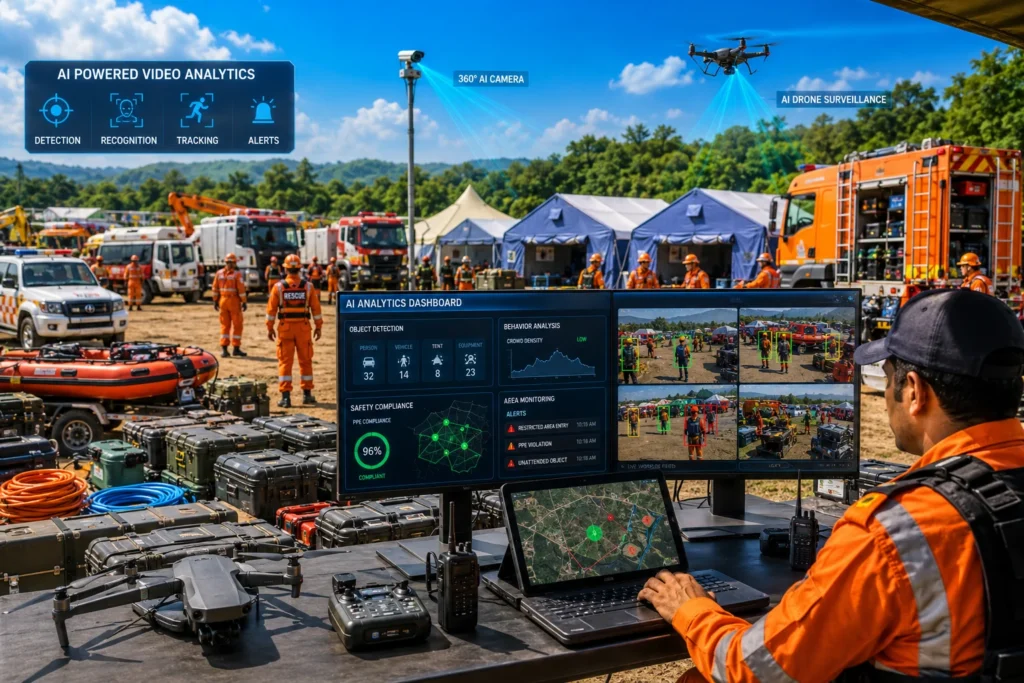
The National Disaster Response Force (NDRF) operates in environments where conditions can change rapidly. Floods, earthquakes, cyclones, landslides, building collapses, industrial accidents, and other emergencies can create difficult working conditions for response teams. Personnel may simultaneously deal with damaged infrastructure, unstable areas, heavy equipment, crowds, vehicles, and limited visibility.
AI-based SOP analytics and video analytics can support NDRF by improving situational awareness and monitoring selected safety procedures. The technology should function as an additional decision-support layer, helping authorised teams identify visible conditions that require attention without replacing trained responders or established emergency protocols.
AI Should Support The Response Cycle
A useful approach is to consider where visual intelligence can assist before, during, and after a response operation.
Response Stage | Potential AI Application | Operational Value |
Preparedness | PPE and equipment-area monitoring | Safety readiness |
Mobilisation | Facility and vehicle monitoring | Faster coordination |
Field Response | Hazard-zone and personnel monitoring | Responder protection |
Relief Operations | Crowd and access monitoring | Better site management |
Review | AI-assisted video search | Faster investigation |
Responder Safety At The Worksite
Disaster-response locations can contain multiple simultaneous hazards. Personnel may work near damaged structures, vehicles, machinery, debris, water, or other unstable conditions.
Video analytics can support selected SOP requirements that are visually identifiable.
Potential applications include:
- Required visible PPE
- Entry into predefined restricted zones
- Personnel-equipment proximity
- Obstructed emergency routes
- Vehicle-person interaction
- Unauthorised movement around operational areas
- Safety-zone compliance
For example, if a response procedure establishes a controlled area around equipment operations, video analytics can identify personnel entering that area and alert the responsible supervisor.
Temporary Response Camps And Staging Areas
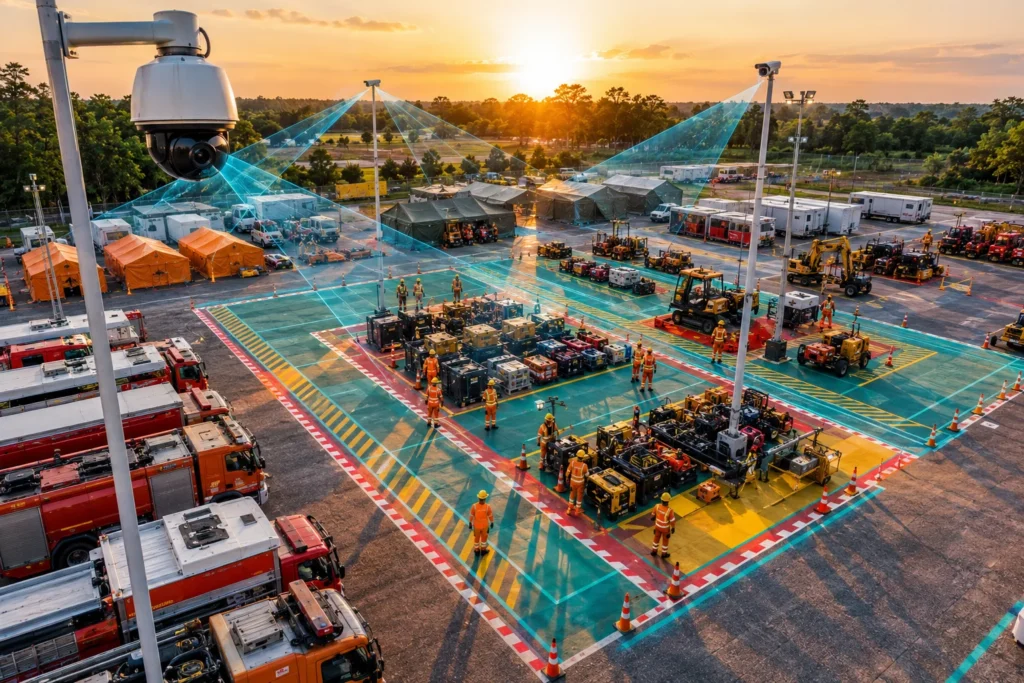
NDRF operations may involve temporary staging areas where personnel, vehicles, equipment, supplies, and support teams operate together.
These locations can provide practical applications for video analytics because many activities take place within defined zones.
AI can assist with monitoring:
- Equipment storage areas
- Vehicle movement
- Controlled access
- Personnel movement
- Loading and unloading zones
- Emergency pathways
- Selected PPE requirements
Flood And Cyclone Response Environments
Disaster sites involving water, heavy rain, poor visibility, or strong winds create additional challenges for visual monitoring.
Where cameras or mobile video systems provide suitable visibility, AI can help identify predefined conditions such as people entering controlled areas, vehicles approaching designated zones, blocked access routes, or unusual crowd accumulation.
However, weather can significantly affect computer-vision performance. Rain, glare, darkness, water reflections, debris, and camera movement can produce inaccurate detections.
Supporting Crowd And Relief-Site Management
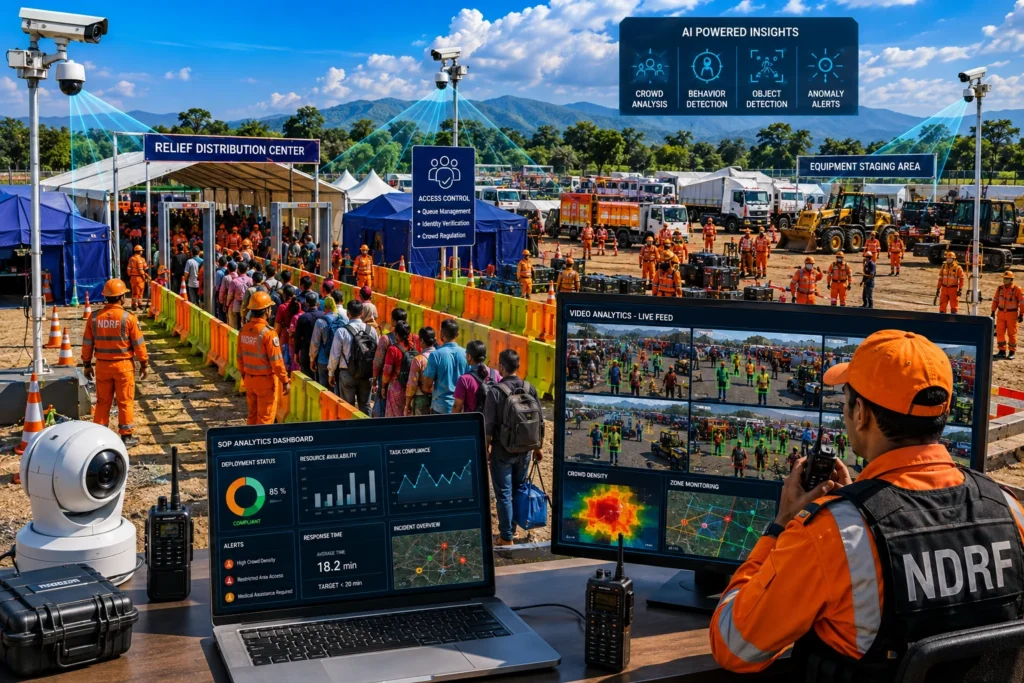
After a disaster, relief and evacuation areas can experience sudden increases in population. Managing movement around assistance centres, medical facilities, supply points, and temporary shelters can become difficult.
Video analytics can support authorised personnel by identifying unusual crowd concentration, congestion around defined access points, or people entering controlled operational areas.
Making SOP Compliance More Measurable
NDRF procedures often involve coordinated activities where specific safety conditions must be maintained. Some of these can be translated into computer-vision rules.
Suitable examples include:
- PPE requirements
- Equipment exclusion zones
- Restricted access
- Vehicle movement
- Designated response areas
- Clear emergency pathways
A major benefit is consistency. Instead of relying only on periodic observation, selected requirements can be monitored continuously while the operation is underway.
Connecting Video With Operational Information
Video analytics can become more useful when combined with information from other systems.
Potential sources include:
- Equipment status
- Vehicle information
- Personnel authorisation
- Incident-management systems
- Weather information
- Site assignments
- Emergency notifications
For instance, a person entering a restricted operational area may be expected if a specific activity is underway. Additional context can help determine whether the event requires escalation.
This can reduce unnecessary alerts and help response teams focus on conditions that deserve immediate review.
After-Action Review With AI
Video analytics can also support NDRF after an operation.
Large volumes of footage may be generated during disaster-response activities. Manually reviewing every recording can take considerable time.
AI-assisted search can help authorised personnel locate relevant footage according to time, location, movement, or predefined event categories.
This can support reviews of responder safety, equipment movement, access issues, and operational coordination. Lessons identified through these reviews can contribute to future training and SOP improvement.
Building A Reliable AI Framework
Disaster environments are unpredictable, so NDRF should validate AI systems under realistic conditions before operational deployment.
Important considerations include:
- Camera stability and positioning
- Poor lighting
- Rain and water exposure
- Dust and debris
- Network connectivity
- False-positive rates
- Data security
- Access controls
- Offline or degraded operating conditions
Critical response decisions should never depend solely on an AI-generated alert
Measuring Practical Benefits
NDRF can evaluate the technology through indicators such as:
- Recurring SOP deviations
- PPE compliance
- Responder-equipment proximity events
- Restricted-area incidents
- Alert response time
- False-positive rate
- Video investigation time
- Corrective-action closure
- Reduction in manual footage review
For NDRF, AI-based SOP analytics and video analytics can strengthen preparedness, responder safety, temporary-site management, and post-operation learning. The most effective deployment will be selective and resilient, using AI to improve visibility while keeping command, rescue, safety, and technical decisions firmly with trained personnel
Frequently Asked Questions
Yes. It can monitor selected visible requirements such as PPE, restricted zones, equipment proximity, and designated safety areas.
It can support monitoring where camera visibility is adequate, but rain, glare, darkness, water, and debris can affect detection accuracy. Human verification remains important.
Yes. Potential applications include equipment-area monitoring, vehicle movement, controlled access, crowd conditions, and selected safety requirements.
Yes. AI-assisted video search can help authorised teams locate relevant footage more efficiently and identify recurring operational or safety issues.