For Employees’ State Insurance Corporation, service delivery extends across hospitals, dispensaries, regional offices, branch offices, laboratories, pharmacies, and other facilities supporting insured workers and their families. The operational challenge is not limited to treating patients or processing claims. It includes keeping facilities ready, moving beneficiaries through defined processes, protecting medicines and records, and responding consistently across a large network. AI based SOP analytics and video analytics can help ESIC strengthen these operational controls.
Where Service Delays Become Operational Signals
An ESIC beneficiary may interact with registration, consultation, diagnostics, pharmacy, admission, discharge, or administrative services during a single episode. Each stage has procedures, responsibilities, and expected turnaround times.
AI based SOP analytics can examine suitable workflow records, checklists, inspection reports, maintenance logs, pharmacy records, incident reports, service requests, and corrective actions. Instead of treating every delay as an isolated event, analytics can identify recurring patterns.
For example, it could reveal that a particular facility repeatedly experiences delays between registration and a downstream service, or that certain corrective actions remain open longer than expected. These patterns give administrators a starting point for investigating staffing, workflow design, resource availability, or procedural clarity.
.
Improving Facility Readiness
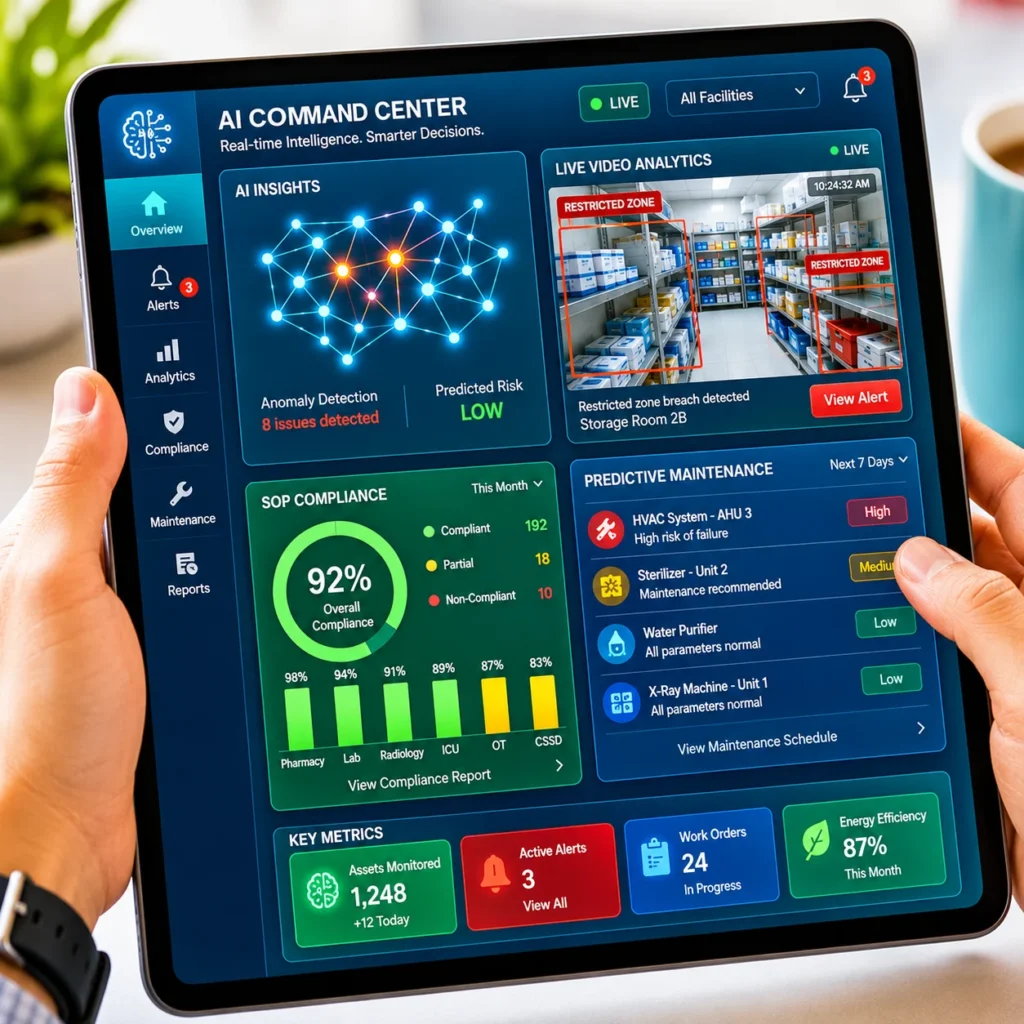
ESIC hospitals and dispensaries depend on supporting infrastructure that may not be visible to patients until something goes wrong. Equipment checks, emergency preparedness, sanitation procedures, maintenance, pharmacy operations, and facility inspections all contribute to reliable service.
SOP analytics can track whether critical checks are completed on schedule and whether identified deficiencies are actually resolved.
A useful distinction is between closure and resolution. If the same issue appears repeatedly after being marked corrected, analytics can flag the recurrence. Administrators can then examine whether the corrective measure addressed the underlying problem.
Protecting Medicines, Equipment And Restricted Areas
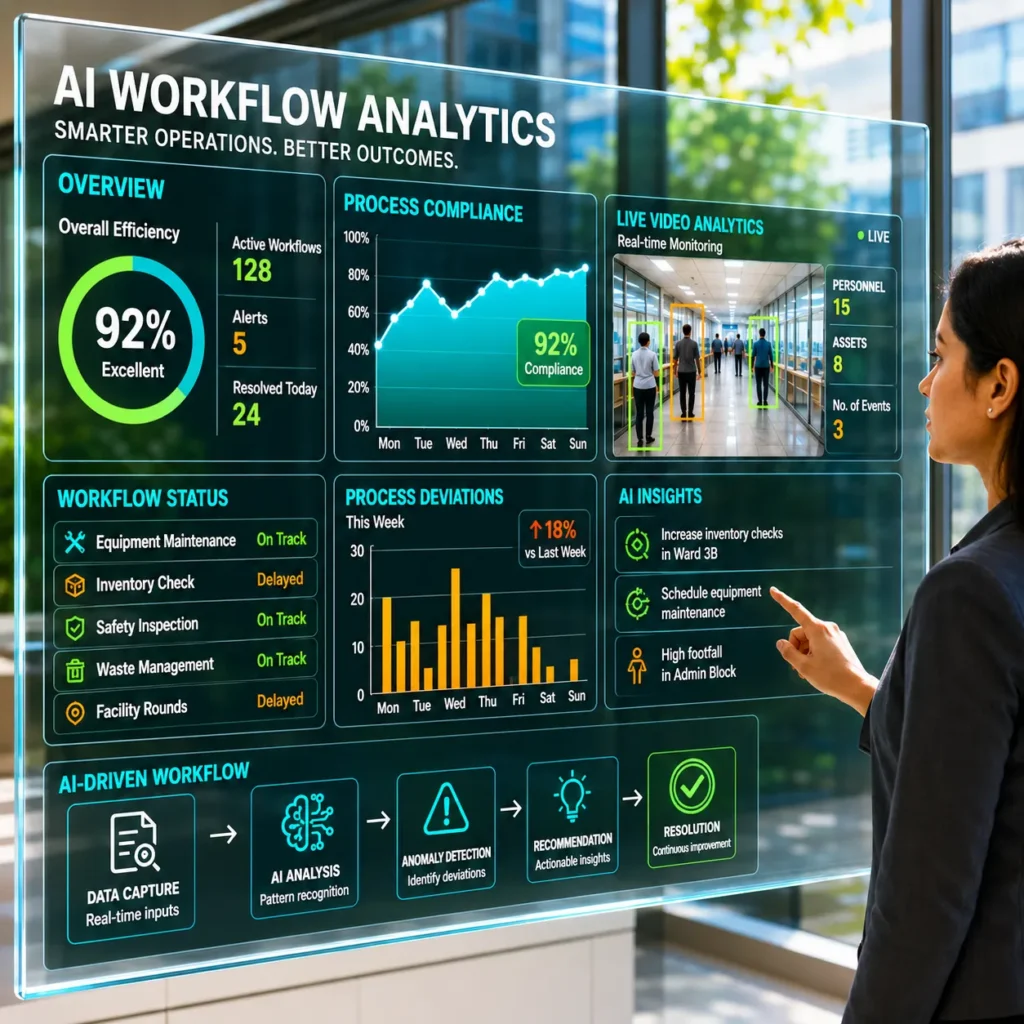
ESIC facilities contain pharmacies, medical stores, laboratories, equipment rooms, records areas, and other controlled spaces. Video analytics can provide event-based monitoring where suitable cameras are available.
Potential applications include detecting unauthorised entry, monitoring access to restricted areas, identifying unusual movement around medical stores, and supporting security reviews after an incident.
Different facilities may require different rules. A pharmacy storage area may need access monitoring, while a hospital loading zone may require vehicle and pedestrian movement monitoring. The objective should be defined operational awareness rather than continuous indiscriminate surveillance.
A Better Way To Review Pharmacy Operations
Pharmacy services provide a particularly useful intersection between SOP analytics and physical monitoring.
SOP analytics can examine whether defined processes for receiving, storage checks, stock verification, dispensing workflow, expiry management, and corrective actions are being followed where appropriate records exist.
Video analytics can support selected storage and access-control requirements, such as identifying entry into restricted medicine-storage areas.
AI should not independently determine medicine quality, clinical appropriateness, or patient eligibility. Those decisions require authorised healthcare and administrative personnel.
Connecting Incidents With Evidence
When an operational incident occurs, investigation often requires information from several sources. An incident report may describe what was observed, while maintenance records, access logs, SOP checklists, and video footage provide additional context.
AI can help organise these sources.
SOP analytics may identify which procedures were due, completed, delayed, or recorded as exceptions. Video analytics can help locate relevant visual events within a defined time and location. Investigators can then assess the evidence together.
This can shorten the search process and support more consistent root-cause reviews without turning AI outputs into automatic findings of responsibility.
Supporting Regional Consistency
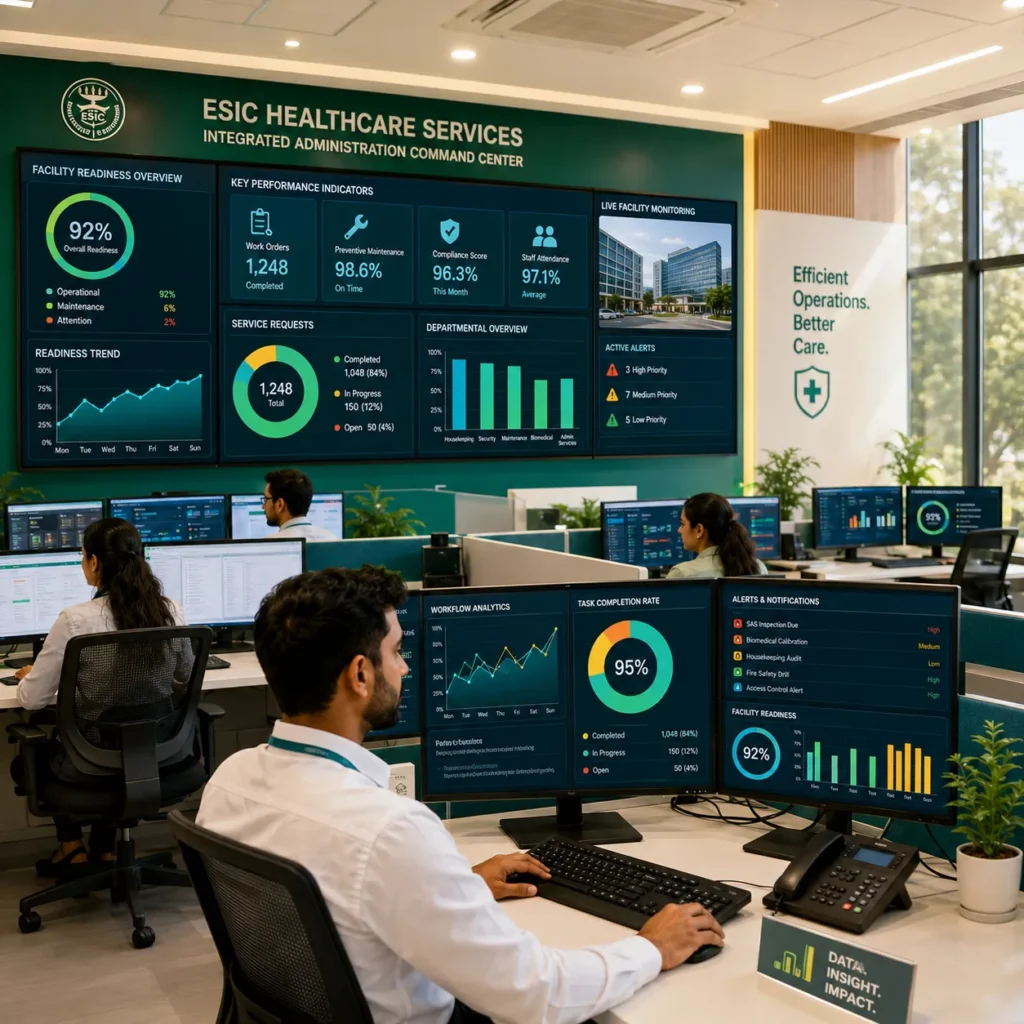
ESIC’s distributed network creates another opportunity for analytics: comparing process performance across facilities without assuming that every location operates under identical conditions.
Management can identify facilities with unusually high recurrence of specific SOP deviations, delayed corrective actions, or repeated operational incidents. The purpose is not simply to rank offices or hospitals. It is to identify where additional support, training, process redesign, or resource assessment may be needed.
This can make organisational learning more systematic.
Designing A Measurable Pilot
ESIC can begin with one operational problem that has clear records and a measurable outcome. Possible pilots include facility-readiness compliance, pharmacy-process monitoring, restricted-area security, maintenance corrective actions, or incident investigation.
The pilot should establish a baseline and evaluate measures such as fewer repeated SOP deviations, faster corrective-action closure, improved inspection completion, reduced investigation time, or more relevant video alerts.
Because ESIC handles sensitive health and beneficiary information, governance should be part of the design from the start. Role-based access, data minimisation, retention policies, cybersecurity, audit trails, privacy safeguards, and human review should be clearly defined.
For Employees’ State Insurance Corporation, AI based SOP analytics and video analytics can strengthen the operational layer behind healthcare and social-security services. The objective is practical: identify recurring weaknesses, improve facility readiness, protect controlled environments, and give administrators better evidence for continuous improvement.
FAQs
It can identify recurring deviations in inspections, maintenance, pharmacy procedures, corrective actions, and other defined operational workflows
Yes, for carefully defined security and operational purposes such as restricted-area access and selected facility-monitoring events, subject to privacy and governance controls.
SOP analytics can review defined receiving, storage, stock, dispensing, and expiry-related procedures, while video analytics can support selected access-control requirements.
Yes. It can identify recurring process patterns across facilities while allowing management to account for differences in workload, infrastructure, and operating conditions.
A focused pilot around facility readiness, corrective-action tracking, pharmacy processes, or restricted-area monitoring can provide measurable results before wider deployment.