Central Armed Police Forces (CAPFs) operate across a wide range of environments, from training institutions and administrative establishments to camps, logistics facilities, airports, industrial locations, and other controlled premises. Their responsibilities require consistent adherence to safety procedures, access protocols, facility-management practices, and workforce discipline.
For CAPFs, AI-based SOP analytics and video analytics can provide a common technology layer for monitoring selected visual conditions. The important opportunity is not to standardise every operational procedure across forces, but to create a flexible analytics framework that can be adapted to the specific requirements of each force and location.
A Common Technology Layer, Not A Common SOP
Different CAPFs have different operational responsibilities. A procedure suitable for a training centre may not be appropriate for an industrial facility or an administrative establishment.
AI can nevertheless support a shared set of capabilities.
Common Requirement | Potential AI Capability | Possible Outcome |
Workplace safety | PPE and zone monitoring | Faster identification of deviations |
Facility security | Restricted-area detection | Better access awareness |
Vehicle movement | Person-vehicle monitoring | Safer premises |
Equipment areas | Proximity detection | Reduced exposure |
Infrastructure | Obstruction detection | Better operational readiness |
The underlying analytics platform can remain common while detection rules are configured according to the relevant force, facility, and SOP.
Where Standardisation Makes Sense
Some visual requirements are common enough across CAPF establishments to benefit from standardised analytics.
PPE monitoring is one example. Workshops, maintenance areas, logistics facilities, and selected training environments may have clearly defined protective-equipment requirements.
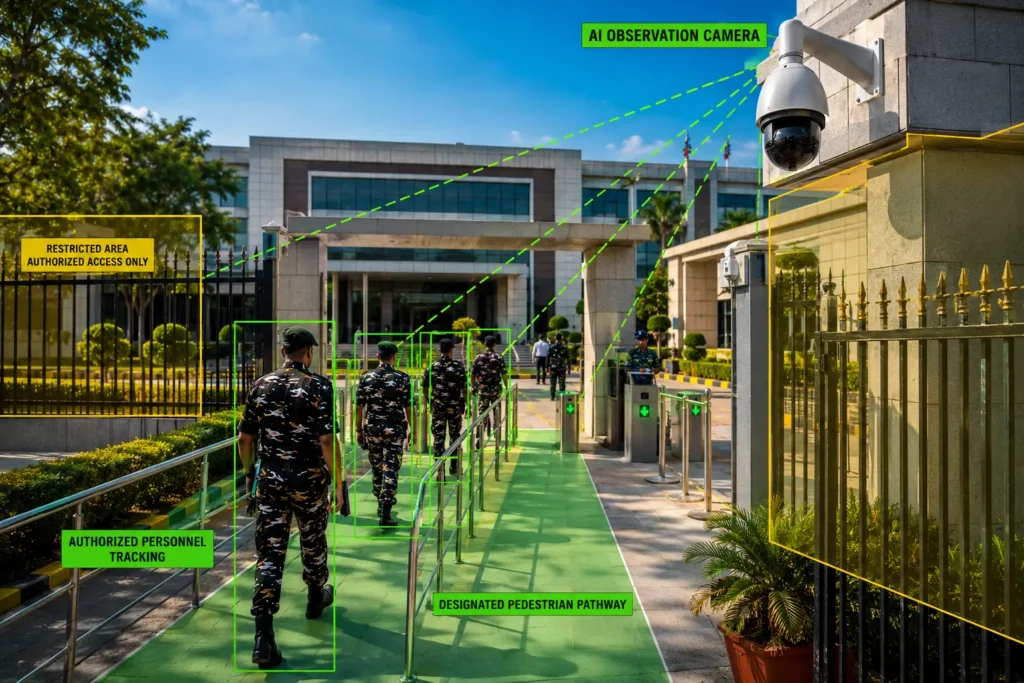
Restricted-area monitoring is another. AI can detect movement across predefined boundaries and generate alerts for authorised personnel.
Other broadly applicable use cases include:
- Obstructed emergency routes
- Unauthorised movement in controlled facilities
- Vehicle-person interaction
- Equipment-zone access
- Camera obstruction or tampering
- Selected housekeeping conditions
Standardising these basic capabilities can reduce duplication while allowing individual forces to maintain their own operational procedures.
How SOP Analytics Changes Supervision
An SOP generally describes what personnel should do under particular circumstances. Video analytics can make some of those requirements continuously observable.
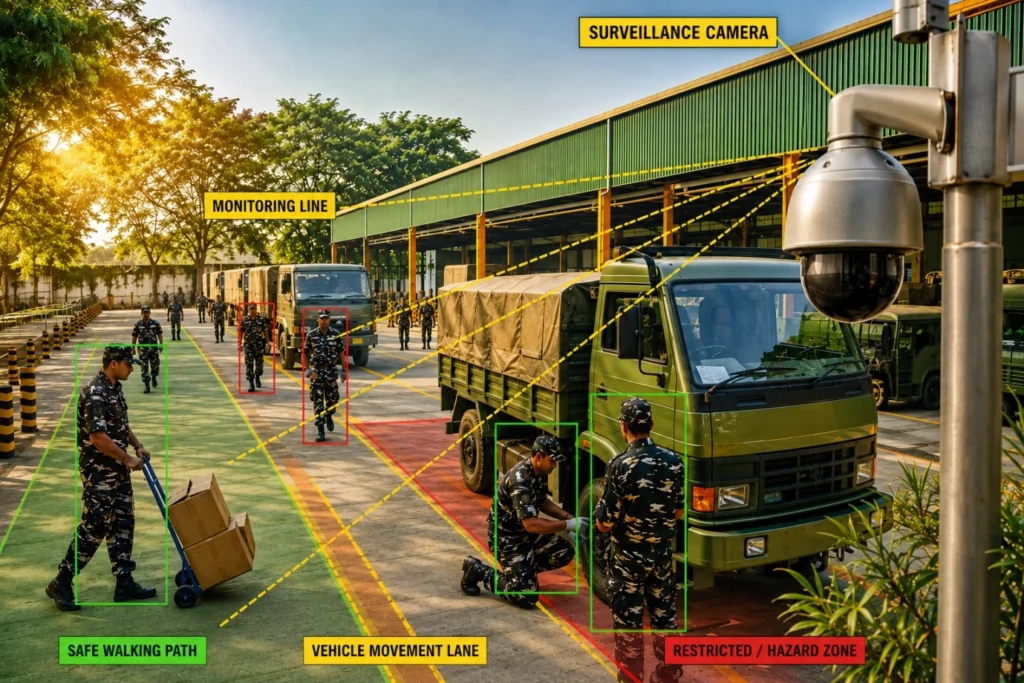
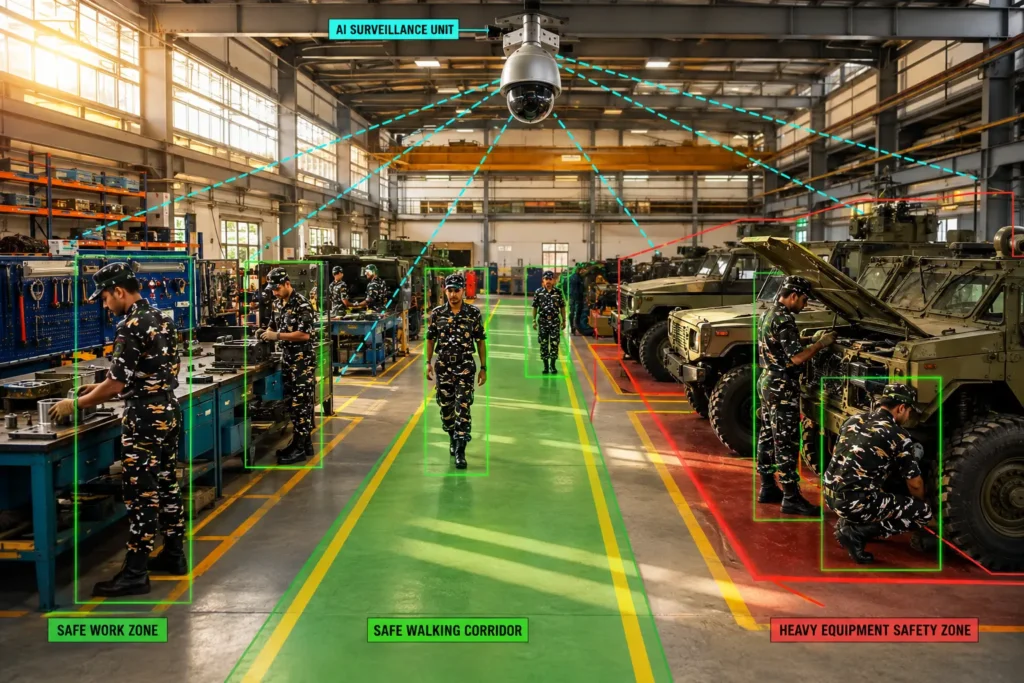
Consider a maintenance facility where personnel are required to remain outside a defined equipment zone during certain activities. A camera can monitor the boundary and identify unexpected entry.
Similarly, where a workshop requires specified PPE, AI can detect visible non-compliance and notify the responsible supervisor.
Different Environments Need Different Analytics
Training Establishments
Training locations can use AI for selected PPE, access, equipment-zone, and facility-safety requirements. Because activities are often scheduled, analytics can potentially be associated with planned training periods.
Logistics And Transport Facilities
Vehicle movement, loading areas, personnel-equipment interaction, and restricted storage zones may be more relevant here.
Administrative And Residential Premises
Analytics can focus on controlled access, selected security conditions, emergency-route clearance, and facility management.
Specialised Operational Facilities
Where environments have higher sensitivity, analytics should be limited to clearly authorised use cases, with stronger controls over video access, retention, and system integration.
This location-based model prevents a single analytics configuration from being unnecessarily applied everywhere.
Making AI Alerts More Context-Aware
A video camera can detect movement, but it does not automatically know whether that movement is legitimate.
CAPF establishments could potentially improve alert prioritisation by connecting video events with appropriate information such as:
- Access permissions
- Duty schedules
- Work authorisations
- Maintenance schedules
- Vehicle permissions
- Facility operating status
A Shared Analytics Centre Can Improve Oversight
For organisations operating across many geographically distributed establishments, analytics can also provide management-level visibility.
Instead of reviewing individual alerts separately, authorised administrators could analyse aggregated trends such as recurring PPE deviations, repeated restricted-area events, or frequent equipment-zone violations.
This could help identify:
- Locations requiring additional supervision
- Procedures that need clarification
- Common training gaps
- Repeated facility-design problems
- Sites requiring technical improvements
Video Analytics For Incident Reconstruction
AI can also help after an event has occurred.
When an incident requires investigation, authorised personnel may need to examine recordings from several cameras. AI-assisted video search can narrow the footage using time, location, movement, vehicle presence, or predefined event categories.
This can support reviews of workplace incidents, unauthorised access, vehicle-related events, facility-security concerns, or SOP deviations.
A Practical Measurement Framework
CAPFs can evaluate AI analytics through outcomes rather than technology deployment numbers.
Relevant measures include:
- Reduction in recurring SOP deviations
- PPE compliance
- Restricted-area events
- Worker-equipment proximity incidents
- Alert response time
- False-positive rate
- Incident investigation time
- Corrective-action closure
- Manual CCTV review effort
The broader value of AI-based SOP analytics and video analytics for Central Armed Police Forces lies in creating a consistent monitoring capability without imposing identical operating procedures on every force. A flexible framework can help individual establishments strengthen safety, access management, facility oversight, and incident review while keeping operational authority and final decisions with trained personnel.
Governance Is As Important As Detection Accuracy
A CAPF-wide analytics programme would involve significant amounts of operational video, making governance essential.
A responsible deployment should consider:
- Role-based access
- Strong authentication
- Network segmentation
- Encryption
- Data-retention policies
- Audit trails
- Cybersecurity assessments
- Model-performance testing
- Human verification of significant alerts
Frequently Asked Questions
Yes. A common platform can provide shared analytics capabilities while allowing each force to configure rules according to its own SOPs and operational requirements.
Training centres, workshops, logistics facilities, vehicle areas, and selected administrative premises can provide suitable starting points because many visual requirements are clearly defined.
Yes. AI can identify predefined visual conditions and generate alerts, while supervisors remain responsible for verifying the situation and deciding the appropriate response.
Potentially. Combining authorised access information with video events can provide context and help distinguish expected activity from events requiring investigation.