Organizations across industries operate in increasingly complex environments where maintaining quality, compliance, operational efficiency, and risk management requires more than simply identifying problems when they occur. Businesses must establish structured mechanisms that not only address operational issues but also prevent them from recurring.
Corrective and Preventive Action (CAPA) systems have long served as a cornerstone of operational governance, helping organizations investigate issues, implement corrective actions, and drive continuous improvement. However, traditional CAPA programs often face limitations due to delayed issue detection, fragmented data sources, manual investigations, and limited visibility into day-to-day operations.
As enterprises embrace digital transformation, Artificial Intelligence (AI) is reshaping how CAPA systems function. By combining continuous monitoring, operational intelligence, and automated analysis, AI-powered CAPA systems enable organizations to strengthen operational controls, improve accountability, and respond to risks more proactively.
Understanding The Role Of CAPA In Modern Organizations
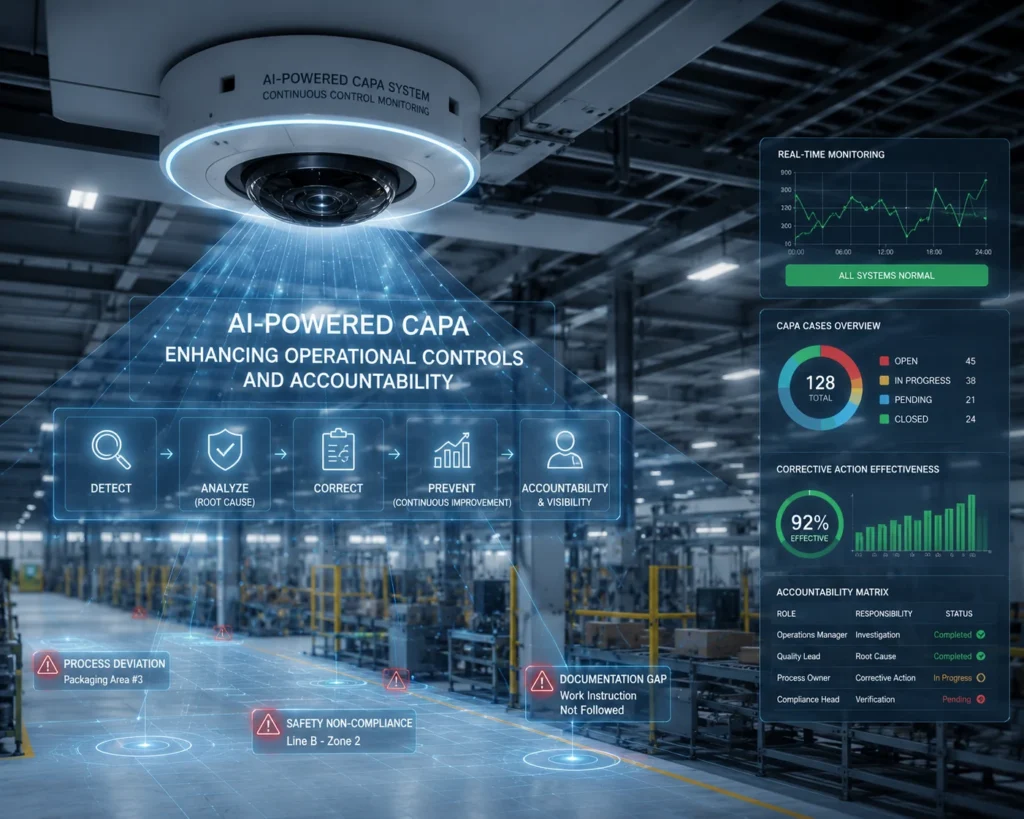
CAPA is a structured approach used to identify, investigate, correct, and prevent operational issues.
Organizations typically use CAPA programs to address:
- Process deviations
- Quality concerns
- Compliance gaps
- Safety incidents
- Operational inefficiencies
- Customer complaints
- Audit findings
The goal is not simply to resolve individual issues but to eliminate root causes and prevent recurrence.
Effective CAPA programs create a framework for accountability, ensuring that identified issues are investigated thoroughly and corrective actions are implemented consistently.
Why Traditional CAPA Systems Face Growing Challenges
While CAPA remains a critical operational discipline, many organizations continue to rely on manual and reactive processes.
Common challenges include:
Delayed Issue Detection
Many issues are identified only after they have already affected operations, quality, or compliance performance.
By the time investigations begin, valuable information may be difficult to recover.
Limited Operational Visibility
Organizations often lack continuous insight into how processes are executed across facilities, departments, and operational environments.
This can make it difficult to identify the true source of recurring problems.
Manual Investigation Processes
Traditional CAPA investigations frequently depend on:
- Manual observations
- Employee interviews
- Audit reports
- Historical records
- Spreadsheet-based analysis
These methods can be time-consuming and may delay corrective actions.
Inconsistent Follow-Through
Corrective actions may be assigned and documented, but organizations sometimes struggle to verify whether improvements are being implemented consistently across locations.
This weakens accountability and increases the likelihood of recurrence.
The Evolution Toward AI-Powered CAPA Systems
AI introduces a new level of intelligence into CAPA programs.
Rather than functioning as a reactive documentation process, CAPA becomes a continuous operational control mechanism supported by real-time insights.
AI-powered CAPA systems help organizations:
- Detect issues earlier
- Accelerate investigations
- Improve root cause analysis
- Monitor corrective action effectiveness
- Strengthen governance oversight
- Reduce operational risk
This shift transforms CAPA from a compliance requirement into a strategic operational capability.
How AI Strengthens Operational Controls
Operational controls are designed to ensure that processes are executed according to established standards and organizational requirements.
AI enhances these controls by providing continuous awareness of operational activities.
Continuous Monitoring
Instead of relying solely on periodic audits and manual reviews, AI enables ongoing visibility into operational performance.
Organizations can monitor:
- Process execution
- Workflow adherence
- Operational anomalies
- Compliance-related activities
- Emerging risks
This creates a stronger foundation for proactive control management.
Early Detection Of Deviations
Many operational issues begin as small deviations that gradually evolve into larger problems.
AI can identify unusual patterns and process variations in real time, enabling organizations to take corrective action before issues escalate.
This helps reduce:
- Quality failures
- Compliance violations
- Operational disruptions
- Financial losses
Improved Control Effectiveness
Organizations often implement controls without fully understanding whether they are functioning as intended.
AI-powered monitoring provides continuous feedback regarding control performance, allowing leaders to identify weaknesses and strengthen operational safeguards.
Enhancing Accountability Through Data-Driven Insights
Accountability is one of the most important outcomes of a successful CAPA program.
Organizations need confidence that identified issues are being addressed effectively and that corrective actions are producing measurable improvements.
AI supports accountability by creating greater transparency throughout the CAPA lifecycle.
Objective Operational Evidence
AI-generated insights provide objective information about operational activities.
Rather than relying solely on manual reporting, organizations can evaluate performance using data-driven evidence.
Improved Action Tracking
AI can help monitor whether corrective actions are being implemented consistently across departments and locations.
This enables leaders to verify progress and ensure responsibilities are fulfilled.
Greater Organizational Transparency
Continuous visibility helps operational teams, supervisors, and executives maintain a shared understanding of performance, risks, and corrective actions.
This strengthens accountability across all levels of the organization.
The Role Of Root Cause Analysis In AI-Powered CAPA
One of the most important aspects of CAPA is identifying why issues occur.
Addressing symptoms without understanding root causes often leads to recurring problems.
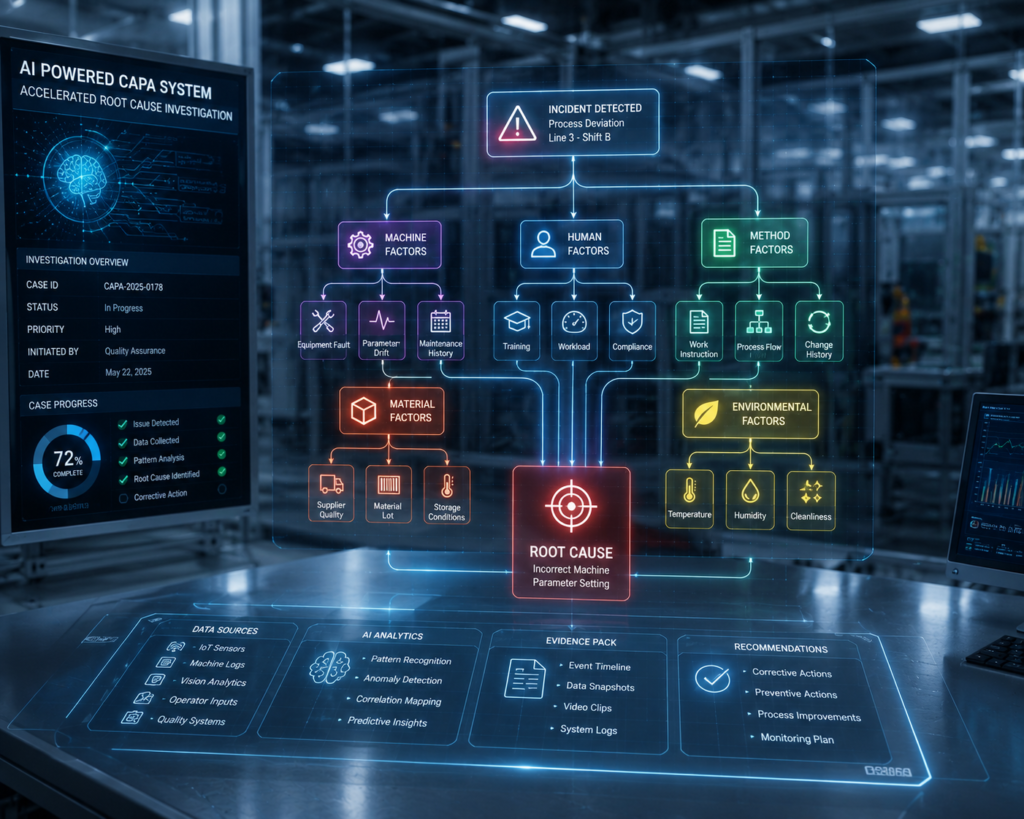
AI strengthens root cause analysis by:
- Identifying hidden operational patterns
- Connecting related events
- Detecting recurring deviations
- Correlating data from multiple sources
- Accelerating investigations
This helps organizations implement corrective actions that address underlying causes rather than surface-level symptoms.
How Computer Vision Expands CAPA Effectiveness
Many operational issues originate within physical environments where traditional enterprise systems provide limited visibility.Computer vision extends CAPA capabilities by transforming visual activity into actionable intelligence.
Organizations can use computer vision to:
- Verify process adherence
- Monitor workflow execution
- Detect process deviations
- Support compliance investigations
- Identify operational bottlenecks
- Capture evidence for root cause analysis
This creates a more comprehensive understanding of operational performance and strengthens corrective action programs.
AI-Powered CAPA Across Multiple Locations
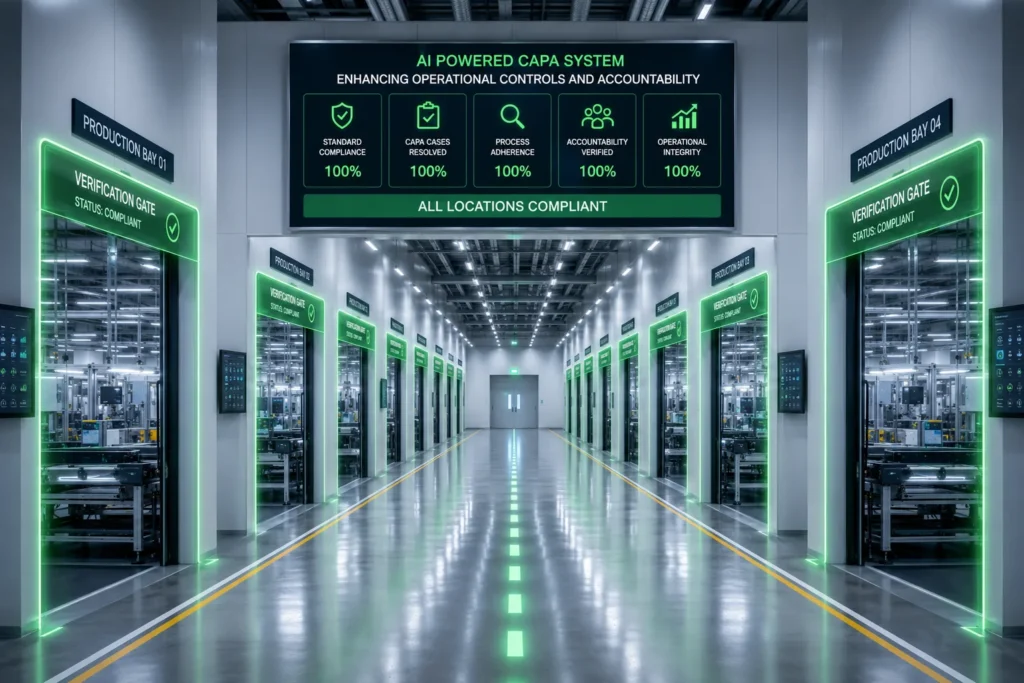
As organizations grow, maintaining consistent operational controls across multiple facilities becomes increasingly difficult.
AI-powered CAPA systems help enterprises:
- Standardize issue management
- Improve investigation consistency
- Strengthen governance oversight
- Monitor corrective actions across locations
- Reduce operational variability
This enables organizations to maintain higher levels of accountability regardless of scale.
Traditional CAPA Versus AI-Powered CAPA
Traditional CAPA | AI-Powered CAPA |
Reactive issue identification | Continuous issue detection |
Manual investigations | Automated intelligence support |
Historical analysis | Real-time operational visibility |
Limited monitoring | Continuous oversight |
Periodic reviews | Ongoing performance verification |
Reactive corrective actions | Proactive risk mitigation |
This evolution enables organizations to move beyond compliance-focused CAPA programs toward intelligent operational control systems.
Building A More Accountable And Controlled Operating Environment
The future of CAPA lies in combining structured corrective action processes with continuous operational intelligence. AI-powered CAPA systems provide organizations with the ability to identify issues earlier, investigate them more effectively, strengthen operational controls, and improve accountability across the enterprise.
As operational complexity continues to increase, organizations that integrate AI, computer vision, and real-time monitoring into their CAPA programs will be better positioned to reduce risk, improve compliance, strengthen governance, and drive sustainable operational excellence.
How CAPASai Supports AI-Powered CAPA Programs
CAPASai helps organizations strengthen CAPA initiatives through AI-powered video analytics, continuous monitoring, operational intelligence, real-time alerts, and workflow visibility. By providing continuous insight into process adherence, operational activities, compliance events, and emerging risks, CAPASai enables enterprises to detect issues earlier, support root cause investigations, improve accountability, and enhance operational control effectiveness across distributed environments.