Why Incident Management Is Critical for Operational Excellence
Every organization encounters incidents that require attention, whether they involve workplace safety concerns, process deviations, quality issues, compliance violations, equipment misuse, or operational disruptions. The ability to identify, document, investigate, and resolve these incidents efficiently can significantly impact productivity, compliance performance, and risk management.
Across industries such as manufacturing, pharmaceuticals, healthcare, logistics, food processing, retail, and construction, incident reporting serves as the foundation for corrective and preventive action programs. However, as operations become larger and more complex, many organizations struggle to ensure that incidents are reported accurately and acted upon promptly.
This has led businesses to explore more automated approaches to incident management and CAPA initiation.

Challenges with Traditional Incident Reporting Processes
Traditional incident reporting often depends on employees, supervisors, or auditors identifying an issue and manually documenting what occurred. While this method remains common, it can introduce delays and inconsistencies.
Organizations frequently encounter challenges such as:
- Delayed incident reporting
- Incomplete documentation
- Human error in data collection
- Inconsistent reporting practices
- Lost or overlooked incident records
- Slow escalation procedures
- Difficulty tracking recurring issues
In many cases, valuable time is lost between the occurrence of an incident and the initiation of corrective actions.
Understanding AI-Driven CAPA Ticketing Systems
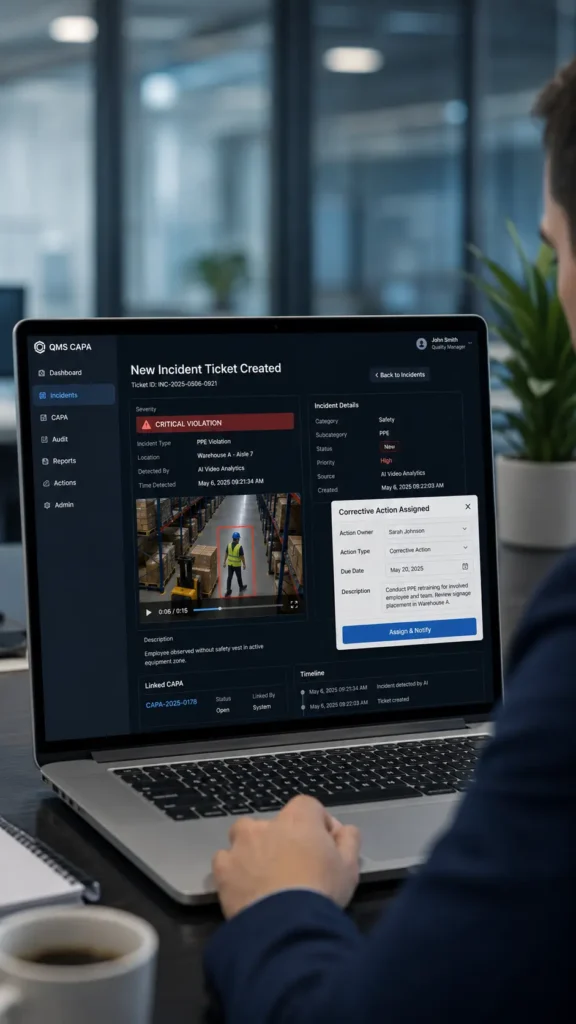
AI-driven CAPA ticketing systems use intelligent technologies to automatically identify predefined events, generate incident records, and initiate corrective action workflows. When integrated with video analytics and monitoring platforms, these systems can create tickets based on operational events rather than waiting for manual reporting.
This approach helps organizations accelerate issue detection, improve documentation quality, and strengthen accountability throughout the CAPA process.
As businesses seek to improve operational responsiveness, many are evaluating how automated ticketing systems compare with conventional reporting methods.
Compare Traditional Incident Reporting vs AI-Driven CAPA Ticketing Systems
Feature | Traditional Incident Reporting | AI-Driven CAPA Ticketing Systems |
Incident Identification | Manual observation | Automated event detection |
Reporting Process | Employee or supervisor initiated | System-generated tickets |
Response Time | Often delayed | Faster initiation |
Documentation Quality | Varies by individual | Consistent event records |
Escalation Process | Manual workflow | Automated workflow triggers |
Investigation Support | Written reports | Event-linked evidence |
Tracking Capability | Manual follow-up | Centralized tracking |
Scalability | Resource dependent | Easily scalable |
The primary difference is that traditional reporting relies on people to identify and document incidents, while AI-driven systems can automatically trigger workflows when predefined conditions occur.
Compare How Corrective Actions Are Initiated
The effectiveness of a CAPA program often depends on how quickly issues are identified and escalated.
Traditional reporting processes typically involve:
- Incident observation
- Manual documentation
- Supervisor review
- Escalation approval
- Corrective action assignment
AI-driven CAPA ticketing systems can streamline this process by automatically creating incident records when operational events are detected.
Examples may include:
- Safety violations
- PPE non-compliance
- Restricted-area breaches
- Process deviations
- Operational anomalies
- Compliance-related events
Organizations frequently compare these approaches when seeking to reduce delays and improve corrective action responsiveness.
How CAPASai Supports Automated CAPA Workflows
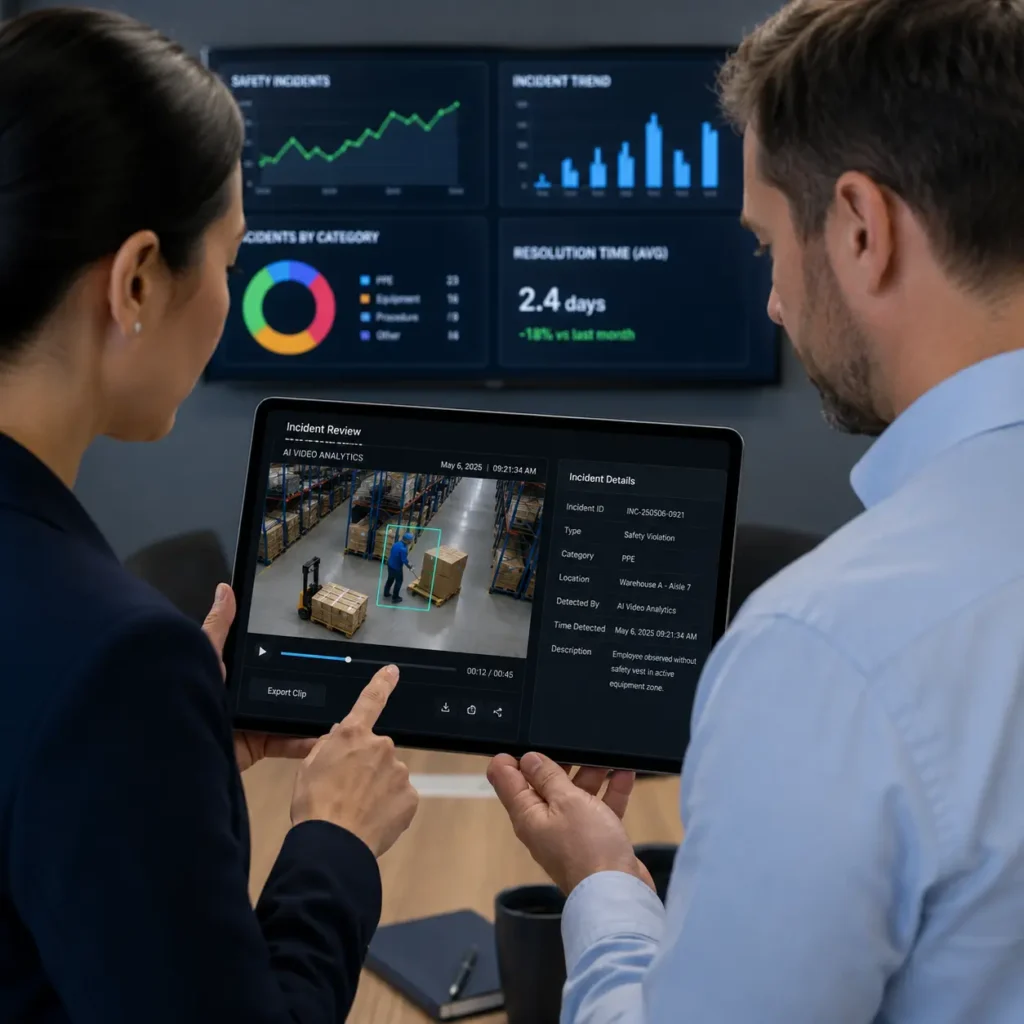
CAPASai combines AI-powered video analytics, remote monitoring, real-time alerts, and automated incident management capabilities to strengthen CAPA processes.
When predefined events are detected through CCTV monitoring, CAPASai can help initiate incident workflows, provide supporting evidence, and improve visibility into operational issues requiring corrective action.
Key capabilities include:
- Automated event detection
- Real-time alert generation
- CAPA ticket initiation support
- Video-supported investigations
- Compliance monitoring
- Operational visibility
- Multi-location oversight
- Centralized incident tracking
By connecting monitoring activities with corrective action processes, CAPASai helps organizations improve response times and strengthen operational accountability.
Modern Organizations Need Faster Incident Resolution
Many operational issues escalate because they are identified too late or insufficiently documented.
For example, a safety violation observed during a shift may not be formally reported until hours later. A process deviation may be noticed during an audit long after the event occurred. A compliance issue may remain unresolved because escalation procedures depend on manual communication.
AI-assisted incident management helps address these challenges by creating more immediate visibility into events and supporting faster action.
Organizations increasingly compare automated CAPA workflows with traditional reporting methods when seeking to improve operational efficiency and risk management.
Benefits of AI-Driven CAPA Ticketing
Organizations implementing intelligent incident management solutions may achieve:
- Faster incident reporting
- Improved documentation quality
- Reduced manual administration
- Enhanced corrective action tracking
- Better compliance visibility
- Improved accountability
- More efficient investigations
- Stronger operational governance
These benefits support a more proactive and structured approach to corrective and preventive action management.
Compare the Future of Incident Reporting and Automated CAPA Management
As organizations continue to prioritize operational excellence, compliance, and risk reduction, incident management processes are becoming more intelligent and data-driven. When incidents rely solely on manual reporting, traditional reporting techniques might cause delays and discrepancies, but they are still crucial for recording observations and capturing human insights. AI-driven CAPA ticketing systems help bridge this gap by automating event detection, accelerating workflow initiation, and improving visibility into operational issues. For organizations seeking faster corrective action and stronger governance, integrating intelligent monitoring with CAPA management can provide a significant advantage in building a more proactive operational culture