Managing Warehouse Operations Across Multiple Locations
State Warehousing Corporations (SWCs) operate warehouses that support the storage of agricultural produce, food grains, fertilizers, seeds, industrial materials, and other essential commodities. With facilities spread across different districts, maintaining consistent operating standards becomes a significant challenge. Warehouse managers must ensure that loading operations, inventory movement, worker safety, and vehicle management follow established Standard Operating Procedures (SOPs) every day.
Traditional supervision relies on manual inspections and CCTV monitoring, which often detect issues only after they have occurred. AI-based SOP analytics and video analytics provide a proactive approach by continuously monitoring warehouse activities and identifying operational deviations in real time.
Why Conventional Warehouse Monitoring Falls Short
As warehouse operations expand, supervisors face several operational challenges that can affect productivity and compliance.
Some common limitations include:
- Limited visibility across multiple warehouse locations
- Manual verification of SOP compliance
- Delayed reporting of safety incidents
- Difficulty monitoring loading docks throughout the day
- Human errors during routine inspections
- Time-consuming review of surveillance footage
These challenges make it difficult to maintain consistent operational standards across an entire warehouse network.
How AI-Based SOP Analytics Works in Warehouses
AI-based SOP analytics combines intelligent video analytics with predefined warehouse rules. Instead of simply recording activities, the system continuously analyzes live video feeds to determine whether warehouse operations comply with approved procedures.
Warehouse Activity | AI Detection | Automated Response |
Vehicle Entry | Authorized vehicle verification | Entry record generated |
PPE Compliance | Missing helmet or safety vest | Instant supervisor alert |
Forklift Operations | Unsafe speed or route deviation | Safety notification |
Loading Dock | Incorrect loading sequence | SOP compliance alert |
Restricted Areas | Unauthorized personnel detection | Immediate security alert |
This automated monitoring enables supervisors to respond quickly while improving operational consistency.
Where AI Video Analytics Delivers the Most Value
Receiving and Vehicle Verification
AI verifies that incoming vehicles follow designated entry routes, stop at inspection points, and reach the correct unloading dock. This minimizes congestion and improves traffic management inside warehouse premises.
Loading and Dispatch Operations
The system monitors dock utilization, vehicle positioning, and loading activities to ensure goods are handled according to approved SOPs. Any deviation generates an immediate notification for warehouse supervisors.
Inventory Handling
AI tracks pallet movement, material handling practices, and forklift operations to ensure goods are transported safely throughout the warehouse.
Worker Safety Monitoring
Video analytics continuously checks PPE compliance, identifies unauthorized access to restricted zones, detects blocked emergency exits, and highlights unsafe employee behavior before incidents occur.
Equipment Movement
Forklift routes, idle equipment, and high-traffic areas are analyzed to improve operational efficiency and reduce workplace risks.
A Typical AI-Monitored Warehouse Scenario
Consider a fertilizer delivery arriving at a State Warehousing Corporation facility.
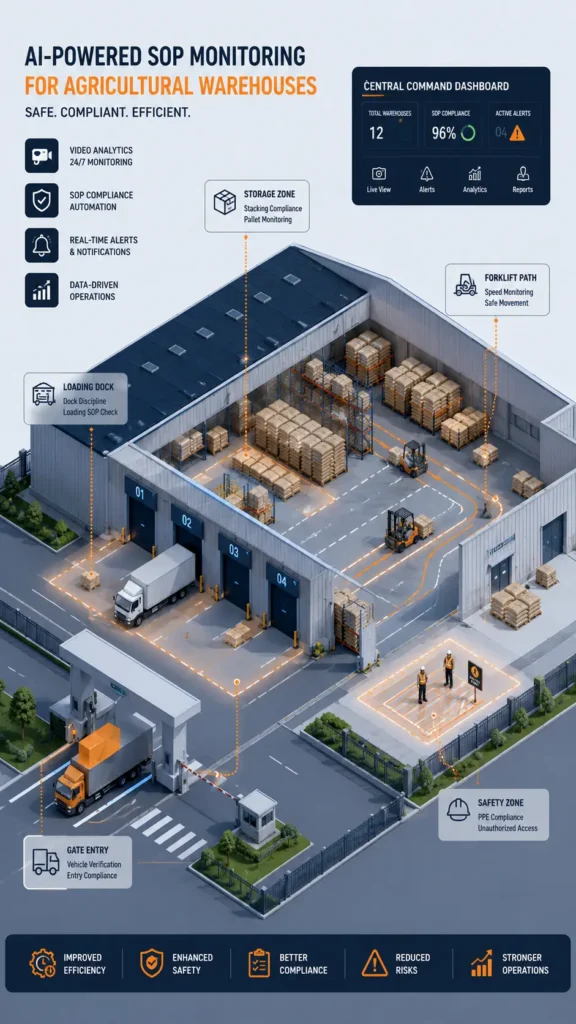
As the truck enters the premises, AI verifies vehicle authorization and records arrival time. The system confirms that the vehicle reaches the assigned loading dock while monitoring dock occupancy.
Before unloading begins, video analytics checks whether warehouse personnel are wearing helmets, reflective jackets, and other required safety equipment. During unloading, forklift movement is tracked to ensure safe operating speeds and designated travel paths are maintained.
If an emergency exit becomes blocked or an unauthorized person enters a restricted storage area, the system immediately alerts the warehouse supervisor. Corrective action can be taken before warehouse operations are affected.
This continuous monitoring helps maintain operational discipline without interrupting daily workflows.
Business Benefits for State Warehousing Corporations
Improved Operational Efficiency
Automated monitoring reduces manual inspections and provides supervisors with real-time operational visibility.
Better Safety Compliance
Continuous PPE monitoring and hazard detection help create a safer working environment.
Enhanced Asset Protection
AI detects unauthorized movement around storage areas, loading docks, and restricted zones, helping protect valuable inventory.
Centralized Multi-Warehouse Visibility
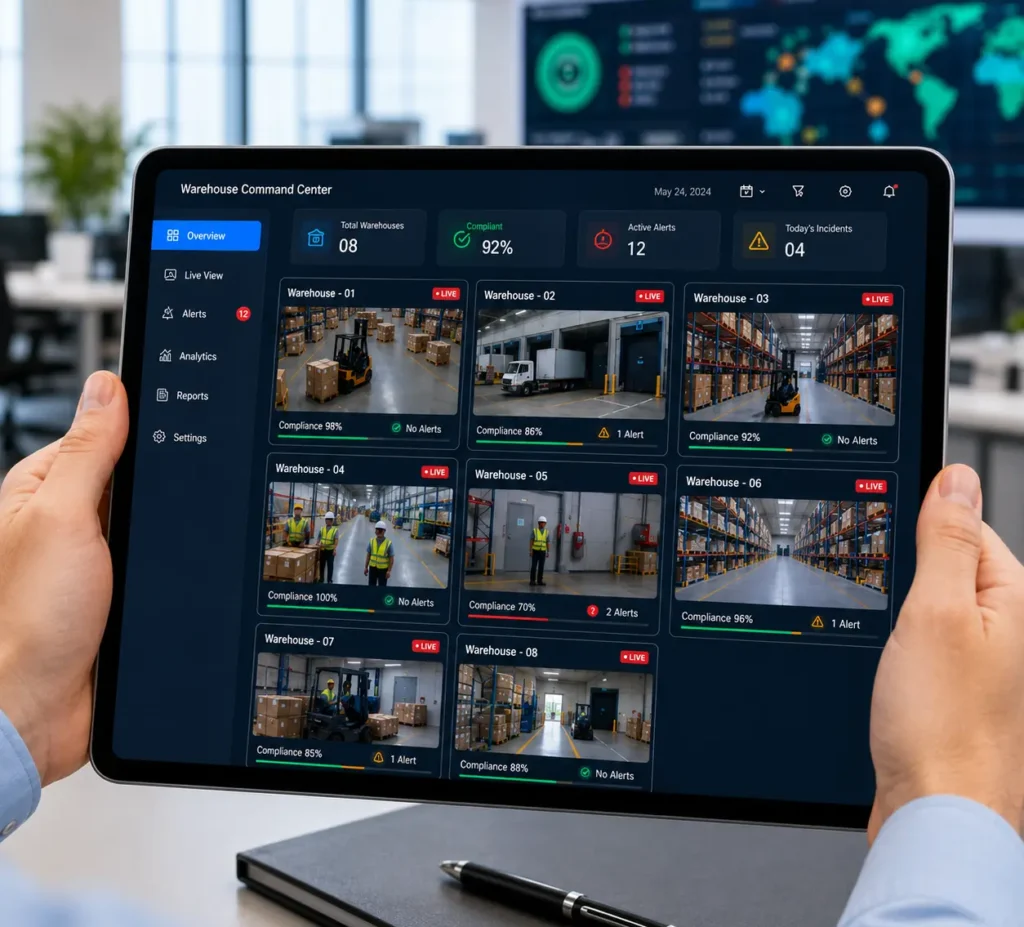
Managers can monitor multiple warehouse locations through a unified dashboard, improving coordination across the network.
Easier Compliance Reporting
Automated reports simplify operational reviews, internal audits, and performance assessments by providing accurate compliance records.
Key AI Capabilities
Capability | Operational Benefit |
SOP Monitoring | Consistent warehouse operations |
Video Analytics | Real-time activity monitoring |
PPE Detection | Improved worker safety |
Vehicle Monitoring | Better dock management |
Forklift Analytics | Safer material movement |
Central Dashboard | Multi-location operational visibility |
Frequently Asked Questions
Yes. AI continuously analyzes live video feeds and provides real-time alerts whenever predefined SOPs or safety rules are violated.
It verifies vehicle positioning, loading sequences, dock utilization, and worker compliance, helping reduce delays and operational errors.
Yes. AI analytics can detect congestion at loading docks, excessive vehicle waiting times, and inefficient forklift movement to support process improvements.
Yes. Centralized dashboards allow supervisors to monitor multiple warehouses simultaneously, making the solution suitable for distributed warehouse operations.
AI platforms can generate reports on SOP compliance, PPE violations, vehicle movement, loading efficiency, safety incidents, equipment utilization, and operational trends.