Rashtriya Ispat Nigam Limited (RINL), the corporate entity of Visakhapatnam Steel Plant, operates a large integrated steel manufacturing complex where safety, process discipline, equipment reliability, and production continuity are closely connected. As the plant continues its operational recovery and digital development, AI-based SOP analytics and video analytics can provide an additional layer of real-time visibility across critical areas.
RINL is already strengthening its IT infrastructure and digital systems. The Ministry of Steel’s 2025–26 Annual Report records continued development of IT infrastructure and applications at RINL, while the company’s official website highlights certifications including ISO 45001 for occupational health and safety and ISO/IEC 27001 for information security
Why AI-Based SOP Analytics Matters For RINL
Standard Operating Procedures (SOPs) define how employees and contractors should perform critical activities. In an integrated steel plant, even a small deviation from an established procedure can create safety or production risks.
AI-based SOP analytics can help RINL move from periodic compliance checks toward continuous monitoring of selected procedures. Instead of relying exclusively on manual observation, AI can analyse video, access information, sensor readings, and process data to identify predefined deviations.
Potential applications include:
- PPE compliance in designated work zones
- Restricted-area access monitoring
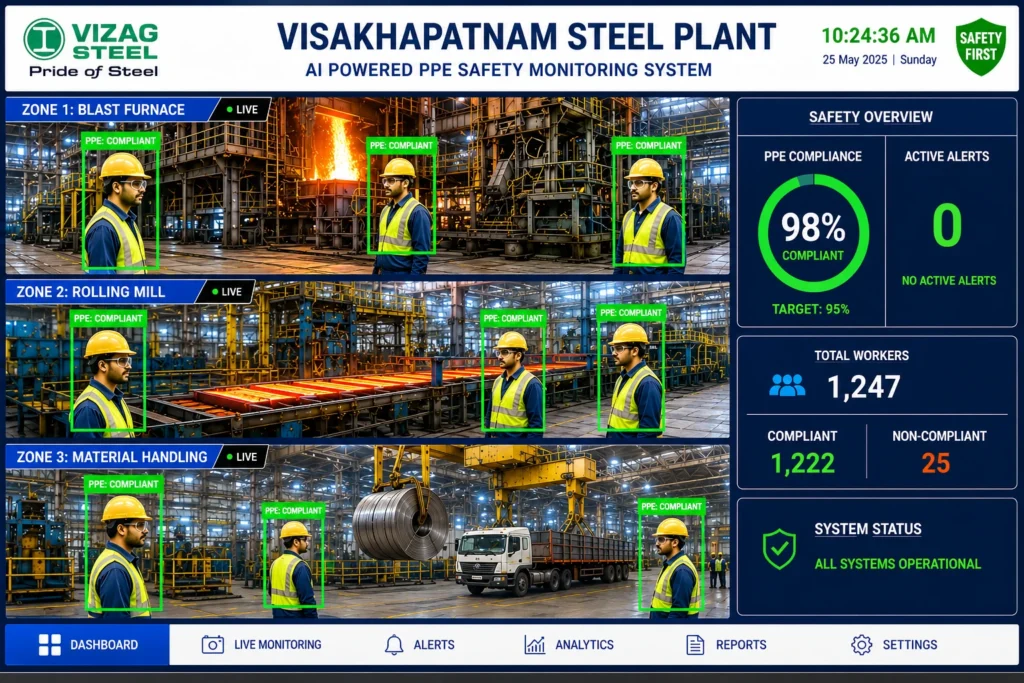
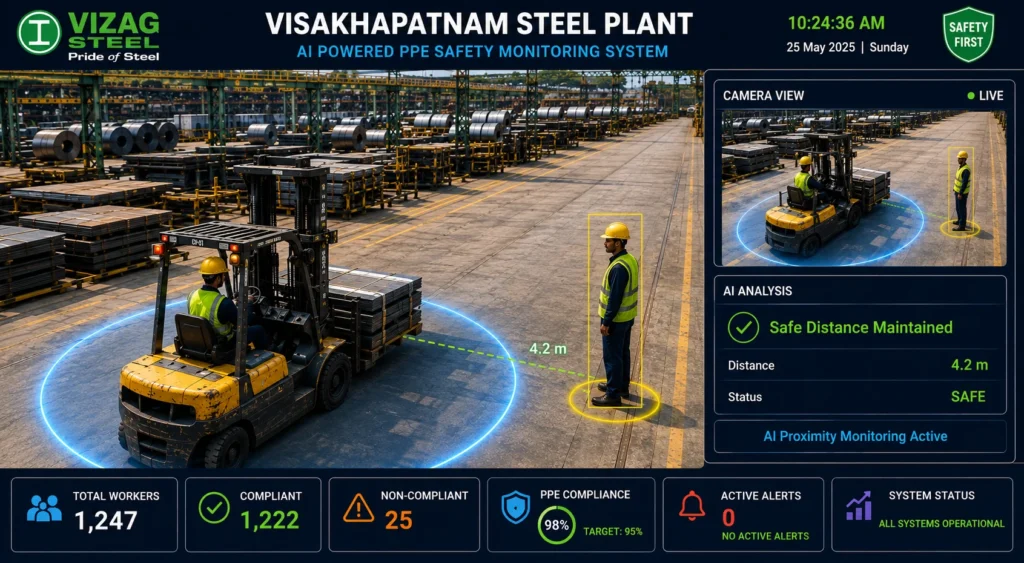
- Safe-distance compliance around mobile equipment
- Verification of selected operating sequences
- Detection of unsafe worker-equipment interactions
- Monitoring of housekeeping and obstruction conditions
- Time-stamped documentation of SOP deviations
Key AI Video Analytics Use Cases
Use Case | Analytics Capability | Potential Value |
PPE Detection | Identify helmets, vests and other required PPE | Faster safety intervention |
Restricted Zones | Detect unauthorised entry | Reduce exposure to hazardous areas |
Worker-Equipment Proximity | Analyse distance and movement | Early warning of collision risks |
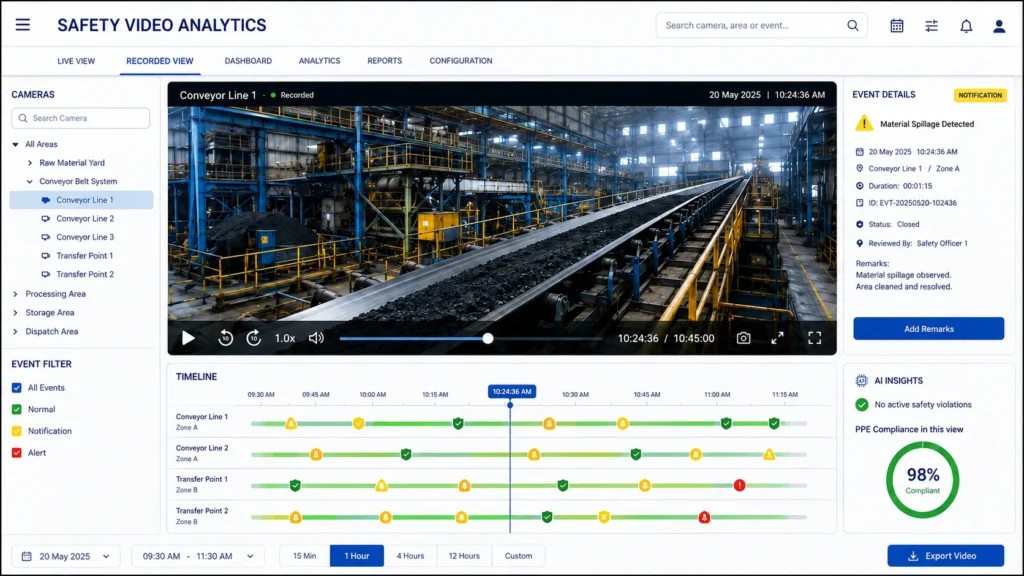
Conveyor Monitoring | Detect people or unusual conditions | Improve operational safety |
Process Observation | Identify visual abnormalities | Faster response to deviations |
Equipment Monitoring | Detect unusual movement or visible conditions | Support maintenance teams |
Incident Analysis | Search recorded footage using events | Faster investigation |
Role Of Video Analytics At Visakhapatnam Steel Plant
Video analytics converts conventional CCTV infrastructure into a source of operational information. Computer vision models can analyse live feeds to identify people, vehicles, equipment, objects, movement patterns, and predefined events.
For RINL, this capability could be particularly useful in areas such as steel melting shops, blast furnaces, rolling mills, material-handling zones, conveyor systems, warehouses, gates, and other high-risk locations.
The timing is especially relevant because a serious accident occurred at Steel Melt Shop-1 on June 8, 2026, resulting in eight fatalities and injuries to six people. The accident is under investigation, including by an external committee. This does not establish that video analytics would have prevented that incident, but it illustrates why continuous monitoring of hazardous operations and SOP adherence can be an important component of a broader safety strategy.
Supporting Safety And Operational Reliability
RINL’s operational priorities include improving production reliability and capacity utilisation. Recent reporting indicates that the plant’s utilisation and production performance improved significantly during 2025–26 as all three blast furnaces returned to operation. In this environment, maintaining safe and stable operations becomes particularly important.
AI-based monitoring can support this objective by providing early alerts rather than waiting for an incident, breakdown, or manual inspection to reveal a problem.
Possible benefits include:
- Faster identification of safety violations
- Improved SOP compliance
- Reduced manual CCTV monitoring
- Better incident investigation
- Improved visibility across large plant areas
- Earlier identification of selected process abnormalities
- Better documentation for safety reviews
Implementation Approach For RINL
A phased implementation would allow RINL to evaluate the technology against measurable operational requirements.
Start With High-Risk Use Cases
The first phase should focus on areas where safety exposure or operational losses are significant. PPE compliance, restricted-zone monitoring, worker-equipment proximity, and critical process observations are suitable candidates.
Integrate Human Review
Every important alert should have a defined response workflow. Safety officers, supervisors, and operations teams should be able to validate alerts and record corrective actions.
Build For Industrial Conditions
Steel plants present difficult conditions for computer vision, including heat, dust, smoke, glare, vibration, changing illumination, and obstructed camera views. Camera positioning, edge computing, network reliability, cybersecurity, and model validation therefore require careful planning.
Measure Business Outcomes
RINL can evaluate deployments using indicators such as safety-alert response time, SOP deviation frequency, false-alert rates, downtime, incident investigation time, and equipment-related interruptions.
Connecting Video Analytics With Plant Data
Video analytics becomes more useful when combined with information from existing industrial systems. RINL can potentially integrate camera events with PLC, SCADA, sensor, access-control, maintenance, and incident-management data.
For example, an abnormal visual condition around equipment could be evaluated alongside temperature, vibration, pressure, or operating-state information. Combining these signals can improve alert quality and help distinguish normal process variation from conditions requiring attention.
Frequently Asked Questions
It is an AI-enabled system that analyses operational information to identify whether selected safety or operating procedures are being followed and alerts personnel when predefined deviations occur.
It can continuously analyse camera feeds for conditions such as missing PPE, restricted-area entry, unsafe proximity, and other predefined risks, helping teams respond faster.
Potentially, yes. Suitability depends on camera resolution, positioning, lighting, network capacity, retention requirements, and the specific AI model being deployed. Some locations may require upgraded cameras.
Yes. Computer vision can identify selected visual abnormalities and, when combined with sensor data, can provide additional information for maintenance and operational teams.
No. AI is better viewed as a monitoring and decision-support layer. Human supervisors and safety professionals should remain responsible for validation, intervention, investigation, and corrective action.