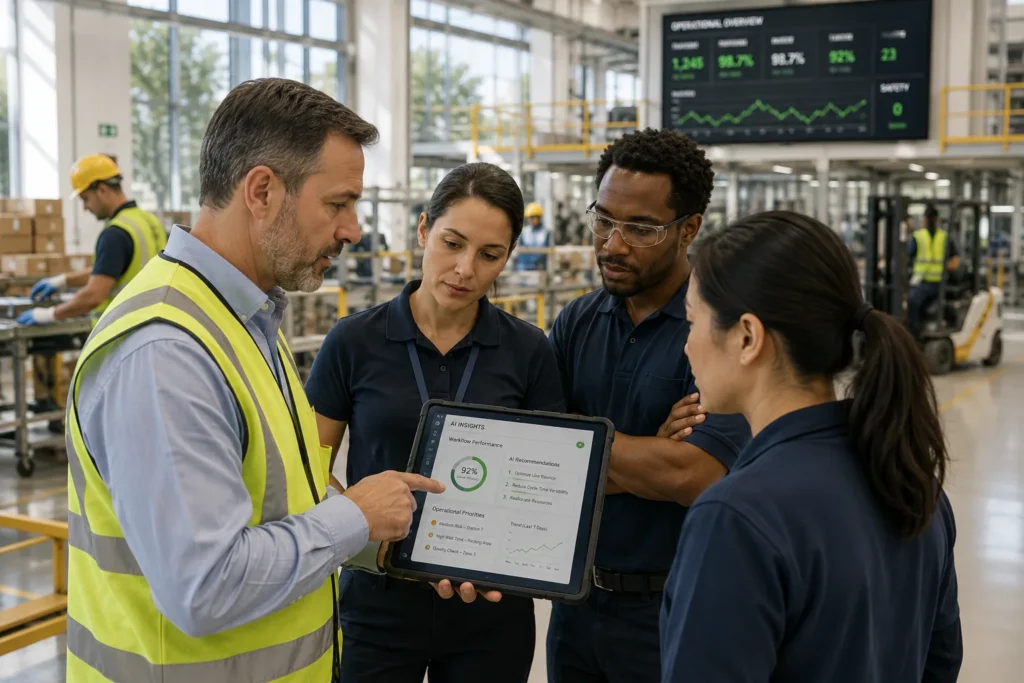
Every organization depends on a workforce to keep operations running. Employees manage workflows, monitor activities, respond to exceptions, verify compliance, and support decision-making across countless business processes. As organizations grow, however, the volume of operational information often increases faster than the ability of people to manage it effectively.
Leaders today face a common challenge: how to maintain visibility, consistency, and responsiveness across increasingly complex operations without continuously adding layers of manual supervision.
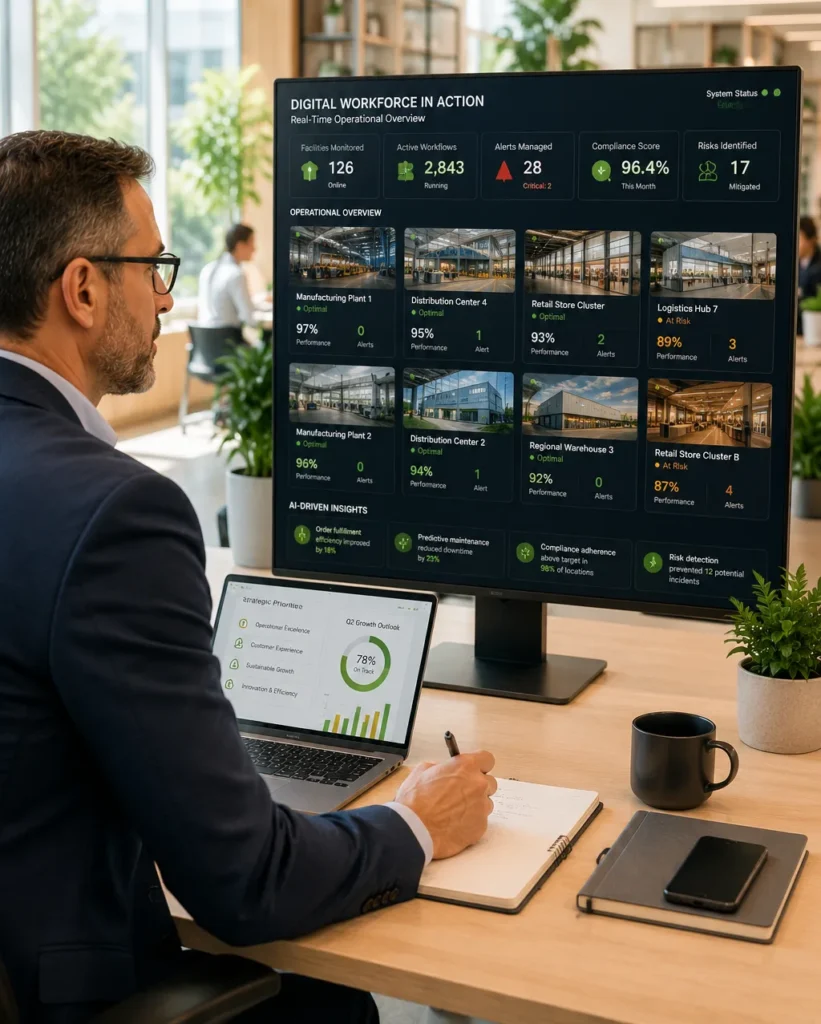
This challenge is driving interest in a new concept—the digital workforce.Unlike traditional automation tools that focus on executing specific tasks, AI is increasingly functioning as a digital workforce capable of observing operations, analyzing information, identifying risks, and supporting human teams with real-time intelligence. Rather than replacing employees, AI is becoming a scalable operational partner that extends organizational capabilities.
Why Traditional Workforce Models Face New Pressures
Modern organizations operate in environments that generate enormous amounts of operational data.
Common challenges include:
- Multi-site operations
- Workforce shortages
- Increasing compliance requirements
- Operational complexity
- Rising customer expectations
- Continuous performance monitoring needs
Many organizations struggle to maintain visibility across facilities, processes, and teams using traditional management approaches alone.
As a result, operational leaders are looking for ways to augment human capabilities without increasing complexity.
What Is A Digital Workforce?
A digital workforce refers to AI-driven systems that continuously perform observation, analysis, monitoring, and decision-support functions across an organization.
Unlike human employees, digital workers can operate continuously, process large volumes of information simultaneously, and identify patterns that might otherwise go unnoticed.
Key capabilities include:
Continuous Monitoring
AI systems can observe operational environments without interruption.
Intelligent Analysis
Large amounts of operational information can be processed in real time.
Risk Identification
Potential issues can be detected before they become larger operational problems.
Decision Support
Actionable recommendations can be delivered to managers and operational teams.
These capabilities help organizations improve responsiveness while reducing dependence on manual oversight.
Compare Traditional Supervision And AI-Powered Digital Workforces
Operational Function | Traditional Approach | AI-Powered Digital Workforce |
Monitoring | Periodic Observation | Continuous Awareness |
Data Analysis | Manual Review | Real-Time Intelligence |
Issue Detection | Reactive Identification | Early Detection |
Operational Coverage | Limited By Resources | Scalable Across Locations |
Decision Support | Historical Reports | Immediate Insights |
Organizations increasingly compare these approaches as they modernize operational management strategies.
How AI Functions As A Digital Workforce
The role of AI extends beyond automation.
Operational Visibility
AI continuously analyzes operational activities and provides real-time awareness of conditions across facilities.
Compliance Monitoring
Organizations gain ongoing visibility into procedural adherence and operational governance.
Workflow Optimization
AI helps identify inefficiencies, bottlenecks, and improvement opportunities.
Performance Intelligence
Leaders gain access to measurable operational insights that support faster decision-making.
This allows employees to focus on higher-value responsibilities while AI manages information-intensive tasks.
Human Expertise Remains Essential
One of the biggest misconceptions about digital workforces is that they eliminate the need for people.
In reality, AI and human employees perform different functions.
AI excels at:
- Processing information
- Monitoring activities
- Detecting patterns
- Generating alerts
- Providing recommendations
Humans remain responsible for:
- Strategic decisions
- Leadership
- Problem-solving
- Creativity
- Relationship management
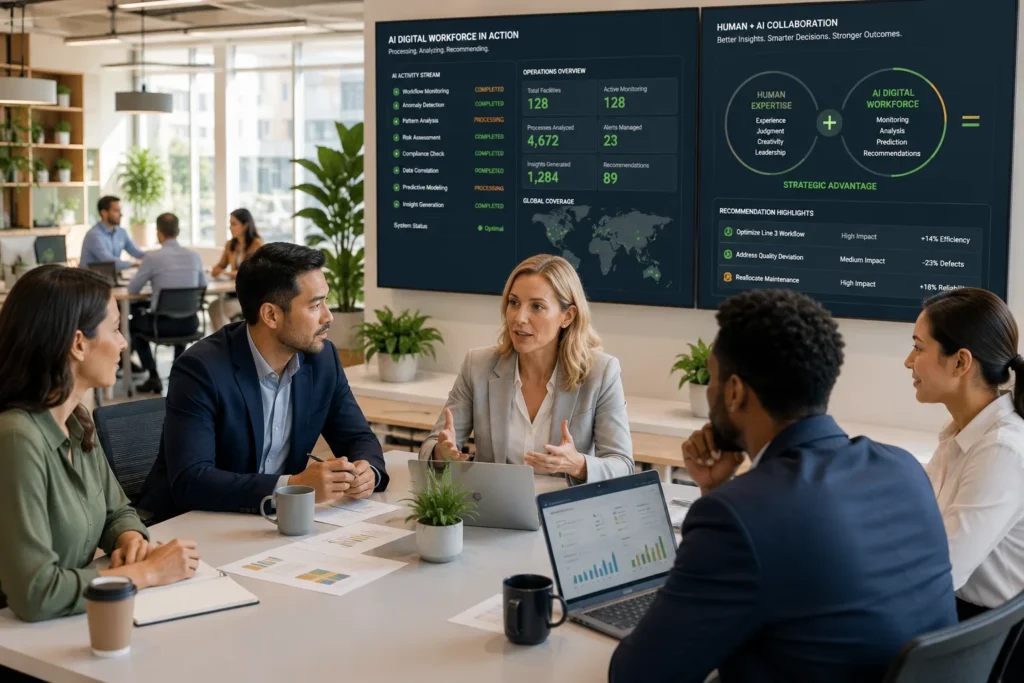
The most effective organizations combine both capabilities rather than viewing them as alternatives.
The Strategic Value Of AI-Powered Workforces
As organizations become larger and more distributed, maintaining operational visibility becomes increasingly difficult. AI provides a scalable solution by functioning as a digital workforce that continuously supports monitoring, analysis, and decision-making activities.
The result is not fewer people, but better-equipped teams. Employees gain access to timely intelligence, leaders gain greater operational awareness, and organizations become more resilient in the face of change.
For many enterprises, the future of work will not be defined by humans versus AI. It will be defined by how effectively human expertise and digital workforces operate together.
Industry Applications Of Digital Workforce Models
AI-powered digital workforce concepts are being adopted across multiple industries.
Manufacturing
Improving process visibility, quality monitoring, and operational oversight.
Retail
Supporting store operations, compliance management, and customer experience initiatives.
Logistics
Enhancing workflow monitoring and operational coordination.
Healthcare
Improving operational consistency and resource management.
Banking And Financial Services
Strengthening governance, compliance oversight, and operational visibility.
Across industries, the objective remains the same: increase operational capacity without proportionally increasing manual effort.
How CAPASai Supports Digital Workforce Initiatives
CAPASai helps organizations build digital workforce capabilities through AI-powered video analytics, remote monitoring, real-time alerts, and operational intelligence. By continuously transforming visual information into actionable insights, CAPASai supports compliance oversight, operational visibility, workflow monitoring, and faster decision-making across distributed environments.