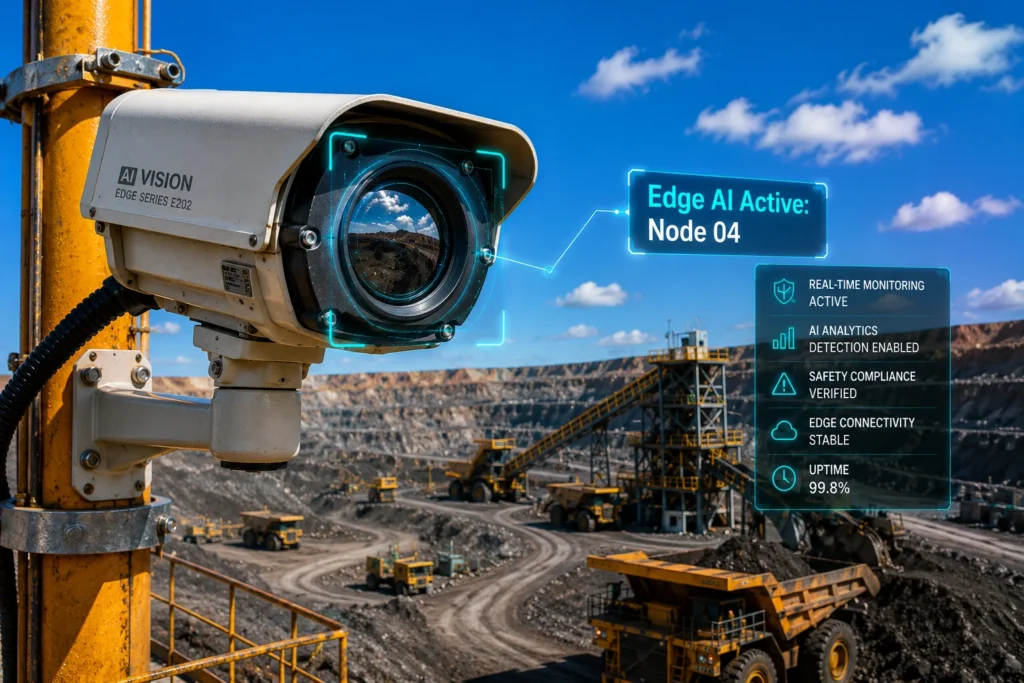
Singareni Collieries Company Limited (SCCL) already has a significant digital monitoring foundation across its mining operations. The company uses vehicle tracking systems, RFID and GPS-enabled monitoring, CCTV at important locations, and an Operator Independent Truck Dispatch System. The Ministry of Coal has also documented SCCL’s use of these technologies for monitoring coal movement and operations.
The next opportunity is to make this infrastructure more intelligent. AI-based SOP analytics and video analytics can help SCCL move from simply observing operations to identifying safety deviations, abnormal situations, and recurring patterns in real time.
Turning Existing Surveillance Into Safety Intelligence
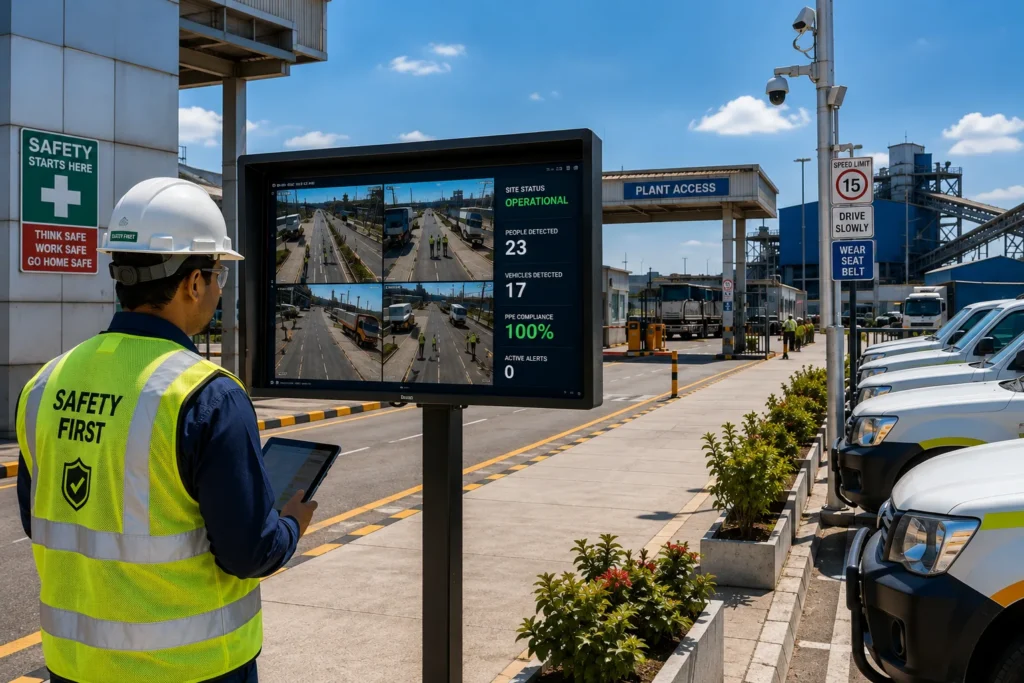
SCCL operates in an environment where workers, heavy vehicles, mining machinery, conveyors, loading systems, and other equipment interact continuously. Manual supervision remains essential, but it is difficult for teams to observe every activity across extensive mining areas.
AI-powered video analytics can act as a continuous observation layer. Instead of requiring operators to watch numerous camera feeds, computer vision can identify predefined events and send alerts when attention is required.
This can be particularly useful for:
- PPE compliance
- Restricted-area entry
- Worker and vehicle proximity
- Unsafe movement around heavy machinery
- Vehicle access and route deviations
- Obstructions in monitored areas
- Unusual activity around critical infrastructure
How SOP Analytics Can Strengthen Compliance
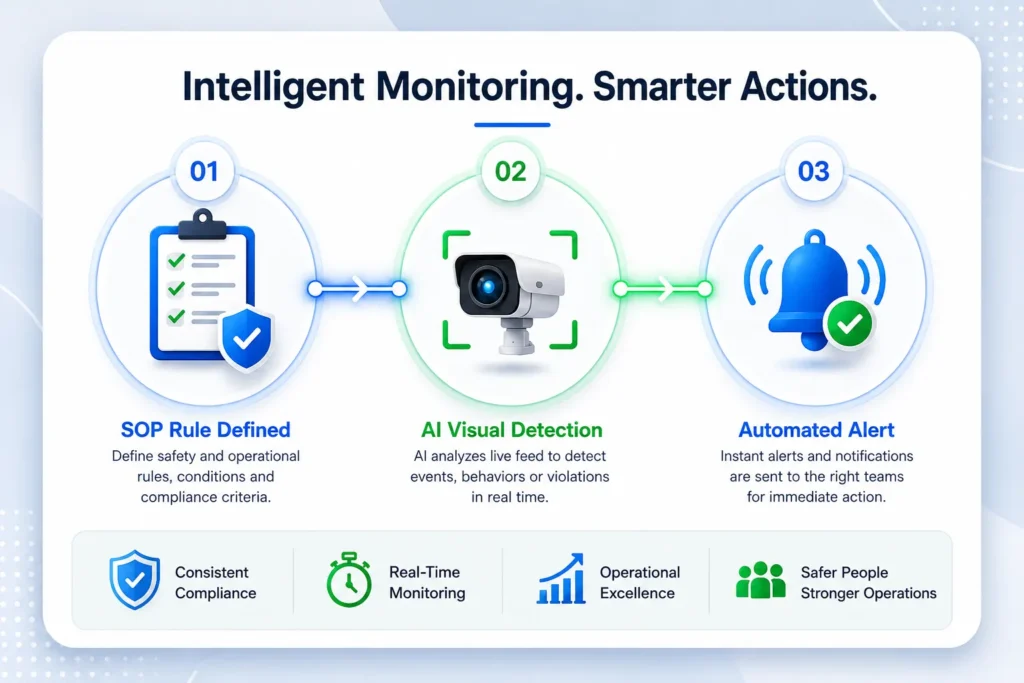
Standard Operating Procedures translate safety policies into specific actions. AI-based SOP analytics can help verify selected actions through visual and operational data.
The objective is not to judge every employee’s behaviour automatically. Instead, the system should focus on clearly defined, measurable conditions where an alert can help prevent escalation.
Examples Of SOP Monitoring
Operational Requirement | AI-Based Observation | Possible Action |
Mandatory PPE | Detect required protective equipment | Alert supervisor |
Restricted access | Identify unauthorised entry | Notify control room |
Equipment exclusion zone | Detect person or vehicle inside zone | Immediate intervention |
Vehicle movement | Identify route or zone deviation | Escalate warning |
Loading-area safety | Monitor people and vehicle positioning | Review unsafe events |
Housekeeping | Detect selected obstructions | Create inspection request |
Where Video Analytics Can Make The Biggest Difference
Mine And Haulage Areas
AI cameras can monitor haul roads, loading points and vehicle movement for predefined safety conditions. Since SCCL already uses GPS and RFID-based vehicle tracking, video events could eventually be correlated with location and vehicle information to provide greater context.
Coal Handling Facilities
Conveyors, transfer points, loading areas and other coal-handling locations can benefit from continuous monitoring. Analytics can identify people in restricted zones, visible obstructions, or unusual activity that warrants inspection.
Workshops And Maintenance Locations
Computer vision can support selected permit-to-work and exclusion-zone requirements by monitoring access, PPE, worker-equipment interaction and other observable conditions.
Power And Supporting Infrastructure
SCCL has also sought AI-based video analytics as part of surveillance requirements at its STPP facility, including coverage of entry and exit gates, truck parking and loading points, junctions and vulnerable perimeter locations. The EoI specified AI-based video analytics and alert generation.
Creating A Connected Monitoring Workflow
The strongest implementation would connect AI alerts with SCCL’s existing digital systems rather than creating another isolated monitoring platform.
This model is important because an AI detection is not automatically an incident. Human review can determine whether an alert represents a genuine safety concern, while the recorded event can become part of the organisation’s safety analytics.
Using Analytics To Identify Recurring Risks
One of the most valuable capabilities is not the individual alert but the pattern behind multiple alerts.
Suppose AI identifies repeated restricted-zone entries at the same location. SCCL could analyse whether the cause is inadequate signage, poor camera visibility, workflow design, equipment positioning, insufficient training, or another factor.
This creates a continuous improvement cycle:
- Detect a deviation.
- Record its location, time and type.
- Analyse recurring patterns.
- Identify the underlying cause.
- Implement corrective action.
Measure whether the deviation decreases
A Practical Roadmap For SCCL
The first stage should identify critical SOPs and locations where visual monitoring can produce measurable results. The pilot should then be tested under actual mining conditions, including dust, rain, low light, glare and changing camera views.
After validation, the system can be integrated with control rooms and operational dashboards. Model accuracy, false-alert rates and response times should be monitored continuously.
The technology should also be designed with appropriate cybersecurity, access controls, data retention policies and human oversight, particularly because surveillance systems may process information about employees, contractors and visitors.
Measuring The Operational Value
A successful AI analytics programme should be measured through outcomes rather than the number of cameras or alerts generated.
Useful KPIs for SCCL could include:
- Reduction in repeated SOP deviations
- Safety-alert response time
- False-positive rate
- Restricted-zone violation frequency
- Incident investigation time
- Corrective-action closure time
- Manual surveillance workload
- Number of potential hazards identified before escalation
Frequently Asked Questions
It is an AI system that compares observable activities and operational data against predefined safety or operating procedures to identify potential deviations.
Conventional CCTV primarily records and displays footage. Video analytics can automatically interpret selected events and generate alerts when predefined conditions occur
Yes. Combining video events with GPS, RFID and vehicle-tracking information can provide additional context for analysing movement, access and safety-related events. SCCL already uses these technologies for coal-transport monitoring
Potential applications include mine loading points, haul roads, coal-handling facilities, workshops, access gates, vehicle parking areas, critical infrastructure and other locations where visual safety conditions can be clearly defined
No. AI should support human safety teams by identifying and prioritising events. Supervisors and safety professionals should validate important alerts, determine corrective actions and oversee the overall safety process.