Steel manufacturing combines high temperatures, heavy machinery, complex processes, and strict safety requirements. For the Steel Authority of India Limited (SAIL), maintaining operational discipline across large integrated plants requires more than periodic inspections and manual reporting. AI-based SOP analytics and video analytics can assist in transforming operational data and current camera infrastructure into ongoing, useful insights.
SAIL is already expanding its digital capabilities. In March 2025, the company announced a comprehensive digital transformation programme covering its value chain from mines to marketing, with AI, cloud computing, and data analytics identified as key technologies. SAIL has also specifically invited startups with expertise in machine vision/video analytics, AI/ML, safety and surveillance, asset monitoring, and related Industry 4.0 technologies.
Why AI-Based SOP Analytics Matters For SAIL
Standard Operating Procedures (SOPs) are essential for ensuring that employees and contractors follow defined methods for operating equipment, entering restricted areas, using personal protective equipment (PPE), and responding to hazardous situations.
Traditional SOP monitoring often depends on supervisors, audits, checklists, and incident investigations. These methods remain important, but they may not continuously capture deviations occurring across a large plant.
Potential applications include:
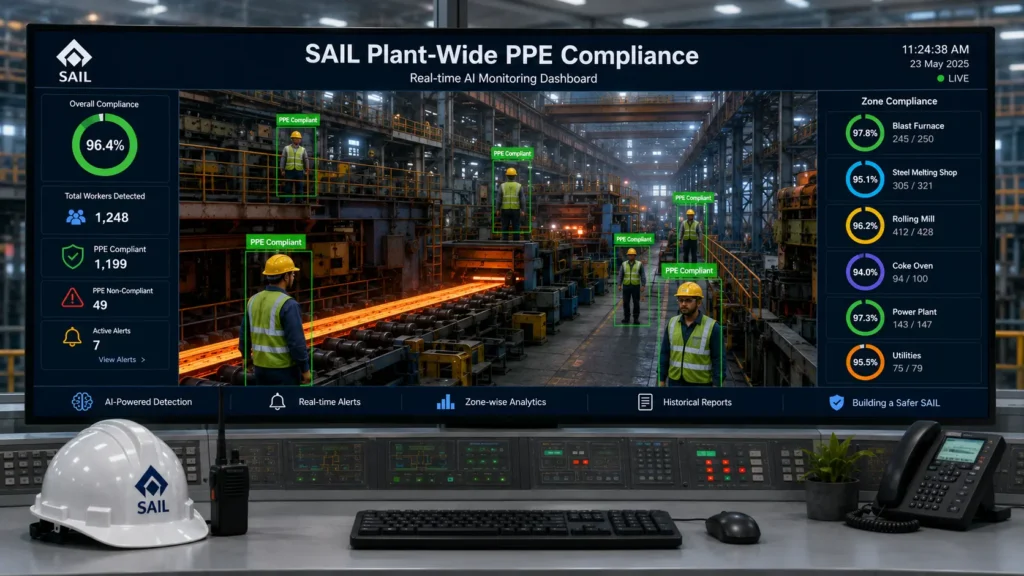
- Detecting whether required PPE is being worn in designated zones.
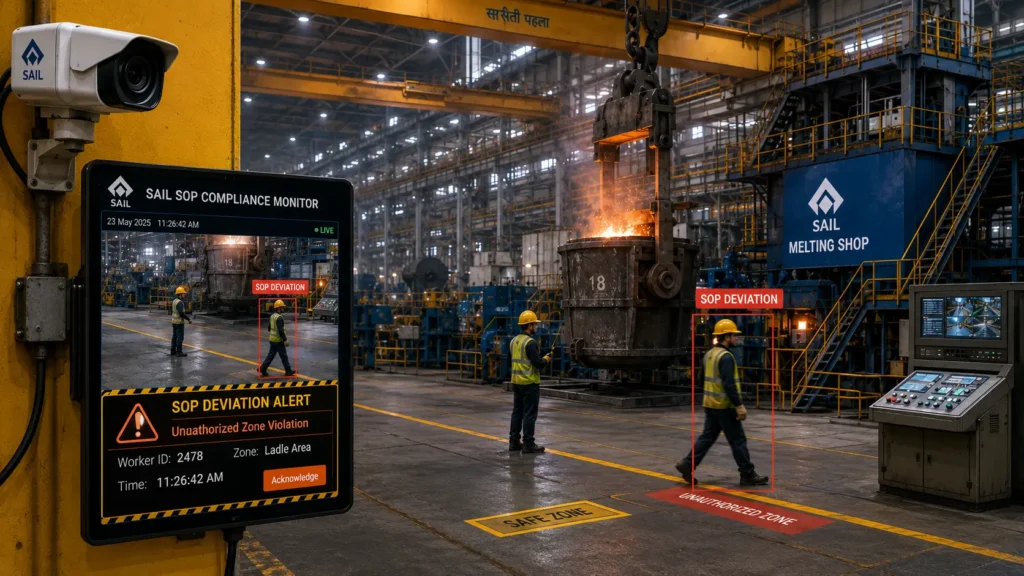
- Identifying entry into restricted or hazardous areas.
- Monitoring compliance with prescribed movement or access procedures.
- Detecting unsafe proximity to moving equipment.
- Identifying deviations from defined operational sequences.
- Generating alerts when a predefined safety condition is breached.
- Producing time-stamped proof for inquiries and remedial measures.
Key Use Cases For SAIL
Application | AI Analytics Capability | Potential Value |
PPE Compliance | Detect helmets, safety shoes, vests and other PPE | Faster safety intervention |
Restricted-Zone Monitoring | Detect unauthorised presence | Reduced exposure to hazards |
Vehicle-Pedestrian Safety | Analyse proximity and movement | Early warning of collision risks |
SOP Deviation Detection | Compare observed actions with defined rules | Better procedural compliance |
Process Monitoring | Detect visual abnormalities | Faster operational response |
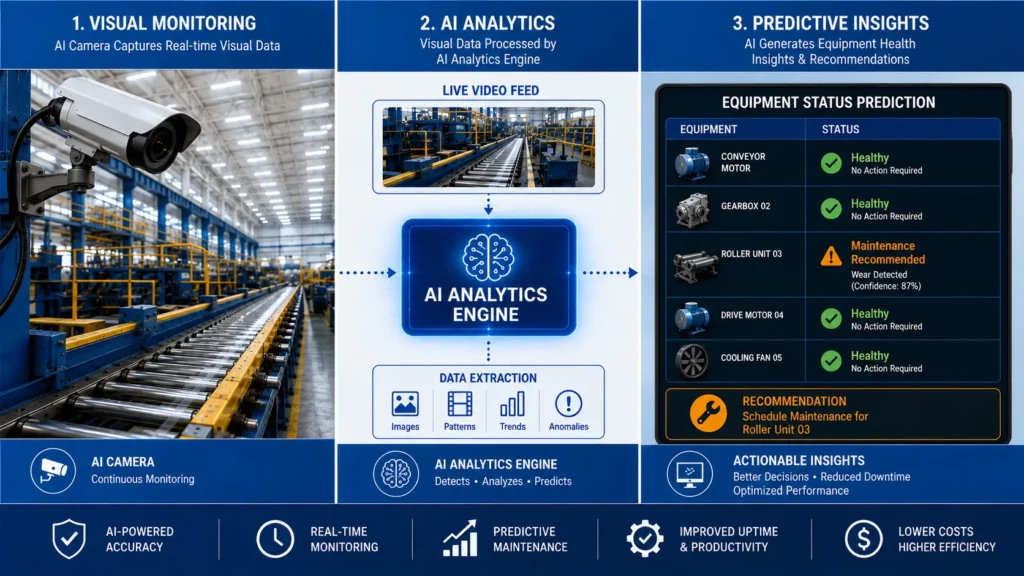
Equipment Observation | Identify unusual visual conditions | Support predictive maintenance |
Incident Investigation | Search and analyse recorded footage | Faster root-cause analysis |
Role Of Video Analytics In Steel Plants
Video analytics uses computer vision models to interpret live or recorded camera feeds. Instead of treating CCTV systems only as surveillance tools, SAIL can use them as sources of operational and safety intelligence.
A practical video analytics architecture could analyse cameras installed around blast furnaces, steel melting shops, rolling mills, material-handling areas, conveyor systems, gates, warehouses, and other high-risk locations.
For example, computer vision can identify people, vehicles, equipment, objects, movement patterns, and predefined unsafe conditions. When combined with plant rules, the system can generate alerts for situations requiring attention.
Implementation Considerations
For successful deployment, SAIL would need to address more than model accuracy. Camera placement, lighting, network availability, data quality, cybersecurity, system integration, and human response procedures are equally important.
A phased approach can reduce implementation risk:
- Identify high-risk areas and high-value SOPs.
- Establish measurable safety and operational KPIs.
- Pilot selected video analytics use cases.
- Validate alerts with plant safety and operations teams.
- Integrate validated alerts with existing workflows.
- Expand successful models across comparable plants and processes.
AI systems should also maintain audit trails so that alerts, responses, and outcomes can be reviewed. This is particularly important when analytics are used for safety compliance or operational investigations.
Integrating AI With Existing Plant Systems
The greatest value comes when video analytics is connected with existing industrial systems rather than operating as an isolated application.
Camera feeds can be combined with data from sensors, PLCs, SCADA systems, maintenance platforms, access-control systems, and incident-management applications. This creates a broader operational picture.
SAIL’s wider AI programme already includes process optimisation, predictive analytics, anomaly detection, and other digital applications. A 2025 Lok Sabha response from the Ministry of Steel identified SAIL among CPSEs using such AI-based technologies, with initial results indicating improvements in process stability, operational efficiency, cost optimisation, and safety.
Expected Benefits
A well-designed AI-based SOP and video analytics programme can help SAIL strengthen safety monitoring, improve operational discipline, reduce manual surveillance workload, and support faster response to abnormal conditions.
The business case can extend beyond safety. Better process visibility may contribute to reduced downtime, improved equipment utilisation, stronger quality control, and more consistent production practices.
SAIL’s current digital initiatives indicate that this direction is already relevant to its transformation agenda. The company’s recent work includes AI-based process optimisation and other Industry 4.0 applications, while its startup programme explicitly lists machine vision and video analytics among areas of interest.
Frequently Asked Questions
It is the use of AI to assess whether defined operating or safety procedures are being followed. It can combine video, sensor, access, and process data to identify deviations and generate alerts.
Video analytics can continuously monitor selected areas for conditions such as missing PPE, restricted-area entry, unsafe proximity, or unusual activity, allowing safety teams to respond more quickly.
Yes. SAIL's Rourkela Steel Plant provides a documented example where automated video analytics are used to detect slag carryover during BOF tapping.
No. The stronger model is human-AI collaboration. AI can monitor large volumes of visual information and highlight exceptions, while safety and operations professionals make decisions and take corrective action