
The Growing Need for Smarter Video Surveillance
Organizations across retail chains, manufacturing facilities, healthcare institutions, banking environments, logistics centers, educational campuses, and critical infrastructure sites depend on video surveillance to improve security, safety, compliance, and operational visibility. As businesses expand across multiple locations, the volume of video data generated every day continues to increase dramatically.
Traditional surveillance systems were designed primarily to record and store footage for later review. However, modern organizations increasingly require real-time visibility, faster incident response, and actionable insights rather than simply accumulating large amounts of video data.
As a result, many businesses are evaluating different surveillance architectures to determine which approach can best support their operational goals.
Common Challenges with Conventional Video Recording Systems
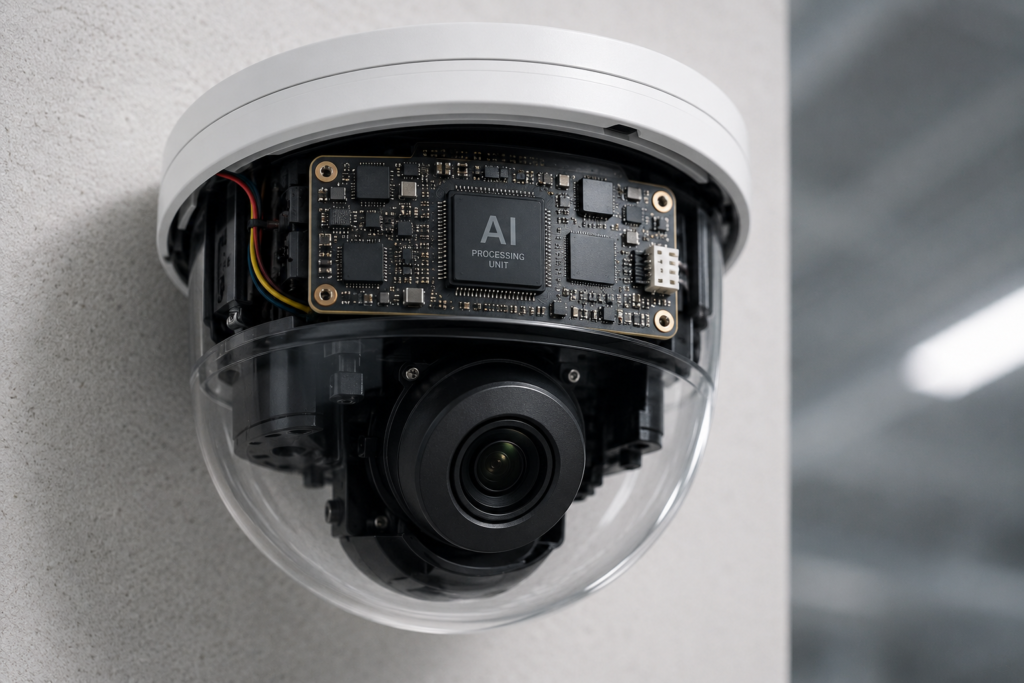
Many organizations still rely heavily on Network Video Recorder (NVR) systems that collect and store footage from multiple cameras.
While NVR-based recording remains widely used, businesses often face challenges such as:
- Delayed incident detection
- Manual video review processes
- Large storage requirements
- Slow investigation workflows
- Limited real-time intelligence
- Dependence on human monitoring
- Difficulty managing large camera deployments
- Increased operational workload
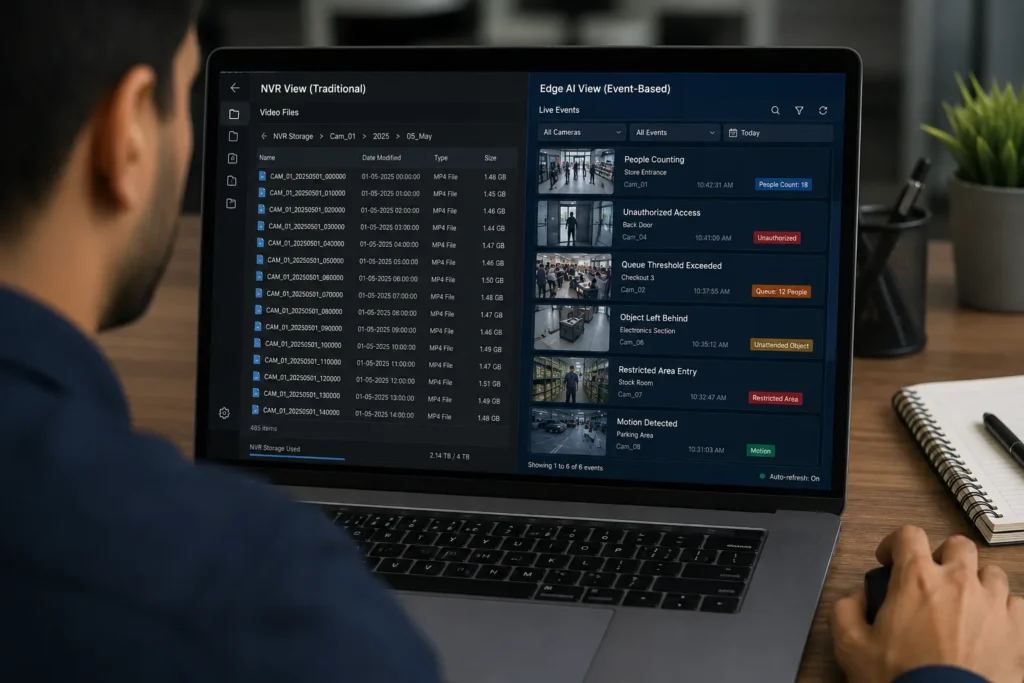
In many cases, critical events are discovered only after someone reviews recorded footage, reducing the ability to take immediate corrective action.
Understanding Edge-Based AI Video Analytics
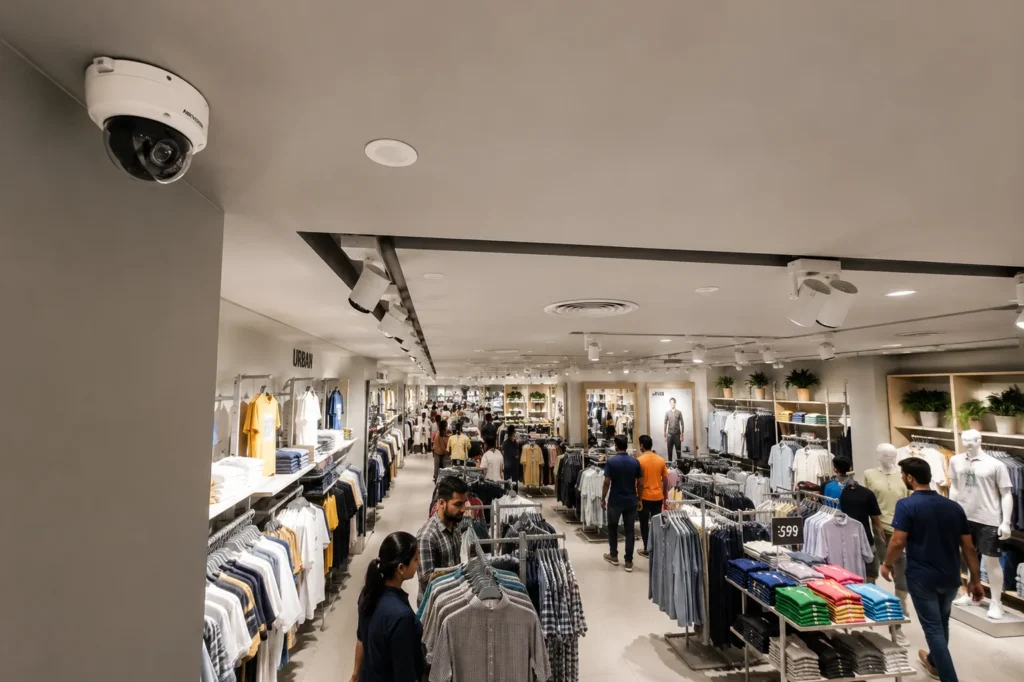
Edge-based AI video analytics processes video directly at the camera or edge device rather than sending all footage to a centralized recording server for analysis.
Using artificial intelligence at the edge, cameras can detect predefined events, analyze behaviors, identify anomalies, and generate alerts in real time. This approach enables organizations to act on critical information immediately while reducing unnecessary data processing.
For industries where rapid response is essential, edge intelligence provides a significant advantage over traditional recording-focused systems.
Compare Edge-Based AI Video Analytics vs NVR-Based Recording Systems
Feature | Edge-Based AI Video Analytics | NVR-Based Recording Systems |
Primary Function | Real-time analysis | Video recording and storage |
Event Detection | Immediate | Post-event review |
Alert Generation | Instant notifications | Manual discovery |
Bandwidth Usage | Optimized | Higher video transmission requirements |
Storage Dependency | Reduced | High storage requirements |
Operational Intelligence | Advanced | Limited |
Response Time | Real-time | Delayed |
Scalability | Highly scalable | Storage-dependent |
When organizations compare these approaches, the key difference lies in whether the system actively detects events or simply records them.
Key Business Benefits of Edge AI Analytics
Businesses adopting edge-based video analytics can benefit from:
Faster Incident Response
Real-time detection enables teams to respond immediately to security, safety, or operational issues.
Reduced Data Processing Requirements
By analyzing video at the source, organizations can minimize unnecessary transmission and storage of footage.
Improved Operational Visibility
AI-driven insights provide greater awareness of activities occurring across facilities and locations.
Enhanced Scalability
Large deployments can be managed more efficiently without continuously increasing centralized storage infrastructure.
Industry Applications for Edge-Based Analytics
Edge AI video analytics supports a wide range of use cases across industries:
- Retail loss prevention and store monitoring
- Manufacturing safety compliance
- Pharmaceutical process monitoring
- Healthcare security and patient safety
- Banking branch monitoring
- Smart city surveillance
- Construction site safety
- Transportation and fleet operations
- Warehouse and fulfillment center monitoring
These applications demonstrate why organizations increasingly compare intelligent analytics platforms with traditional recording systems when modernizing surveillance operations.
How CAPASai Delivers Intelligent Video Analytics
CAPASai helps organizations transform existing CCTV infrastructure into a proactive monitoring solution through AI-powered video analytics, remote monitoring, and real-time alerts.
The platform enables businesses to:
- Detect operational and security events in real time
- Monitor multiple locations from a centralized dashboard
- Receive instant notifications for critical incidents
- Improve compliance monitoring
- Strengthen safety oversight
- Enhance operational visibility
- Reduce dependence on manual surveillance review
By converting video streams into actionable intelligence, CAPASai helps organizations move beyond passive recording toward proactive decision-making.
Moving Beyond Passive Video Recording
Video surveillance is evolving from simple recording systems toward intelligent platforms capable of delivering real-time insights and immediate action. Organizations that compare edge-based AI video analytics with traditional NVR-based recording systems often discover significant advantages in responsiveness, operational awareness, and scalability. As the demand for smarter monitoring grows, AI-powered solutions such as CAPASai help transform surveillance infrastructure into a valuable source of actionable business intelligence.