Why Organizations Need Smarter Video Monitoring
Security and operational monitoring requirements have evolved significantly over the past decade. Businesses today are expected to manage security risks, improve workplace safety, maintain compliance, and enhance operational efficiency across multiple facilities and locations. As a result, CCTV systems have become an essential component of modern business operations.
However, simply capturing video footage is no longer enough. Organizations increasingly require technologies that can identify meaningful events, reduce unnecessary alerts, and provide actionable information in real time. This growing demand for intelligent monitoring has led many businesses to evaluate the differences between traditional motion detection systems and AI-powered video analytics.
Understanding these technologies is important for organizations seeking to improve visibility while maximizing the value of their surveillance investments.
Common Challenges with Basic Motion Detection Systems
Motion detection cameras have been widely used because they provide a simple method for identifying movement within a camera’s field of view. When movement is detected, the system can trigger recording, notifications, or alarms.
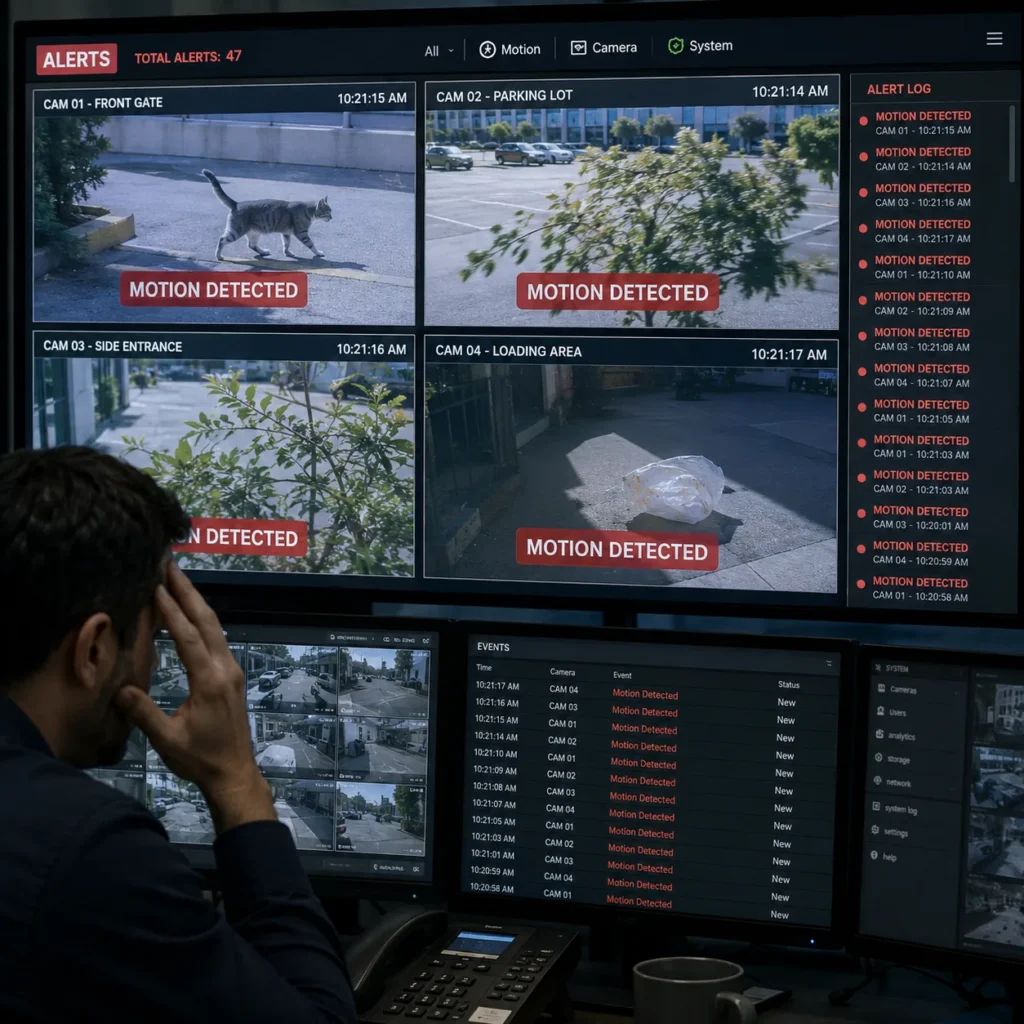
While useful in certain scenarios, motion detection technology often faces several limitations:
- Difficulty distinguishing between important and unimportant movement
- Frequent false alerts caused by shadows, weather, lighting changes, or animals
- Limited understanding of activities and behaviors
- High volumes of unnecessary notifications
- Reduced effectiveness in busy environments
- Minimal operational intelligence beyond movement detection
As facilities become more complex, organizations often require greater context than simple motion-based alerts can provide.
Understanding AI Video Analytics Using CCTV
AI video analytics applies artificial intelligence to CCTV footage to identify specific objects, activities, events, and behavioral patterns. Instead of merely detecting movement, the system analyzes what is happening within the scene and determines whether predefined conditions have been met.
This allows organizations to monitor operational activities, safety compliance, security risks, and business processes with greater accuracy and relevance.
Many organizations compare motion-based systems with AI-powered analytics when looking for more advanced monitoring capabilities and better alert quality.
Compare AI Video Analytics Using CCTV vs Motion Detection Cameras
Although both technologies are designed to support monitoring operations, they operate very differently.
Feature | Motion Detection Cameras | AI Video Analytics Using CCTV |
Detection Method | Movement-based detection | Intelligent scene analysis |
Event Understanding | Detects motion only | Identifies activities and objects |
Alert Accuracy | Can generate false alerts | Context-aware notifications |
Behavioral Analysis | Not available | Supported |
Operational Insights | Limited | Extensive |
Compliance Monitoring | Not supported | Supported |
Object Recognition | Limited | Advanced detection capabilities |
Business Intelligence | Minimal | Actionable insights |
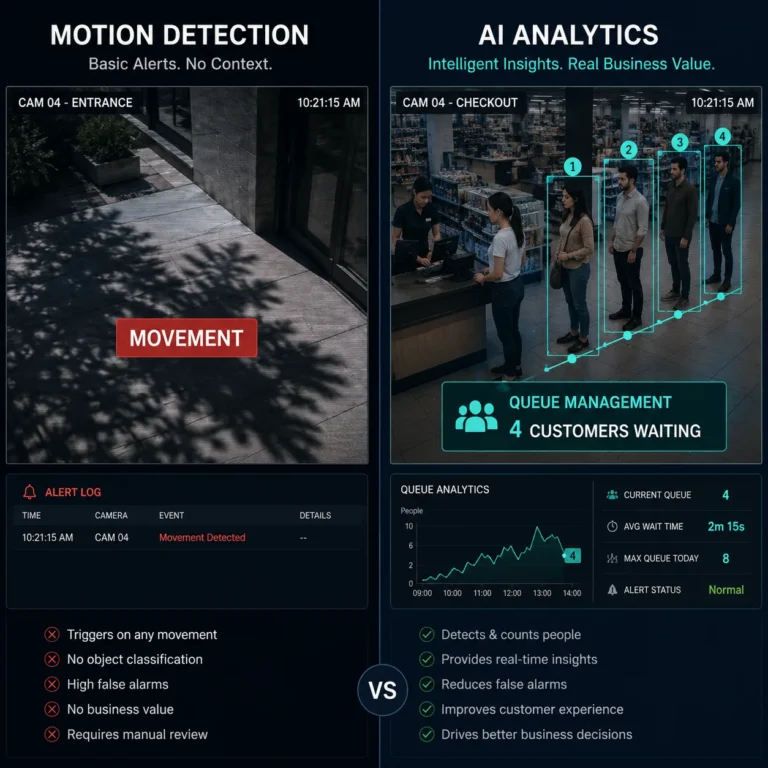
The key difference is that motion detection identifies movement, while AI video analytics interprets what the movement represents and whether action is required.
Compare How Alerts Are Generated
One of the most important differences between these technologies is the way alerts are triggered.
Motion detection systems typically react whenever movement occurs within a defined area. This means that environmental changes, moving shadows, weather conditions, or routine activity may generate notifications.
AI-powered analytics uses predefined rules and intelligent analysis to determine whether an event is relevant. For example, the system can distinguish between normal movement and activities that may indicate a safety violation, unauthorized access attempt, or operational concern.
Organizations often compare these approaches because reducing unnecessary alerts can improve monitoring efficiency and response effectiveness.
How CAPASai Enhances Intelligent Monitoring
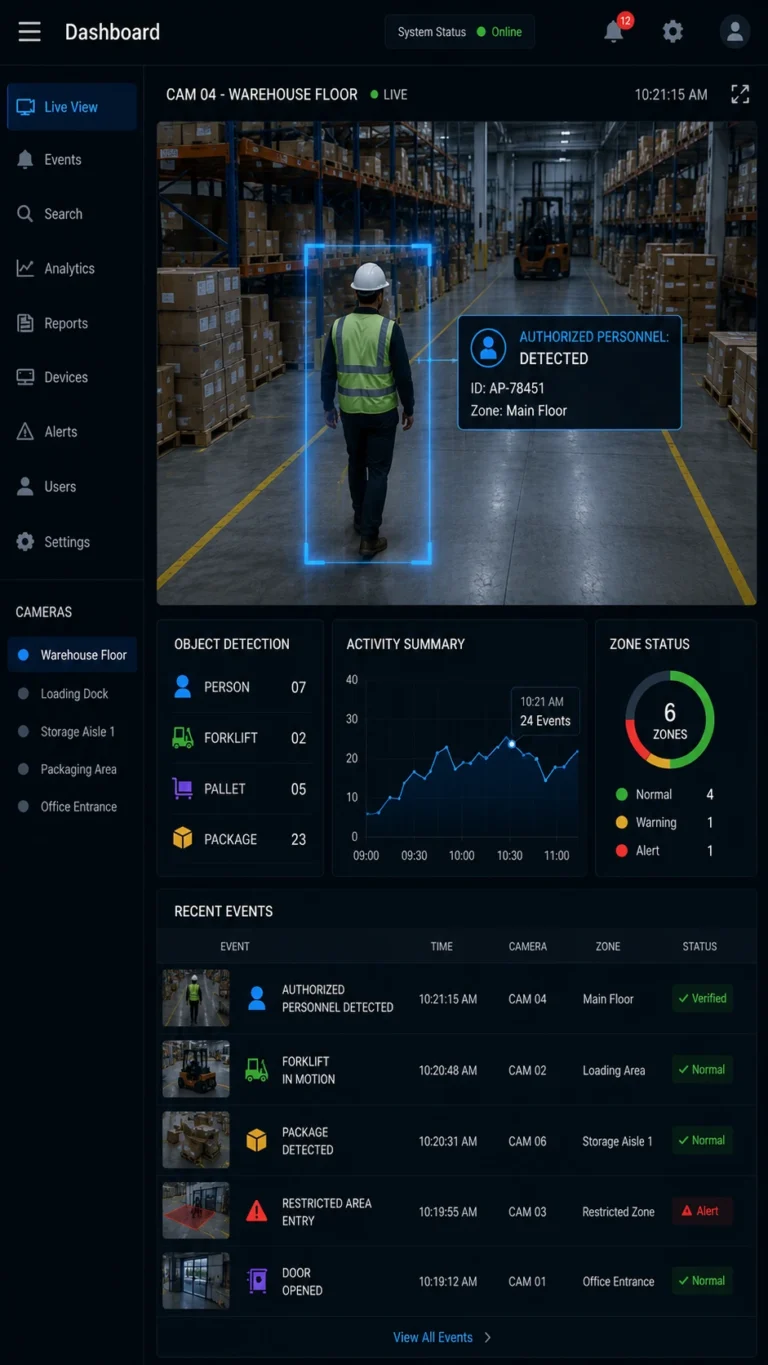
CAPASai transforms conventional CCTV systems into intelligent monitoring platforms through AI-powered video analytics, remote monitoring, and real-time alerts.
Rather than generating notifications for every movement detected, CAPASai analyzes activities occurring within monitored environments and identifies events that require attention. This helps organizations focus on meaningful incidents rather than reviewing large volumes of non-critical alerts.
Key capabilities include:
- Intelligent event detection
- Real-time alert generation
- Operational monitoring
- Compliance monitoring support
- Safety violation detection
- Remote monitoring capabilities
- Multi-site visibility
- Automated incident awareness
This approach helps organizations gain more value from existing CCTV infrastructure while improving operational visibility.
Different Monitoring Technologies Serve Different Business Needs
The choice between motion detection and AI analytics often depends on organizational objectives.
Motion detection may be sufficient for basic monitoring scenarios where simple movement alerts are required. However, organizations seeking deeper visibility into safety, compliance, security, and operational performance often require more advanced analytical capabilities.
For example:
- Manufacturing facilities may need workplace safety monitoring.
- Retail businesses may seek loss prevention insights.
- Healthcare facilities may require patient-area visibility.
- Logistics operations may need warehouse activity monitoring.
- Educational institutions may focus on campus security.
In these environments, understanding the context behind an event is often more valuable than simply knowing movement occurred.
Benefits of Intelligent Video Analytics
Organizations implementing AI-powered monitoring solutions can achieve:
- Reduced false alerts
- Faster incident detection
- Improved operational visibility
- Enhanced compliance monitoring
- Better resource allocation
- Increased situational awareness
- More efficient investigations
- Stronger decision-making support
These advantages enable businesses to move beyond basic motion-triggered monitoring toward more intelligent surveillance strategies.
Compare the Future of Intelligent Monitoring and Motion-Based Detection
As organizations seek more meaningful insights from surveillance systems, monitoring technologies are evolving beyond simple movement detection. While motion detection remains useful for basic applications, businesses increasingly require systems that can understand activities, identify risks, and support operational decision-making. AI-powered video analytics addresses these needs by transforming CCTV footage into actionable intelligence. For organizations evaluating long-term monitoring strategies, the ability to understand events rather than simply detect motion is becoming an increasingly important advantage.