
Why Video Analytics Deployment Models Matter
Organizations are increasingly adopting AI-powered video analytics to improve security, operational visibility, compliance monitoring, and incident response. Across industries such as manufacturing, retail, healthcare, banking, logistics, education, and critical infrastructure, CCTV systems are no longer viewed solely as recording tools. Businesses now expect surveillance systems to deliver actionable insights that support day-to-day operations.
As demand for intelligent monitoring grows, organizations must decide how video analytics should be deployed. Two of the most common approaches are cloud-based video analytics and on-premise video analytics. Each model offers distinct advantages, and selecting the right option often depends on operational requirements, infrastructure capabilities, security policies, and long-term business objectives

Key Considerations Before Choosing a Deployment Approach
The decision extends beyond technology alone. Organizations must evaluate factors such as data accessibility, system management, scalability, network requirements, and compliance obligations.
Common considerations include:
- Growth plans and future scalability
- IT infrastructure availability
- Data governance requirements
- Network reliability
- Operational complexity
- Cybersecurity policies
- Budget allocation strategies
- Multi-site monitoring needs
Understanding these factors helps organizations choose a deployment model that aligns with their operational goals.
Understanding Cloud-Based and On-Premise Video Analytics
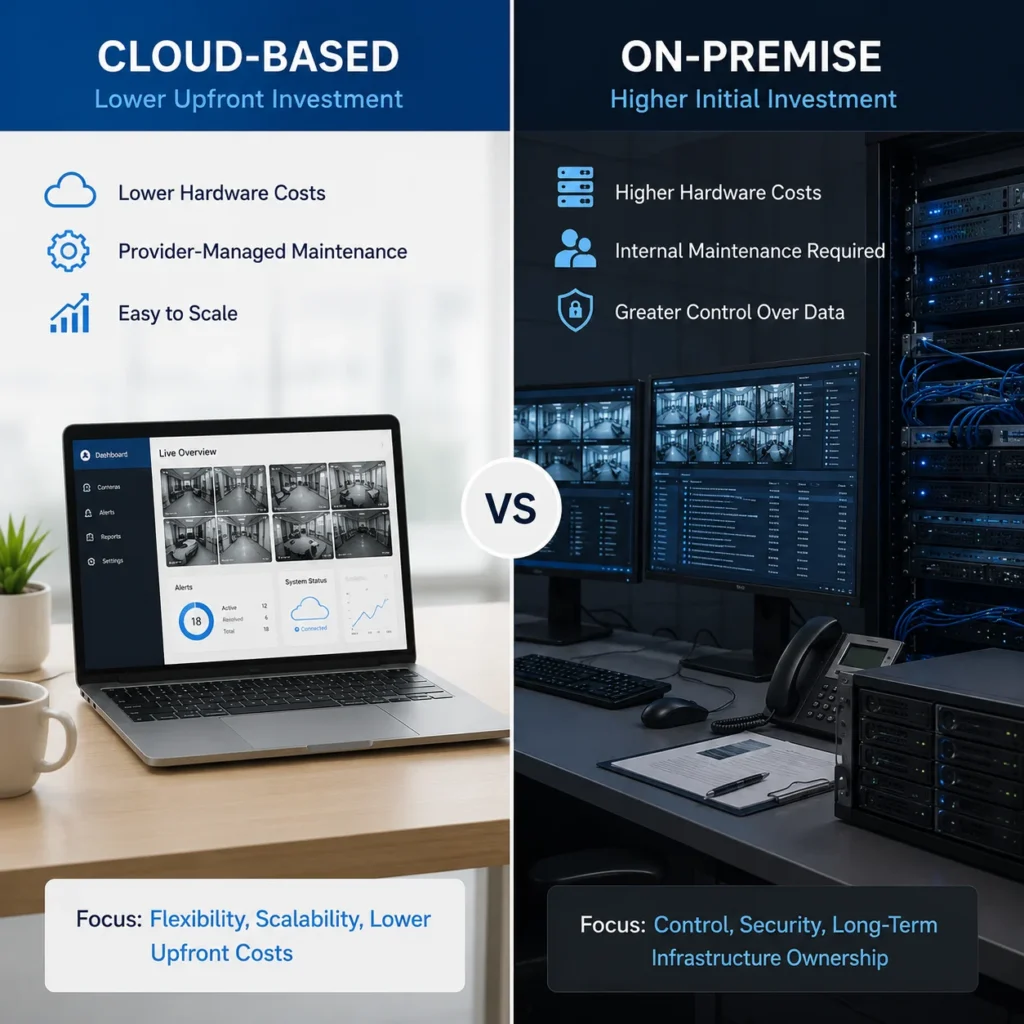
Cloud-based video analytics processes, stores, and manages video data through remote cloud infrastructure. Organizations can access analytics dashboards, reports, and alerts through centralized platforms connected via the internet.
On-premise video analytics processes video data within the organization’s own facilities using local servers, storage systems, and computing resources. The organization maintains direct control over infrastructure, processing, and data management.
Both approaches support AI-powered monitoring, but they differ significantly in management, accessibility, and operational flexibility.

Compare Cloud-Based Video Analytics vs On-Premise Video Analytics Using CCTV
Feature | Cloud-Based Video Analytics | On-Premise Video Analytics |
Infrastructure Location | Remote cloud environment | Local facility infrastructure |
Initial Investment | Lower upfront cost | Higher initial investment |
Scalability | Highly scalable | Hardware-dependent |
System Maintenance | Managed centrally | Managed internally |
Remote Accessibility | Easy access from anywhere | Depends on internal configuration |
Software Updates | Typically automated | Manual management often required |
Data Control | Shared cloud responsibility | Direct organizational control |
Deployment Flexibility | Faster expansion | Site-specific expansion |
The right choice often depends on whether an organization prioritizes flexibility and scalability or greater control over infrastructure and data.
Compare Operational Advantages of Both Approaches
Organizations evaluating deployment models frequently compare how each option supports day-to-day operations.
Cloud-Based Video Analytics
Cloud deployments are often preferred by organizations that require:
- Rapid deployment
- Centralized management
- Multi-location visibility
- Simplified software maintenance
- Flexible expansion across facilities
These benefits might be especially helpful for businesses that have several locations.
On-Premise Video Analytics
On-premise deployments are often selected when organizations prioritize:
- Direct infrastructure control
- Internal data management
- Custom system configurations
- Independent operational control
- Site-specific deployment requirements
This approach is common in environments with strict governance or specialized operational needs.
How CAPASai Supports Intelligent Video Analytics Deployments
Whether organizations choose cloud-based, on-premise, or hybrid environments, the goal remains the same: transforming CCTV footage into actionable intelligence.
CAPASai enhances video monitoring through AI-powered analytics, remote monitoring capabilities, and real-time alerts that help organizations improve security, safety, compliance, and operational performance.
Key capabilities include:
- Intelligent event detection
- Automated alert generation
- Operational visibility across facilities
- Compliance monitoring support
- Remote monitoring capabilities
- Centralized oversight
- Real-time incident awareness
By leveraging AI-driven analytics, organizations can gain greater value from existing CCTV infrastructure regardless of deployment architecture
Deployment Priorities Differ Across Organizations
Deployment decisions are often influenced by business strategy rather than technology alone.
A rapidly expanding retail chain may prioritize centralized visibility across locations. A manufacturing facility may focus on maintaining operational control within its own infrastructure. Healthcare organizations may evaluate accessibility and governance requirements, while logistics providers may seek solutions that support distributed operations.
For many enterprises, the decision is not simply about technology preference but about aligning deployment architecture with operational objectives and future growth plans.
Organizations frequently compare cloud-based and on-premise solutions to determine which model best supports long-term scalability, management efficiency, and business continuity.
Benefits of AI-Powered Video Analytics Regardless of Deployment Model
Whether deployed in the cloud or on-premise, intelligent video analytics can help organizations achieve:
- Faster incident detection
- Improved operational visibility
- Enhanced compliance monitoring
- Better resource utilization
- Increased situational awareness
- Reduced investigation times
- More proactive risk management
- Stronger decision-making support
These benefits help transform surveillance systems into valuable operational intelligence platforms.
Compare the Future of Cloud and On-Premise Video Analytics
As organizations continue to modernize surveillance and operational monitoring systems, deployment flexibility is becoming increasingly important. While cloud-based platforms offer scalability and centralized management, on-premise solutions provide greater infrastructure control and customization. The best choice depends on business priorities, governance requirements, and operational strategy. Rather than focusing solely on where analytics are deployed, organizations should evaluate how effectively a solution delivers actionable insights, supports decision-making, and enhances overall operational performance.