Organizations today operate across multiple facilities, regions, and business units to support growth, improve customer service, and maintain operational efficiency. Whether managing manufacturing plants, retail chains, logistics hubs, healthcare facilities, financial branches, or distribution centers, maintaining consistent operational performance across geographically dispersed locations presents significant challenges.
As organizations expand, operational risk becomes increasingly difficult to manage. Limited visibility, inconsistent process execution, compliance gaps, and delayed issue detection can create vulnerabilities that impact productivity, quality, safety, and business continuity. To address these challenges, enterprises are increasingly adopting AI-powered monitoring and operational intelligence solutions that provide real-time visibility across distributed operations.
Understanding Operational Risk In Multi-Site Environments
Operational risk refers to the potential for losses, disruptions, or performance issues resulting from failures in processes, people, systems, or external events.
In distributed environments, operational risks can emerge from:
- Process inconsistencies
- Compliance violations
- Safety incidents
- Workflow disruptions
- Equipment failures
- Resource shortages
- Communication gaps
- Delayed issue escalation
Because these risks can develop independently across multiple locations, organizations often struggle to identify problems before they affect overall performance.
Why Distributed Facilities Create Unique Challenges
Managing risk within a single facility is already complex. Managing risk across dozens or hundreds of locations introduces additional layers of operational complexity.
Limited Visibility Across Locations
Corporate teams often rely on reports, audits, and periodic site visits to understand operational performance.
However, these methods provide only snapshots of activity rather than continuous insight into daily operations.
Inconsistent Process Execution
Different facilities may interpret procedures differently or develop local variations in workflow execution.
Over time, these inconsistencies can increase operational risk and impact quality standards.
Delayed Incident Detection
Issues that occur at remote locations may not be reported immediately, allowing risks to escalate before corrective actions are taken.
Growing Compliance Requirements
Organizations operating across regions often face varying regulatory and operational requirements, increasing the need for consistent oversight and governance.

The Cost Of Unmanaged Operational Risk
When operational risks remain undetected, organizations may experience:
- Production disruptions
- Increased operational costs
- Quality failures
- Customer dissatisfaction
- Compliance penalties
- Safety incidents
- Resource inefficiencies
- Reputational damage
The impact becomes even greater when similar issues occur across multiple facilities simultaneously.
The Role Of Computer Vision In Distributed Operations
Many operational risks originate within physical environments where traditional enterprise systems provide limited visibility.
Computer vision helps organizations monitor physical operations continuously.
Organizations can use computer vision to:
- Verify process adherence
- Monitor workflow execution
- Detect safety concerns
- Identify operational bottlenecks
- Support compliance initiatives
- Improve operational consistency
By transforming visual observations into actionable intelligence, organizations gain deeper awareness of activities occurring across facilities.
Compare Traditional Risk Management And AI-Powered Risk Management
Traditional Approach | AI-Powered Approach |
Periodic reviews | Continuous monitoring |
Manual reporting | Automated intelligence |
Reactive response | Proactive risk detection |
Limited visibility | Enterprise-wide visibility |
Historical analysis | Real-time insights |
Delayed intervention | Immediate alerts |
This comparison highlights how AI strengthens operational oversight across distributed environments.
How AI Improves Operational Risk Management
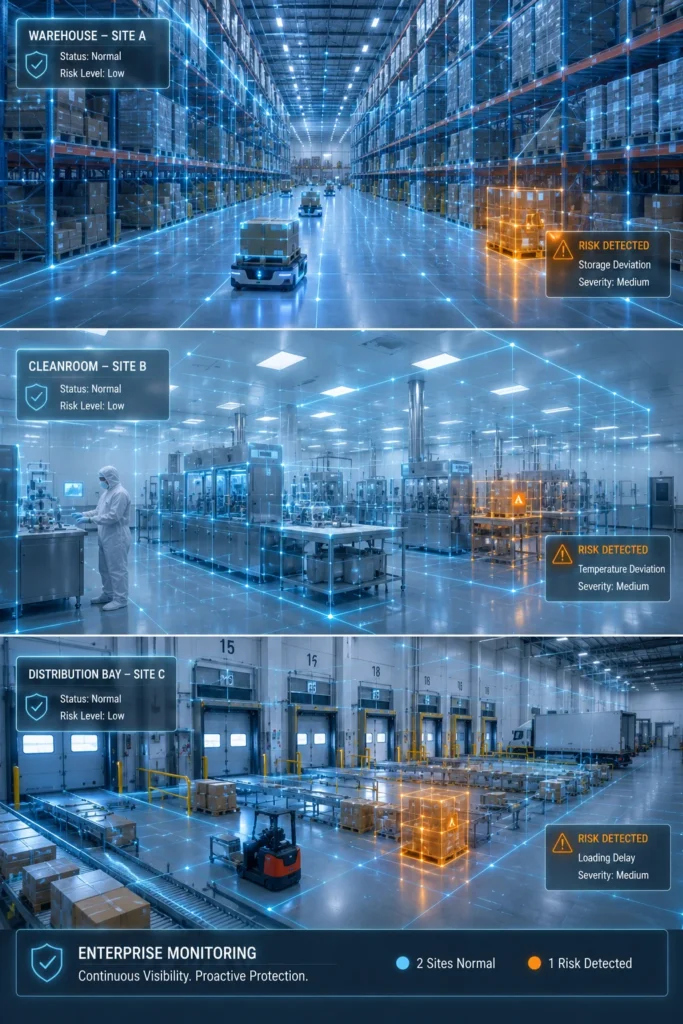
Artificial Intelligence enables organizations to move beyond reactive risk management by providing continuous operational visibility and proactive risk identification.
Continuous Monitoring
AI systems can monitor operational activities across multiple facilities simultaneously.
This allows organizations to identify unusual patterns, process deviations, and emerging risks in real time.
Early Risk Detection
Many operational issues begin as small anomalies before developing into larger disruptions.
AI helps identify these warning signs early, enabling faster intervention and reducing potential business impact.
Operational Pattern Analysis
AI can analyze large volumes of operational data and recognize trends that may indicate elevated risk levels.
This helps organizations understand where risks are emerging and prioritize corrective actions.
Real-Time Alerts
Organizations can receive immediate notifications when predefined risk conditions are detected.
This improves response times and supports proactive decision-making.
Strengthening Governance Across Multiple Locations
Effective operational risk management requires consistent governance across the enterprise.
AI-powered monitoring supports governance by helping organizations:
- Standardize operational oversight
- Improve accountability
- Verify compliance performance
- Detect deviations early
- Support corrective action programs
- Maintain operational consistency
This enables leaders to make informed decisions based on real-time operational intelligence rather than relying solely on historical reports.
Building Resilient Multi-Site Operations
Organizations that successfully manage operational risk across distributed facilities are better positioned to maintain business continuity, improve efficiency, and support sustainable growth.
By combining AI, computer vision, and continuous monitoring, enterprises can identify risks earlier, strengthen governance, and improve operational performance across all locations.
As operational networks continue to expand, proactive risk management will become increasingly important for maintaining resilience, consistency, and long-term business success.
How CAPASai Helps Manage Operational Risk
CAPASai helps organizations manage operational risk through AI-powered video analytics, remote monitoring, real-time alerts, and operational intelligence. By providing continuous visibility into workflows, compliance activities, process adherence, and facility operations, CAPASai enables enterprises to identify risks early, improve response times, and maintain operational consistency across distributed locations.