Organizations today operate in increasingly complex environments where maintaining operational consistency, compliance, quality, and accountability requires more than traditional management practices. As operations expand across facilities, departments, and geographic regions, organizations face growing challenges in identifying issues, implementing corrective actions, and ensuring long-term process improvement.
Corrective and Preventive Action (CAPA) systems have long played a critical role in helping organizations address operational issues and prevent recurrence. However, traditional CAPA programs often struggle with delayed issue detection, fragmented investigations, manual workflows, and limited operational visibility.
Artificial Intelligence (AI) is helping organizations modernize CAPA programs by introducing continuous monitoring, automated analysis, and real-time operational intelligence. The integration of CAPA and AI enables organizations to move from reactive issue management toward proactive operational control, creating smarter and more resilient operating environments.
Why Operational Control Systems Need To Evolve
Operational control systems are designed to ensure that processes are executed consistently, risks are managed effectively, and organizational objectives are achieved.
Historically, these systems have relied on:
- Periodic audits
- Manual inspections
- Incident reports
- Compliance reviews
- Human observations
While these methods remain important, they often provide only partial visibility into operational performance.
In fast-moving operational environments, organizations need the ability to identify emerging issues quickly and respond before they affect productivity, compliance, quality, or customer outcomes.
This requirement is driving the convergence of CAPA and AI.
Understanding The Relationship Between CAPA And Operational Controls
CAPA and operational controls are closely connected.Operational controls help prevent issues from occurring, while CAPA systems provide a structured framework for addressing issues when they are identified.
Together they support:
- Process consistency
- Compliance management
- Risk reduction
- Continuous improvement
- Accountability
- Governance
When integrated effectively, CAPA becomes more than a corrective process. It becomes an active component of operational control.
The Limitations Of Traditional CAPA Programs
Many organizations continue to manage CAPA activities using manual workflows and disconnected systems.
Common challenges include:
Delayed Issue Identification
Problems are often discovered after they have already affected operations.
Investigations may begin only after quality failures, compliance concerns, or operational disruptions have occurred.
Fragmented Information Sources
Investigators frequently gather information from multiple systems, reports, and departments.
This can slow investigations and make it difficult to identify root causes accurately.
Reactive Decision-Making
Traditional CAPA systems often focus on addressing historical events rather than identifying emerging risks.
As a result, organizations spend significant time reacting to problems instead of preventing them.
Limited Visibility Into Corrective Action Effectiveness
Organizations may struggle to verify whether corrective actions are consistently implemented and producing the desired outcomes.
How AI Enhances CAPA Systems
AI introduces intelligence, speed, and scalability into CAPA processes.
Rather than relying solely on historical information, organizations gain access to continuous operational insights that improve both issue detection and decision-making.
Continuous Operational Monitoring
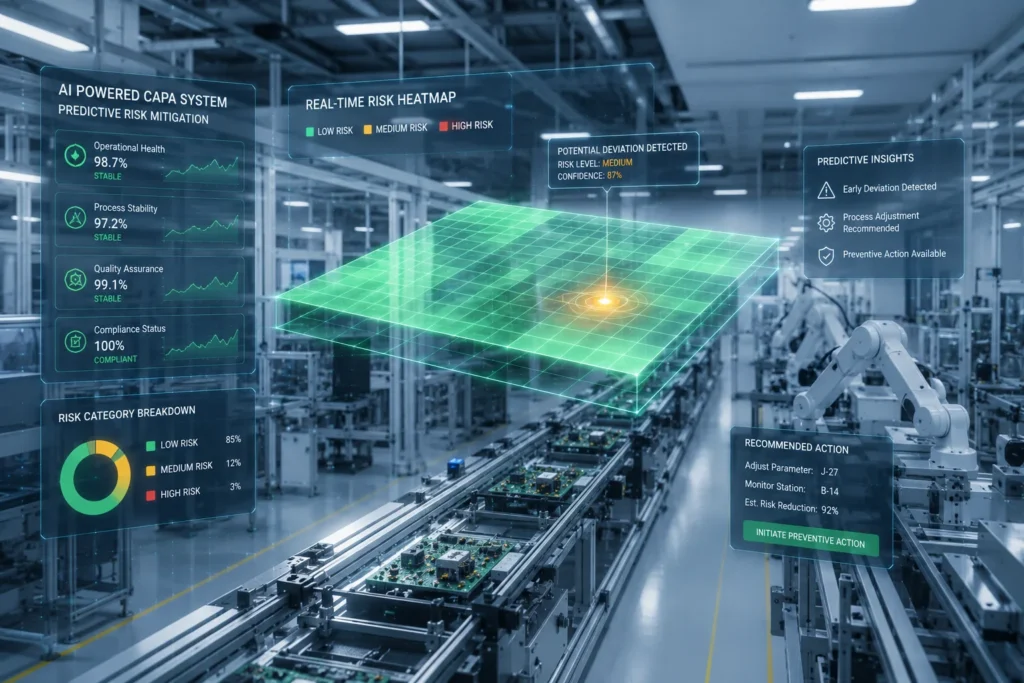
AI can continuously analyze operational activities and identify unusual patterns that may indicate emerging problems.
This provides earlier visibility into:
- Process deviations
- Compliance concerns
- Workflow disruptions
- Operational anomalies
- Performance deterioration
Early detection enables faster intervention and reduces the impact of potential issues.
Faster Root Cause Analysis
One of the most challenging aspects of CAPA is determining why an issue occurred.
AI can evaluate large volumes of operational data, identify relationships between events, and uncover patterns that may not be immediately visible through manual analysis.
This helps organizations accelerate investigations and implement more effective corrective actions.
Intelligent Risk Identification
AI helps organizations move beyond reactive issue management by identifying potential risks before they become significant operational problems.
This proactive approach supports stronger operational controls and reduces overall business risk.
Creating Smarter Operational Control Systems
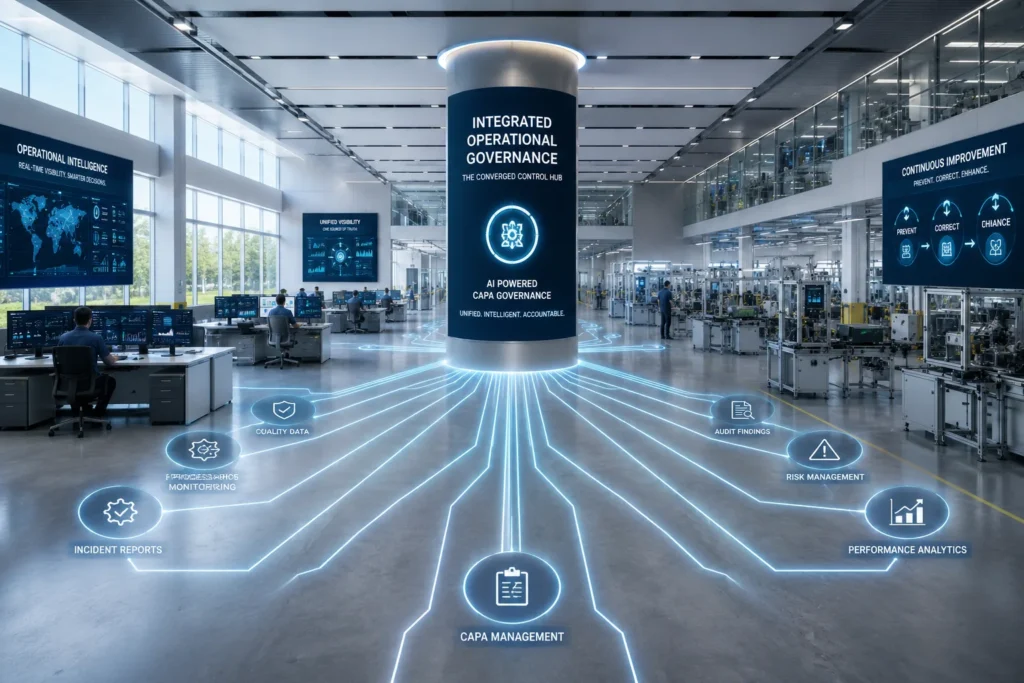
The integration of CAPA and AI enables organizations to build operational control systems that are more adaptive, intelligent, and responsive.
Real-Time Visibility
AI provides continuous insight into operational activities, enabling leaders to understand what is happening across facilities, teams, and processes.
This visibility supports more informed decision-making and stronger governance.
Automated Issue Escalation
Potential issues can be identified and escalated automatically based on predefined criteria.
This helps ensure that critical events receive timely attention and corrective actions are initiated quickly.
Continuous Verification
Organizations can continuously verify whether operational controls are functioning as intended.
This helps reduce blind spots and strengthens overall control effectiveness.
Data-Driven Decision Support
AI-generated insights provide objective evidence that supports investigations, corrective actions, and continuous improvement initiatives.
This improves both operational efficiency and accountability.
Strengthening Accountability Across The Enterprise
Accountability is a critical component of any effective CAPA program.
Organizations need confidence that identified issues are investigated thoroughly and corrective actions are implemented consistently.
AI helps strengthen accountability by providing:
- Greater operational transparency
- Objective performance data
- Continuous monitoring
- Improved action tracking
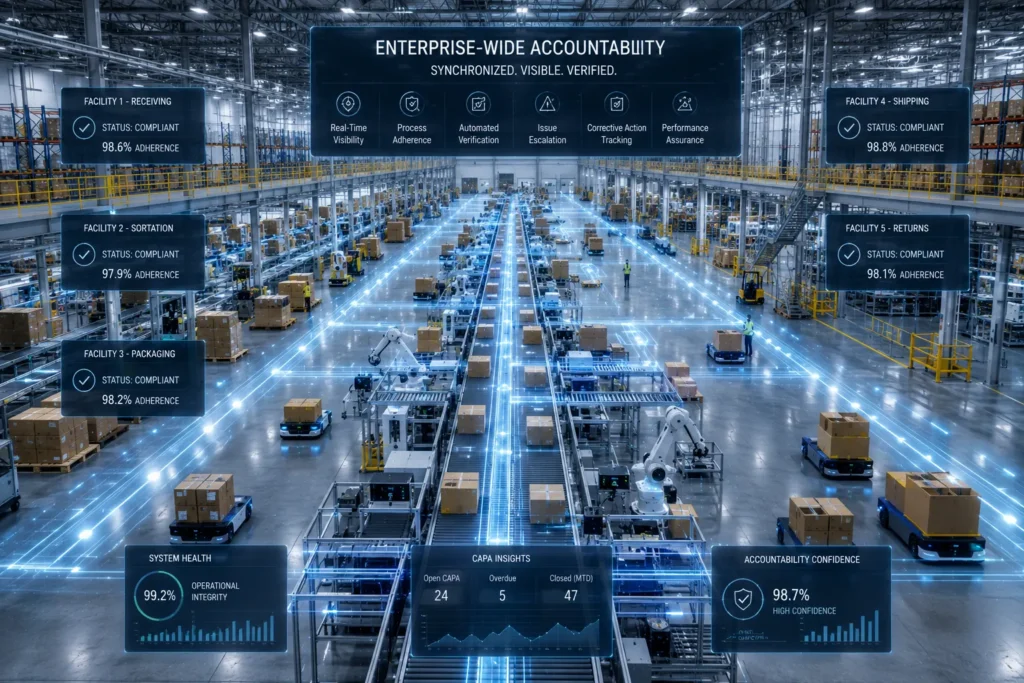
- Enterprise-wide visibility
This allows leaders to monitor progress, verify compliance, and ensure that responsibilities are fulfilled effectively.
The Role Of Computer Vision In Modern CAPA Programs
Many operational activities occur within physical environments where traditional software systems provide limited visibility.
Computer vision extends operational awareness by transforming visual observations into actionable intelligence.
Organizations can use computer vision to:
- Verify process adherence
- Detect operational deviations
- Monitor workflow execution
- Support compliance initiatives
- Capture evidence for investigations
- Improve operational consistency
These capabilities help strengthen both CAPA effectiveness and operational control systems.
Supporting Multi-Site Operations Through Intelligent Controls
Large enterprises often face challenges maintaining consistent standards across multiple facilities.
AI-powered CAPA systems help organizations:
- Standardize issue management processes
- Monitor operational performance continuously
- Improve investigation consistency
- Verify corrective action implementation
- Strengthen governance across locations
This enables organizations to maintain operational control at scale while reducing variability between sites.
Traditional Operational Controls Versus AI-Enabled Controls
Traditional Controls | AI-Enabled Controls |
Periodic reviews | Continuous monitoring |
Manual investigations | Automated intelligence support |
Reactive issue management | Proactive risk identification |
Limited visibility | Real-time operational awareness |
Historical analysis | Predictive insights |
Isolated data sources | Connected operational intelligence |
The result is a smarter control environment capable of responding to operational challenges more effectively.
Building The Future Of Intelligent Operational Governance
The integration of CAPA and AI represents an important evolution in how organizations manage operational performance, compliance, and risk. By combining structured corrective action processes with continuous intelligence, organizations can strengthen operational controls, improve accountability, and create more resilient operating environments.
As operational complexity continues to grow, enterprises that embrace AI-powered CAPA systems will be better positioned to identify issues earlier, respond more effectively, and drive continuous improvement across their operations.
How CAPASai Supports Intelligent Operational Control Systems
CAPASai helps organizations strengthen operational controls through AI-powered video analytics, real-time monitoring, operational intelligence, and automated alerts. By providing continuous visibility into process execution, compliance activities, workflow adherence, and emerging risks, CAPASai enables enterprises to improve CAPA effectiveness, strengthen accountability, and support smarter operational governance across distributed environments.