Organizations have long relied on audits to evaluate process performance, verify compliance, and identify operational issues. Audits remain an important component of governance and operational oversight, helping businesses assess whether established procedures are being followed and whether performance standards are being met.
However, modern operational environments move faster than ever before. Processes run continuously, workflows change dynamically, and operational risks can emerge between audit cycles. As a result, organizations are increasingly recognizing that periodic audits alone cannot provide the visibility needed to maintain consistent operational performance.
Continuous process monitoring addresses this challenge by providing real-time awareness of operational activities, enabling organizations to identify issues as they occur rather than discovering them weeks or months later.
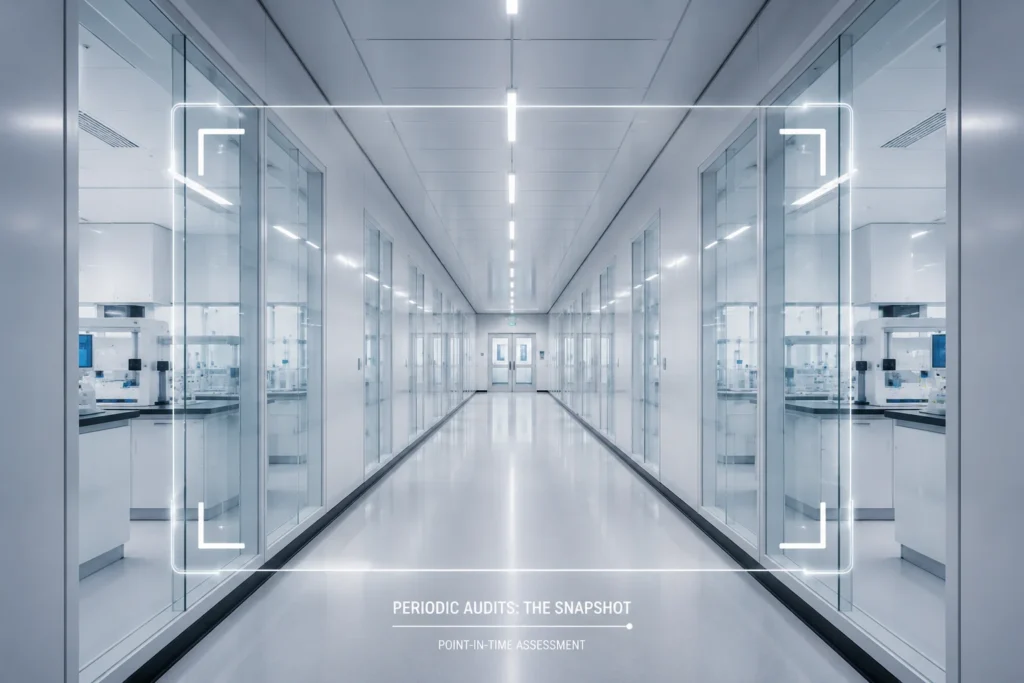
The Traditional Role Of Periodic Audits
Periodic audits have historically served as a structured mechanism for evaluating operational performance.
Organizations use audits to:
- Assess compliance with procedures
- Verify process execution
- Review documentation
- Identify control gaps
- Support governance initiatives
While audits provide valuable insights, they offer only a snapshot of operations at a specific point in time.
The challenge is that operational performance is constantly evolving between those snapshots.
The Visibility Gap Between Audits
A process may appear compliant during an audit but experience multiple deviations shortly afterward.
Similarly, operational inefficiencies, workflow disruptions, or safety concerns may emerge and persist long before the next scheduled review.
This creates a visibility gap where organizations may lack awareness of:
- Process deviations
- Workflow bottlenecks
- Compliance risks
- Operational delays
- Resource utilization issues
- Quality inconsistencies
In complex enterprises, these issues can accumulate and impact performance before they are formally identified.
Why Continuous Monitoring Changes The Equation
Continuous process monitoring provides ongoing visibility into operational activities.
Rather than relying solely on periodic assessments, organizations gain real-time awareness of how processes are being executed across facilities, teams, and workflows.
This shift creates several important advantages.
Earlier Detection Of Process Deviations
Process deviations rarely begin as major problems.
They often start as small variations that gradually become larger operational issues.
Continuous monitoring enables organizations to identify deviations immediately, allowing corrective action before broader impacts occur.
Faster Response To Operational Risks
Operational risks become more difficult and costly to address as they grow.
Real-time monitoring allows leaders to:
- Identify emerging issues
- Investigate root causes faster
- Respond proactively
- Reduce operational disruption
This significantly improves organizational responsiveness.
Improved Process Consistency
Maintaining consistent execution across multiple facilities and teams can be challenging.
Continuous monitoring helps verify that processes are being performed according to established standards, supporting greater operational consistency and discipline.
Better Support For Continuous Improvement
Continuous improvement depends on visibility.
Organizations cannot improve what they cannot see.
By providing ongoing operational intelligence, continuous monitoring helps teams:
- Measure process performance
- Track improvement initiatives
- Validate corrective actions
- Identify optimization opportunities
This creates a stronger foundation for long-term operational excellence.
Periodic Audits Versus Continuous Monitoring
Both approaches play important roles, but they serve different purposes.
Periodic Audits | Continuous Process Monitoring |
Point-in-time assessment | Ongoing operational visibility |
Scheduled reviews | Real-time awareness |
Retrospective analysis | Immediate issue detection |
Manual evaluation | Automated monitoring |
Compliance verification | Operational intelligence |
Reactive identification | Proactive intervention |
Organizations achieve the greatest value when audits and continuous monitoring work together rather than independently.
The Role Of AI In Continuous Monitoring
Artificial Intelligence enables organizations to monitor operations at a scale that would be difficult to achieve through manual methods alone.
AI can continuously analyze operational activities and identify:
- Process deviations
- Workflow bottlenecks
- Operational anomalies
- Compliance risks
- Performance trends
This transforms monitoring from a periodic exercise into a continuous source of operational intelligence.
How Computer Vision Expands Operational Visibility
Many critical processes occur within physical environments where traditional software systems have limited visibility.
Computer vision extends monitoring capabilities by transforming visual observations into actionable insights.
Organizations can use computer vision to:
- Verify process adherence
- Monitor workflow execution
- Detect bottlenecks
- Identify safety concerns
- Support compliance initiatives
- Improve operational consistency
This provides a more complete understanding of operational performance across physical environments.
Building A More Responsive Operating Model
Organizations that rely exclusively on periodic audits often discover issues after performance has already been affected. Continuous process monitoring shifts the focus from retrospective evaluation to real-time awareness, enabling faster responses, stronger compliance oversight, and more effective operational decision-making.
As operational environments continue to become more complex, organizations that combine periodic audits with AI-powered continuous monitoring will be better positioned to improve consistency, reduce risk, strengthen governance, and drive sustainable operational excellence.

How CAPASai Supports Continuous Process Monitoring
CAPASai helps organizations move beyond periodic oversight through AI-powered video analytics, real-time monitoring, operational intelligence, and automated alerts. By providing continuous visibility into workflows, process adherence, compliance activities, and operational performance, CAPASai enables enterprises to identify issues earlier, improve consistency, and strengthen operational excellence across multiple locations.
.