Organizations often invest significant effort in addressing operational issues such as production delays, quality deviations, workflow bottlenecks, compliance gaps, and service disruptions. While corrective actions may resolve immediate symptoms, many recurring problems persist because the underlying causes remain unidentified.
Root Cause Analysis (RCA) has long been a critical component of operational excellence, helping organizations understand why problems occur and how to prevent them from happening again. However, as business operations become increasingly complex, traditional approaches to root cause analysis face new challenges.
Artificial Intelligence (AI) is transforming root cause analysis by enabling organizations to identify patterns, uncover hidden relationships, and detect contributing factors faster and more accurately than traditional methods alone.
Why Root Cause Analysis Matters
Operational issues rarely occur in isolation.
A production delay may result from process deviations, staffing constraints, equipment inefficiencies, or workflow interruptions. Similarly, quality issues may stem from inconsistent procedures, resource allocation problems, or environmental factors.
Without identifying the true cause of a problem, organizations often risk:
- Repeated operational disruptions
- Increased costs
- Reduced productivity
- Quality inconsistencies
- Compliance challenges
- Ineffective corrective actions
Root cause analysis helps organizations move beyond symptom management and focus on long-term improvement.
The Limitations Of Traditional Root Cause Analysis
Traditional RCA methods often rely on:
- Manual investigations
- Employee interviews
- Historical reports
- Audit findings
- Spreadsheet-based analysis
While these approaches remain valuable, they can be time-consuming and may depend heavily on human interpretation.
Challenges commonly include:
- Incomplete data visibility
- Delayed investigations
- Difficulty identifying hidden relationships
- Inconsistent analysis across locations
- Limited access to real-time operational information
As operations scale, these limitations can make identifying root causes increasingly difficult.
How AI Enhances Root Cause Analysis
AI enables organizations to analyze large volumes of operational data and identify relationships that may otherwise remain hidden.
Rather than relying solely on manual investigations, organizations gain access to continuous intelligence that helps accelerate problem-solving.
Detecting Operational Patterns
Many recurring issues follow patterns that are difficult to identify through traditional analysis.
AI can evaluate operational activities across multiple processes and identify:
- Repeated workflow disruptions
- Recurring quality deviations
- Performance anomalies
- Process inconsistencies
- Emerging operational risks
This allows organizations to investigate problems with greater precision.
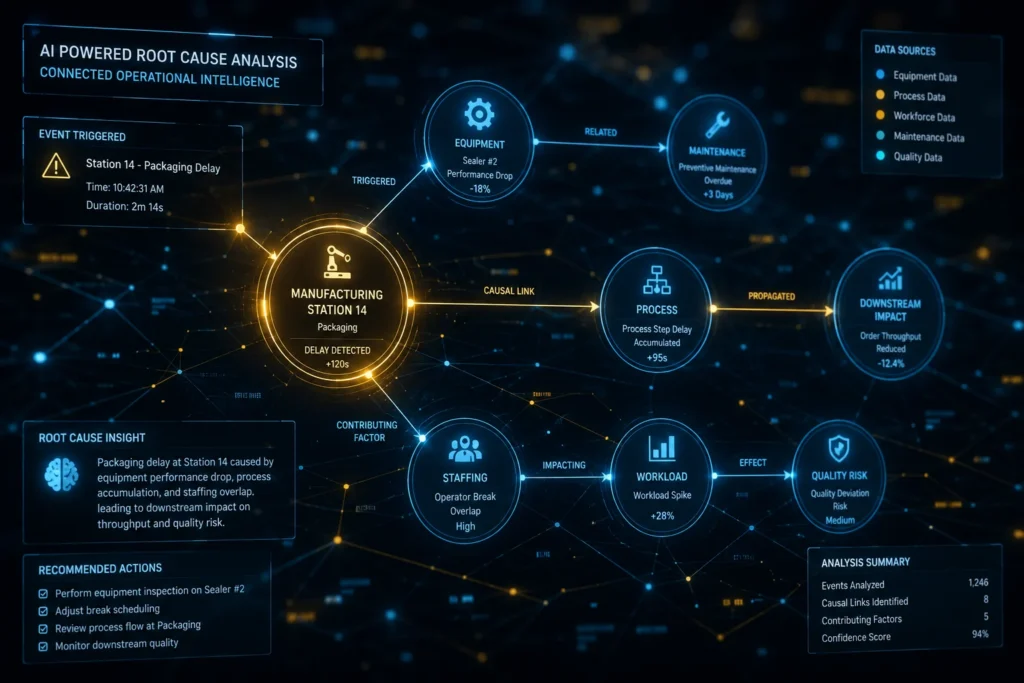
Connecting Related Events
Operational issues often result from multiple contributing factors rather than a single cause.
AI can correlate information across different systems, locations, and operational activities to reveal relationships between events.
For example, AI may identify connections between:
- Equipment performance and production delays
- Staffing levels and process bottlenecks
- Process deviations and quality issues
- Workflow interruptions and customer service impacts
This broader perspective improves root cause identification.
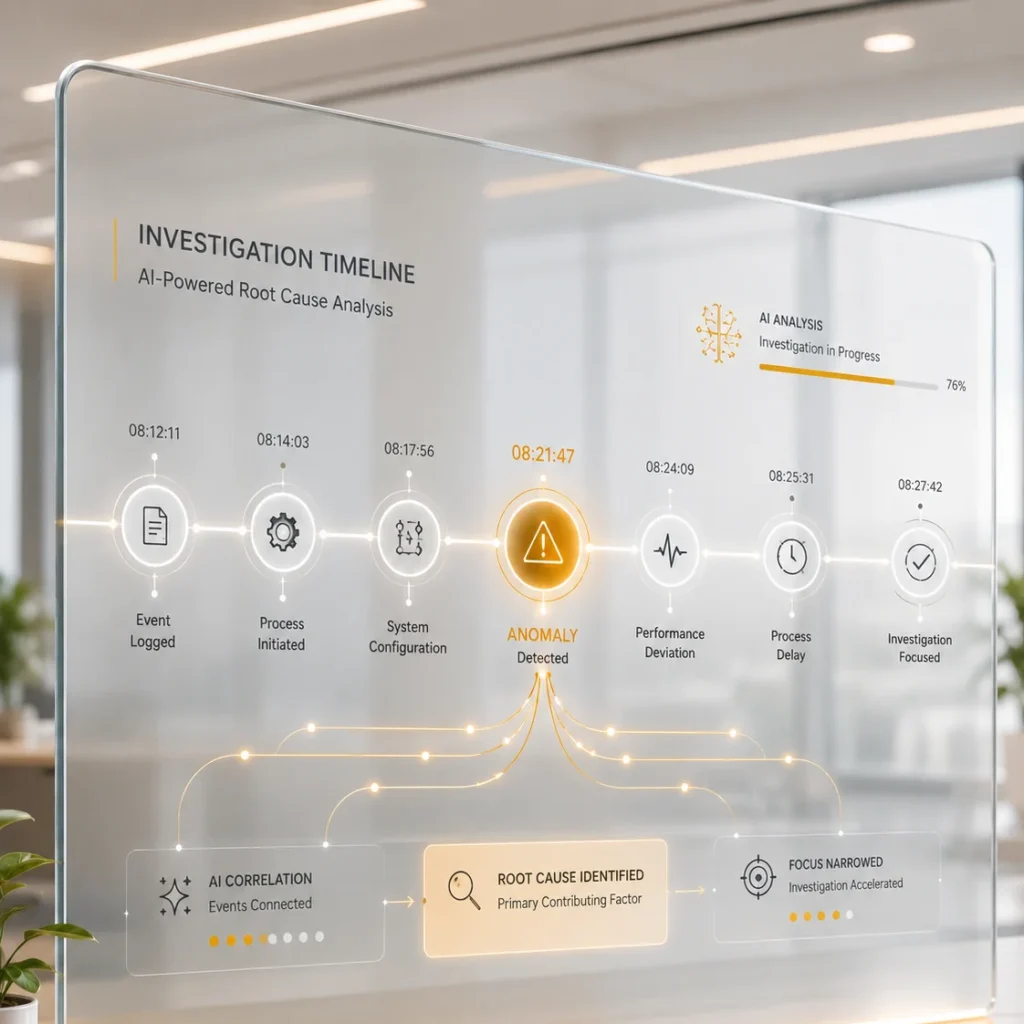
Accelerating Investigations
Traditional investigations can take days or weeks to complete.
AI helps organizations accelerate analysis by automatically highlighting potential contributing factors and narrowing investigation scope.
Benefits include:
- Faster issue resolution
- Reduced investigation time
- Improved decision-making
- More effective corrective actions
This enables operational teams to focus their efforts where they can have the greatest impact.
The Role Of Computer Vision In Root Cause Analysis
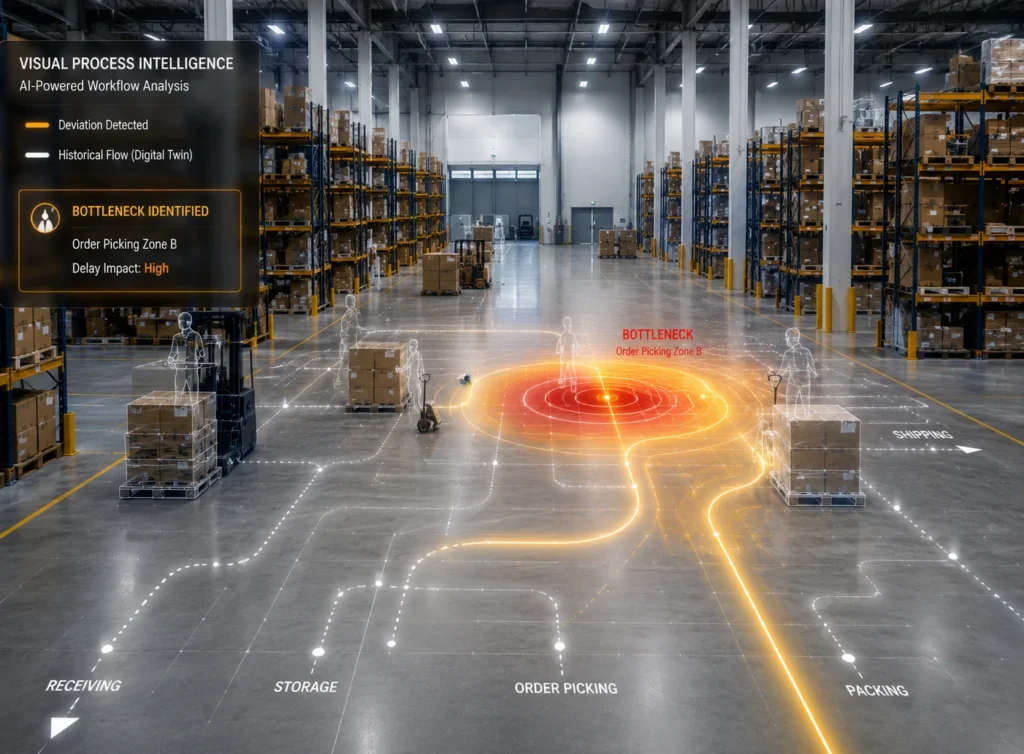
Many operational challenges originate within physical environments where traditional systems have limited visibility.
Computer vision enhances root cause analysis by providing continuous insight into operational activities through visual intelligence.
Organizations can use computer vision to:
- Monitor workflow execution
- Verify process adherence
- Detect operational bottlenecks
- Identify abnormal activity patterns
- Analyze movement and resource utilization
- Support compliance investigations
This creates a more complete understanding of what occurred before an issue developed.
From Reactive Investigations To Continuous Intelligence
Traditional root cause analysis often begins after a problem has already occurred.
AI enables organizations to move toward a more proactive model.
Traditional RCA | AI-Powered RCA |
Manual Investigations | Automated Analysis |
Historical Data Review | Continuous Monitoring |
Reactive Problem Solving | Early Pattern Detection |
Isolated Data Sources | Connected Operational Intelligence |
Time-Consuming Analysis | Faster Root Cause Identification |
This shift helps organizations address issues earlier and prevent recurrence.
Supporting Continuous Improvement
Root cause analysis is most valuable when it contributes to continuous improvement.
AI helps organizations create a feedback loop where operational insights continuously inform process enhancements.
Organizations can use AI-driven root cause analysis to:
- Improve process design
- Strengthen operational controls
- Reduce recurring disruptions
- Enhance compliance oversight
- Improve quality performance
- Support long-term operational excellence
The result is a more resilient and efficient operating environment.
From Identifying Problems To Preventing Recurrence
The true value of root cause analysis lies not simply in understanding what went wrong, but in preventing similar issues from occurring again. AI-powered root cause analysis provides organizations with deeper visibility into operational performance, helping leaders uncover hidden contributing factors, accelerate investigations, and implement more effective corrective actions.
As operational environments continue to grow in complexity, organizations that combine AI, computer vision, and continuous operational intelligence will be better equipped to identify root causes, strengthen decision-making, and build sustainable operational excellence.
How CAPASai Supports Root Cause Analysis
CAPASai helps organizations strengthen root cause analysis through AI-powered video analytics, real-time monitoring, operational intelligence, and automated alerts. By providing continuous visibility into workflows, process adherence, operational activities, and compliance events, CAPASai enables enterprises to investigate incidents more effectively, uncover contributing factors, and support data-driven corrective actions.