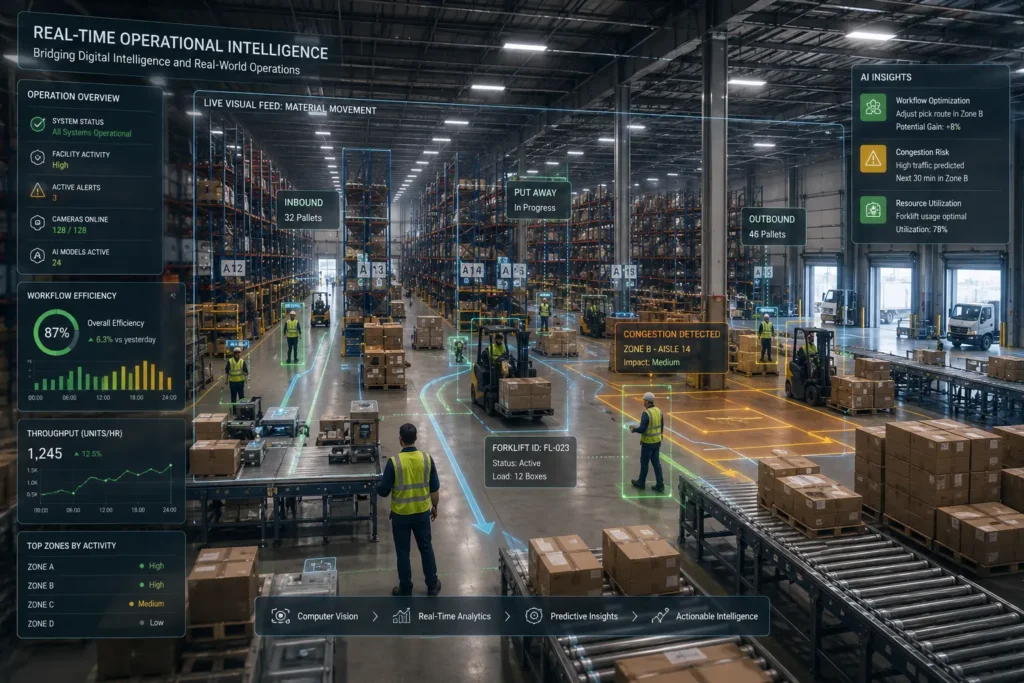
The discussion around Industry 5.0 often focuses on the relationship between people and technology. Unlike earlier industrial models that prioritized automation and efficiency above all else, Industry 5.0 emphasizes human-centered operations, organizational resilience, and intelligent decision-making. As enterprises move toward this new operating model, one technology is playing an increasingly important role in bridging the gap between digital intelligence and real-world operations: computer vision.
Organizations generate enormous amounts of operational activity every day, yet much of this activity remains difficult to measure consistently. Processes, workflows, safety practices, compliance procedures, and workforce interactions occur in physical environments where traditional data systems often provide only partial visibility.
Computer vision is changing this by enabling organizations to transform visual activity into operational intelligence.
Why Industry 5.0 Requires Greater Operational Visibility
Industry 5.0 encourages enterprises to create environments where people and intelligent technologies collaborate to achieve better outcomes.
However, effective collaboration depends on visibility.
Business leaders need answers to questions such as:
- Are operational procedures being followed consistently?
- Where are process bottlenecks occurring?
- Are safety standards being maintained?
- Which operational risks require attention?
- How can decision-makers respond faster to changing conditions?
Traditional reporting systems often provide answers after events have already occurred. Industry 5.0 requires more timely awareness.
This is where computer vision becomes a valuable source of operational intelligence.
Understanding Computer Vision In Enterprise Operations
Computer vision enables intelligent systems to analyze visual information captured through cameras and transform it into structured insights.
Rather than simply recording activities, computer vision can identify patterns, detect events, measure workflows, and monitor operational conditions in real time.
Common applications include:
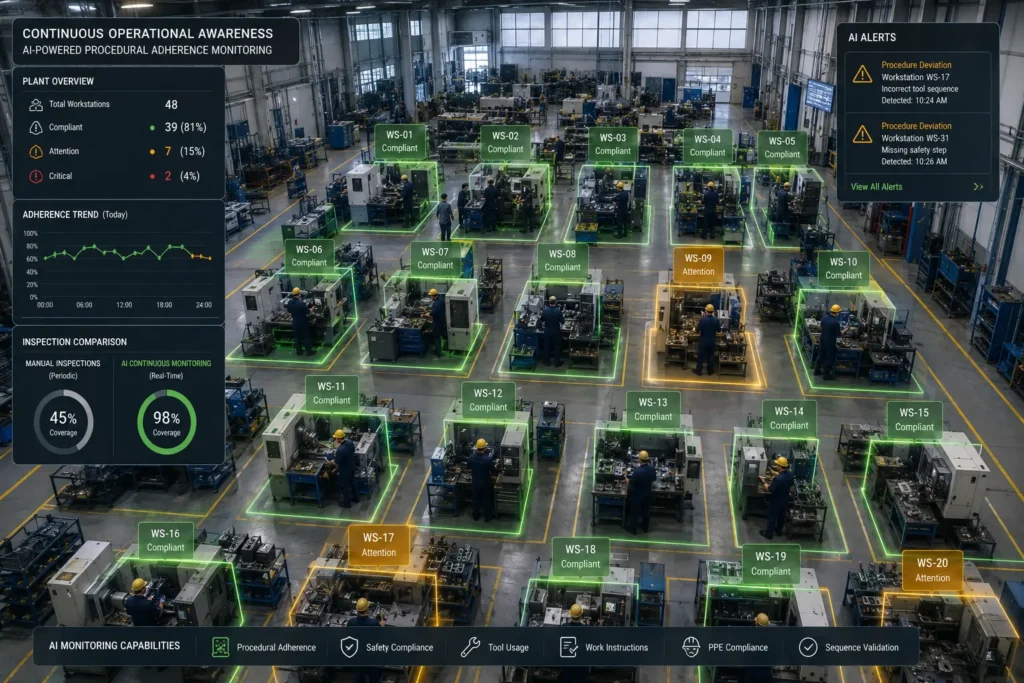
Process Monitoring
Tracking workflow execution and identifying process deviations.
Safety Compliance
Monitoring workplace safety conditions and procedural adherence.
Operational Analytics
Measuring activity patterns, congestion points, and process efficiency.
Governance And Oversight
Supporting continuous visibility into operational performance.
These capabilities help organizations move from observation to actionable intelligence.
Compare Traditional Monitoring And Computer Vision
Operational Area | Traditional Monitoring | Computer Vision |
Visibility | Manual Observation | Continuous Awareness |
Issue Detection | Reactive | Real-Time Identification |
Compliance Verification | Periodic Audits | Continuous Monitoring |
Process Analysis | Sample-Based Reviews | Ongoing Measurement |
Decision Support | Historical Reports | Live Operational Insights |
This shift supports the Industry 5.0 objective of creating more adaptive and informed operations.
How Computer Vision Supports Industry 5.0 Principles
Human-Centric Operations
Computer vision does not replace employees. Instead, it provides information that helps people make better decisions and manage operations more effectively.
Managers gain visibility into conditions that would otherwise be difficult to monitor consistently across facilities.
Organizational Resilience
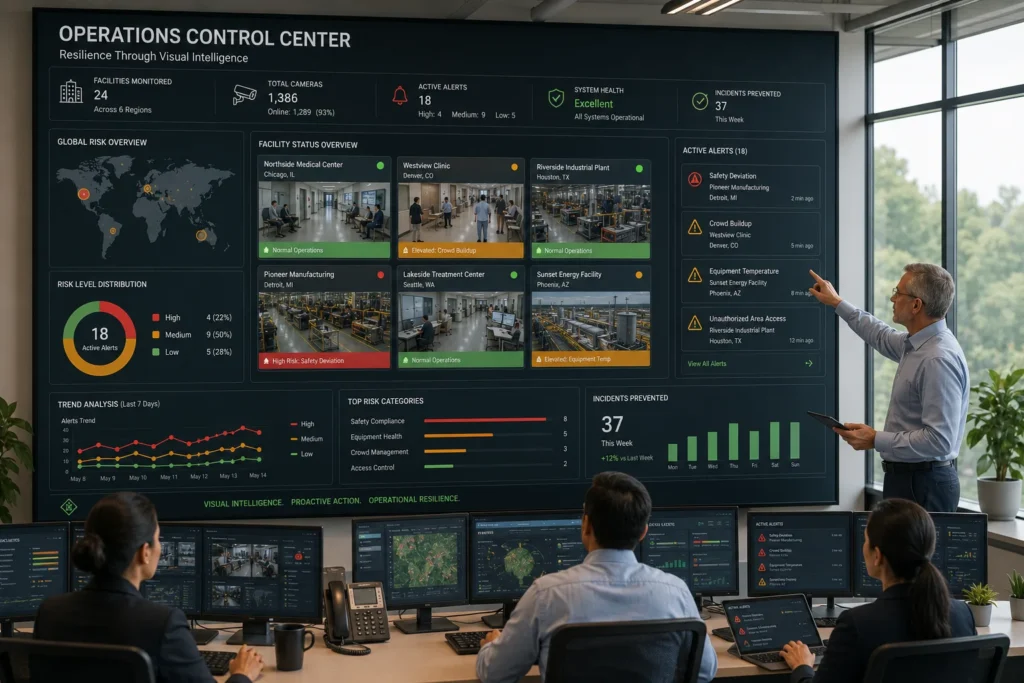
Real-time visibility enables organizations to identify risks earlier and respond more quickly to operational disruptions.
Continuous awareness improves adaptability and strengthens operational continuity.
Intelligent Decision-Making
Computer vision converts visual activity into measurable operational data, helping leaders make decisions based on objective evidence rather than assumptions.
This improves consistency across governance, compliance, and operational management.
Industry Applications Of Computer Vision
Computer vision is becoming increasingly valuable across multiple sectors.
Manufacturing
Organizations improve process visibility, quality monitoring, and safety oversight.
Retail
Managers gain insight into store operations, customer flow, and compliance execution.
Logistics
Operations teams monitor workflow efficiency, congestion areas, and material movement.
Healthcare
Healthcare providers strengthen process consistency and operational coordination.
Smart Infrastructure
Organizations improve visibility across large-scale facilities and public environments.
These applications demonstrate how visual intelligence is becoming a foundational capability for modern enterprises.
Human Expertise Remains Central
One of the defining characteristics of Industry 5.0 is the belief that technology should enhance human capabilities rather than replace them.
Computer vision follows this principle.
While intelligent systems can detect patterns and identify events, people remain responsible for interpreting context, making strategic decisions, and determining appropriate actions.
The strongest outcomes occur when operational intelligence and human expertise work together.
A Critical Technology For Industry 5.0
Industry 5.0 is accelerating the shift toward more intelligent, resilient, and human-centered operations. To achieve these goals, organizations require greater awareness of what is happening across their operational environments.
Computer vision helps close this visibility gap by transforming visual activity into actionable intelligence. By providing continuous operational awareness, supporting governance initiatives, and enabling more informed decision-making, computer vision is becoming a key technology in the Industry 5.0 transformation journey.
How CAPASai Supports Computer Vision Initiatives
CAPASai helps organizations leverage computer vision through AI-powered video analytics, remote monitoring, real-time alerts, and operational intelligence capabilities. By converting visual information into actionable insights, CAPASai supports compliance oversight, operational visibility, governance initiatives, and data-driven decision-making across distributed environments