Computer vision for operational governance is transforming how enterprises monitor, verify, and improve day-to-day operations. Governance has traditionally been associated with policies, audits, reporting structures, and management oversight. Yet many operational failures occur despite having established governance frameworks in place.. Yet many operational failures occur despite having established governance frameworks in place. The challenge is often not the absence of rules but the inability to consistently verify whether those rules are being followed across day-to-day operations.
As enterprises expand across multiple facilities, business units, and geographic regions, maintaining visibility into operational activities becomes increasingly difficult. Leaders responsible for governance frequently rely on periodic reports, site inspections, and compliance reviews to understand what is happening on the ground. While these approaches remain important, they often provide a delayed view of operational reality.
The emergence of computer vision is introducing a new model of governance—one built on continuous visibility, objective evidence, and real-time operational awareness.
Governance Challenges Hidden Inside Daily Operations
Many governance risks originate within routine activities that receive little attention until an incident occurs. A missed safety procedure, unauthorized access to a restricted area, non-compliance with operational protocols, or deviations from standard workflows can remain unnoticed for extended periods.
These seemingly minor issues can create significant consequences:
- Compliance violations
- Safety incidents
- Operational disruptions
- Product quality concerns
- Financial losses
- Reputational risks
Traditional oversight methods often identify these issues only after reviews, investigations, or customer complaints reveal their existence.
This delay creates a gap between governance intent and operational execution.
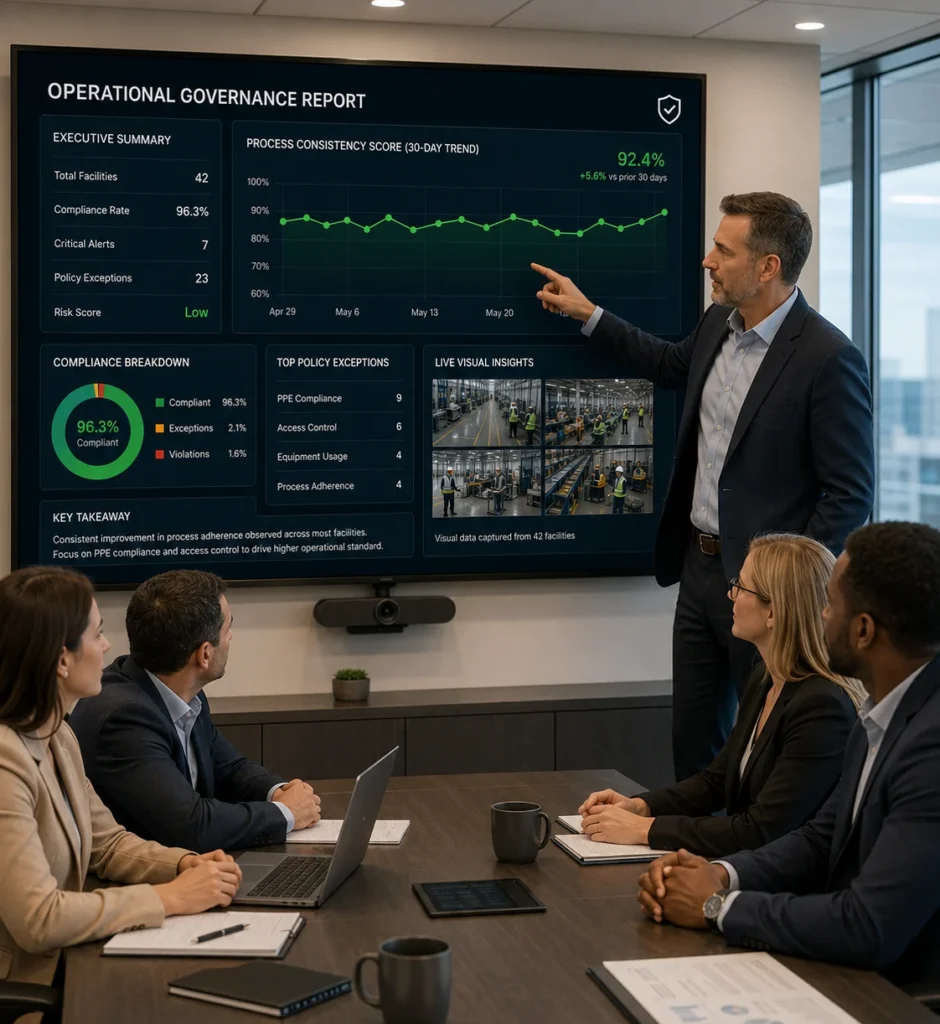
Moving Beyond Audit-Based Governance
Governance is evolving from a periodic activity into a continuous discipline.
Rather than waiting for scheduled inspections, organizations are increasingly seeking systems capable of identifying operational deviations as they occur.
Computer vision supports this shift by analyzing visual information from existing camera infrastructure and transforming it into actionable operational intelligence.
This capability enables enterprises to monitor:
Safety Compliance
Verification of protective equipment usage, restricted-area access, workplace safety procedures, and hazardous activities.
Process Adherence
Identification of workflow deviations, procedural inconsistencies, and operational exceptions.
Quality Assurance
Monitoring production processes and operational activities to support quality standards.
Security And Access Control
Detection of unauthorized activities and access violations across facilities.
Operational Performance
Observation of workflows, bottlenecks, congestion points, and resource utilization patterns.
The Visibility Problem Facing Enterprise Leaders
Executives and operational leaders are expected to ensure consistency across environments they cannot physically observe every day. A manufacturing organization may operate dozens of facilities. A retail chain may manage hundreds of stores. A logistics company may oversee multiple warehouses and distribution centers simultaneously.
The question becomes increasingly important:
How can leaders govern operations they cannot continuously see?
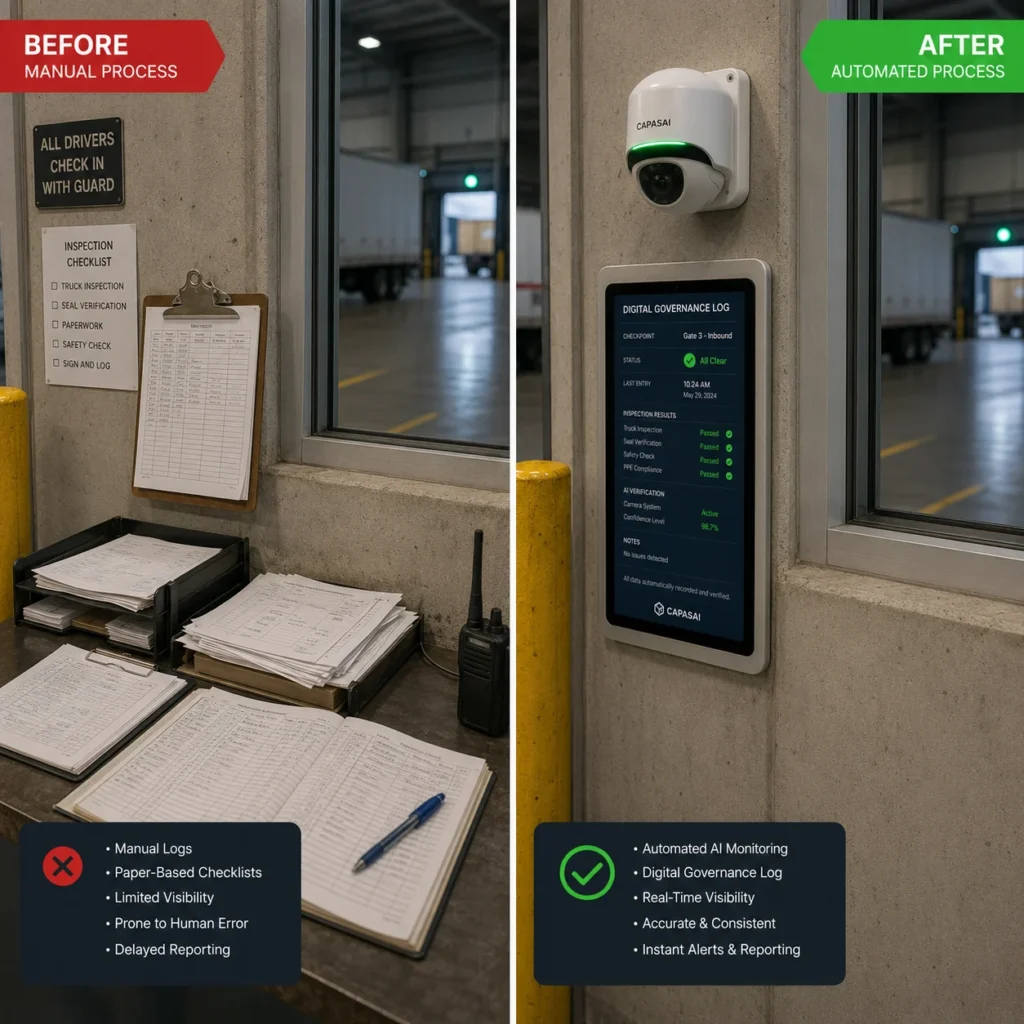
Historically, organizations attempted to address this challenge through audits, checklists, manual reporting, and supervisory reviews. These tools remain valuable, but they often depend heavily on human observation and periodic assessments.
Computer vision introduces an additional layer of oversight by enabling continuous monitoring of operational environments.
Compare Traditional Governance And Visual Governance
Governance Dimension | Traditional Approach | Computer Vision-Enabled Approach |
Oversight Frequency | Periodic Reviews | Continuous Monitoring |
Evidence Collection | Manual Documentation | Automated Visual Verification |
Issue Detection | After Occurrence | Near Real-Time |
Multi-Site Visibility | Limited | Centralized Visibility |
Compliance Verification | Sample-Based Audits | Ongoing Observation |
This comparison highlights why many organizations are beginning to view computer vision not simply as a monitoring tool but as an operational governance capability.
Why Objectivity Matters In Governance
One of the most significant advantages of computer vision is the ability to provide objective operational evidence.
Governance decisions are often influenced by incomplete information, subjective observations, or inconsistent reporting practices. Visual intelligence introduces a more standardized method for understanding operational conditions.
Instead of relying solely on assumptions or retrospective reports, organizations can evaluate actual activities occurring within facilities.
This creates stronger accountability while supporting more informed decision-making.
Governance Applications Across Industries
The impact of visual governance extends across numerous sectors.
Manufacturing And Pharmaceuticals
Organizations use computer vision to support compliance, quality assurance, safety management, and process consistency.
Retail And Quick Service Restaurants
Businesses monitor operational standards, customer service procedures, and store-level compliance across multiple locations.
Healthcare And Hospitals
Healthcare providers strengthen patient safety initiatives, operational oversight, and regulatory compliance efforts.
Logistics And Transportation
Computer vision helps monitor loading activities, warehouse operations, fleet processes, and safety procedures.
Smart Cities And Public Infrastructure
Authorities improve situational awareness, infrastructure monitoring, and public safety management.
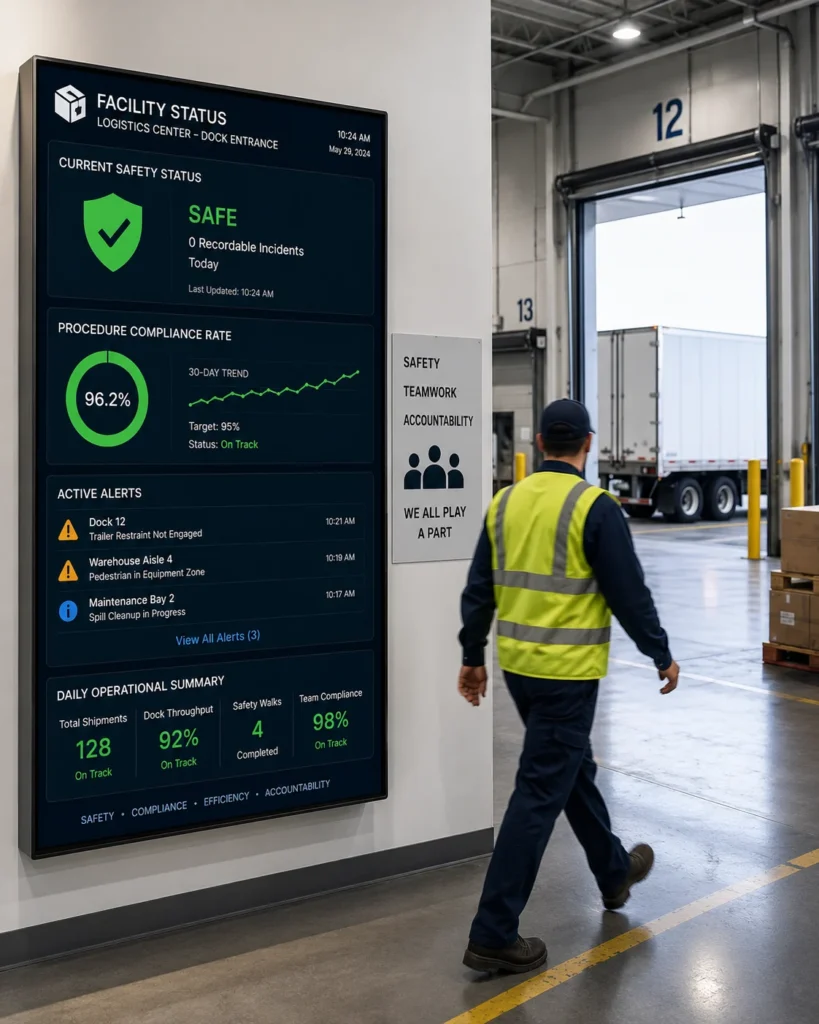
Building Governance That Scales
As organizations grow, governance models must evolve beyond manual supervision alone. Enterprise leaders increasingly require mechanisms capable of maintaining consistency across distributed environments without creating excessive administrative burden.
Computer vision contributes to scalable governance by providing continuous operational visibility, enabling leaders to focus attention on exceptions, risks, and areas requiring intervention.
This approach helps transform governance from a reactive process into a proactive operational capability.
How CAPASai Supports Governance Objectives
Organizations seeking stronger operational governance increasingly require technologies that connect visibility with action. CAPASai supports this objective through AI-powered video analytics, remote monitoring, and real-time alerting capabilities that help enterprises identify operational deviations, strengthen compliance oversight, and improve situational awareness across multiple facilities. By turning visual data into actionable intelligence, organizations can reinforce governance practices while improving operational responsiveness.