Auditing Is Evolving Faster Than Traditional Methods Can Keep Up
For decades, audits have been a cornerstone of operational governance. Organizations have relied on audit teams, inspections, checklists, and supervisory reviews to evaluate compliance, identify risks, and maintain operational standards.
While these methods continue to play an important role, modern enterprises face a new reality. Operations now span multiple locations, thousands of daily activities, and increasingly complex compliance requirements. As businesses grow, the volume of processes requiring verification often exceeds the capacity of traditional audit models.
This has led many organizations to explore AI-based auditing as a complementary approach to conventional audits.
The necessity of audits is no longer a dispute.
The question is whether traditional audit methods alone can provide the level of visibility required in today’s operational environments.
Understanding the Two Approaches
Before comparing the two models, it is important to understand their fundamental differences.
Traditional Manual Audits
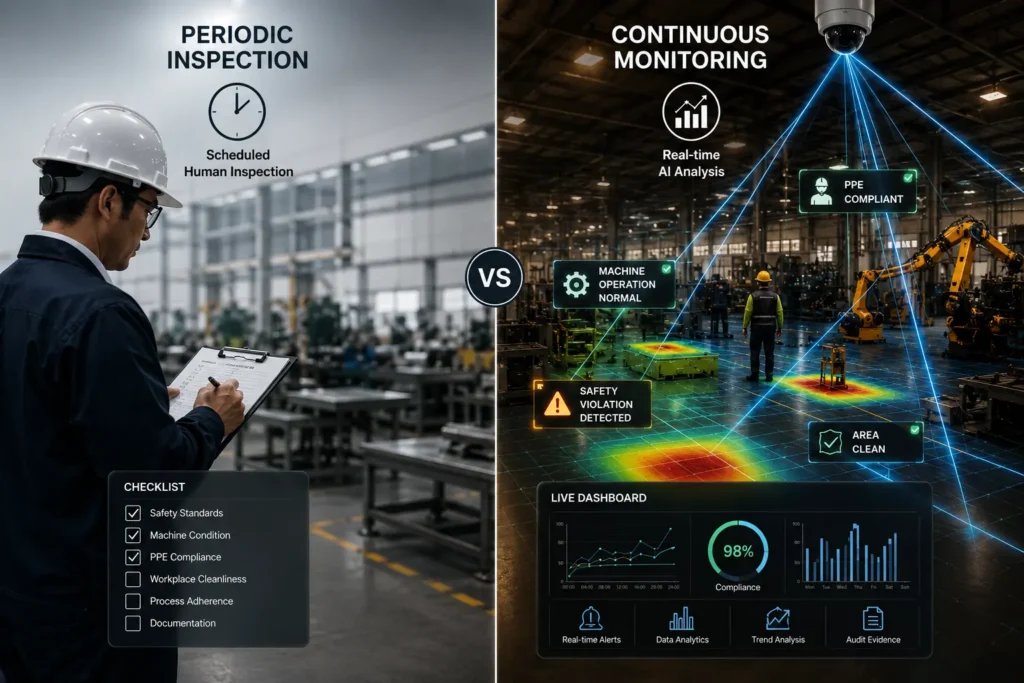
Traditional audits rely on human observation, inspections, interviews, documentation reviews, and sample-based evaluations. They are typically conducted periodically and focus on verifying whether operational standards have been followed
AI-Based Auditing
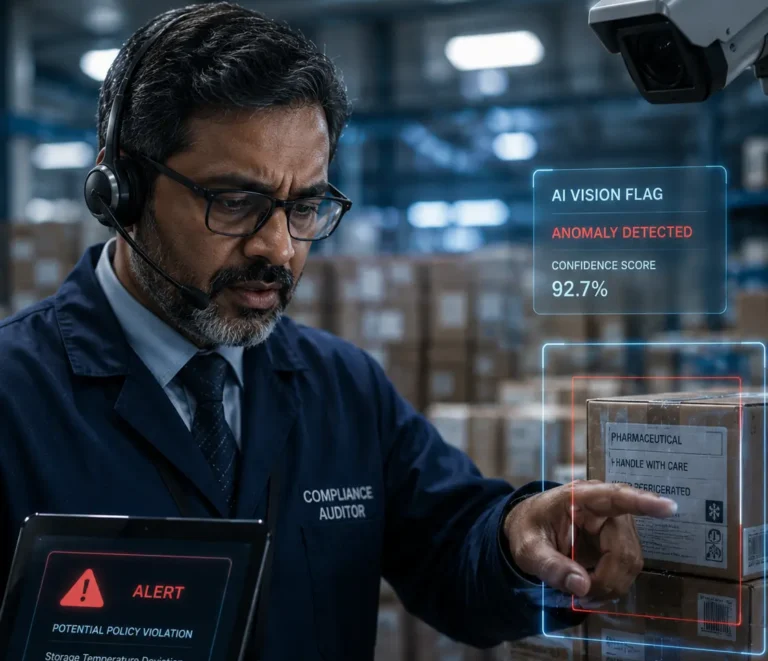
AI-based auditing uses technologies such as computer vision, video analytics, machine learning, and automated monitoring systems to evaluate operational activities continuously and identify deviations that may require attention.
AI allows for more extensive and frequent verification instead of depending just on planned inspections.
Side-by-Side Comparison
Audit Factor | Traditional Manual Audits | AI-Based Auditing |
Frequency | Periodic | Continuous |
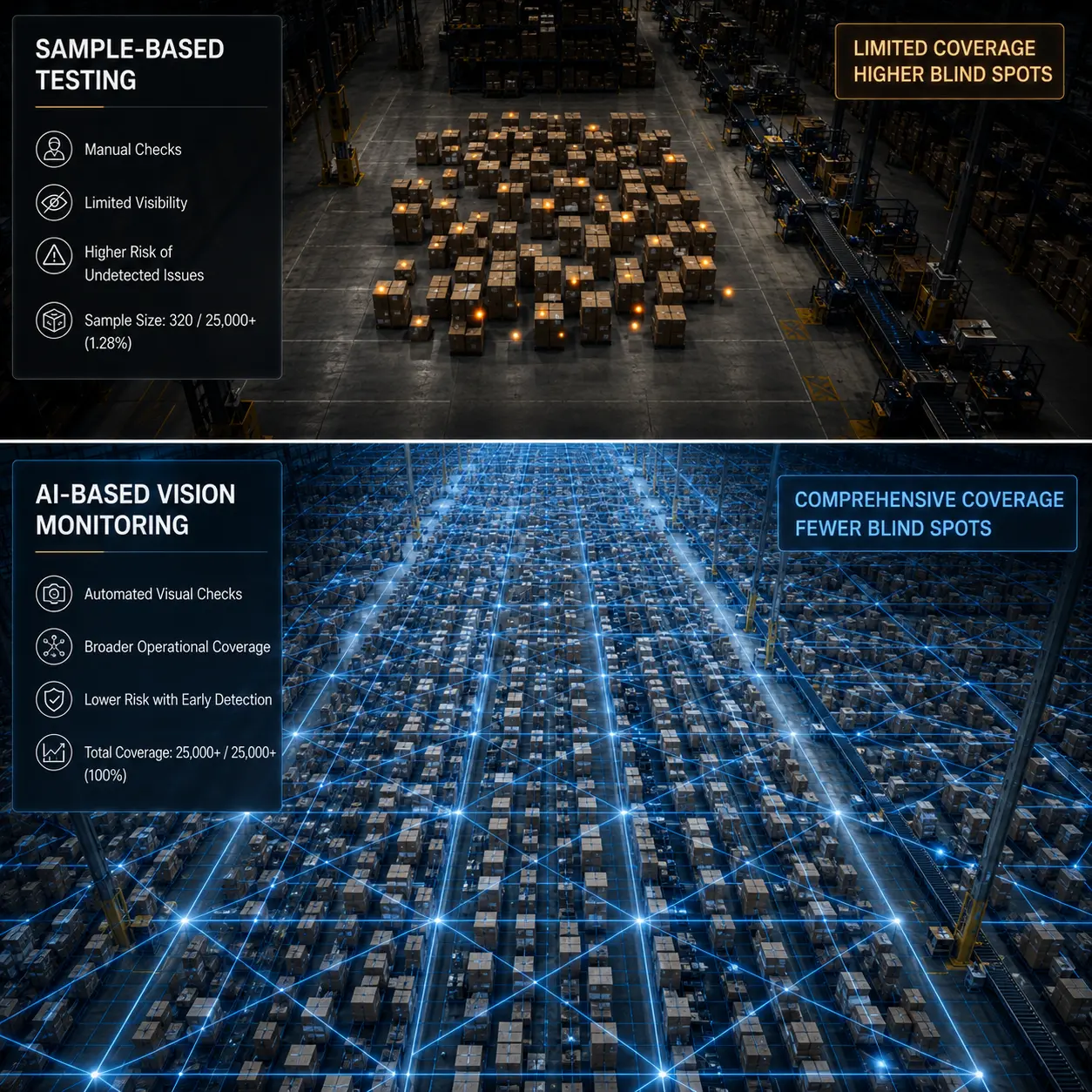
Coverage | Sample-based | Broader operational coverage |
Detection Speed | Often after the event | Near real-time identification |
Resource Requirements | High human involvement | Automated monitoring support |
Multi-Site Visibility | Limited by available personnel | Scalable across locations |
Data Collection | Manual documentation | Automated evidence generation |
Consistency | May vary by auditor | Standardized evaluation criteria |
Scalability | Resource dependent | Technology driven |
The comparison highlights why many organizations are beginning to supplement manual audits with AI-powered capabilities.
Where Traditional Audits Continue to Add Value
Where Traditional Audits Continue to Add Value
Despite technological advancements, manual audits remain valuable in several areas.
Contextual Evaluation
Organisational culture, staff conduct, and situational elements that automated systems might not always record can all be evaluated by human auditors.
Policy Interpretation
Certain compliance requirements require judgment, discussion, and interpretation rather than simple verification.
Root Cause Investigation
Auditors often play an important role in understanding why an issue occurred and recommending process improvements.
For these reasons, audit experts shouldn’t be replaced by AI.
Instead, it should be viewed as a tool that enhances their effectiveness.
Where AI-Based Auditing Creates Advantages
The greatest strength of AI lies in its ability to address challenges associated with scale.
Continuous Observation
AI systems can evaluate operational environments throughout the day without being constrained by audit schedules.
Faster Identification of Deviations
Potential issues can be identified much earlier, allowing organizations to respond before risks escalate.
Enterprise-Wide Visibility
Organizations operating multiple facilities can gain broader oversight without proportionally increasing audit resources.
Automated Evidence Collection
AI systems can help create digital records of operational activities, reducing reliance on manual documentation processes.
Choosing the Right Approach
For most organizations, the decision is not a choice between manual audits and AI-based auditing.
Combining the two is frequently the most successful approach.
Traditional Audits Are Best For:
- Regulatory assessments
- Detailed investigations
- Policy reviews
- Governance evaluations
AI-Based Auditing Is Best For:
- Continuous verification
- Process compliance monitoring
- Operational standard enforcement
- Multi-site oversight
- Early issue detection
By combining these approaches, organizations can strengthen both operational visibility and audit effectiveness.
The Emerging Hybrid Audit Model
A growing number of enterprises are moving toward what can be described as a hybrid audit model.
In this approach:
- AI continuously monitors operational activities.
- Potential deviations are automatically flagged.
- Audit teams focus on investigation and corrective actions.
- Management receives faster access to operational evidence.
How CAPASai Supports AI-Based Auditing
CAPASai uses AI-powered video analytics, computer vision, remote monitoring, and real-time alerting capabilities to assist organisations improve their auditing and compliance procedures.
By leveraging existing CCTV infrastructure, CAPASai can help identify process deviations, generate operational evidence, and provide continuous visibility across multiple locations.
This enables audit teams to focus on higher-value analysis while improving the speed and consistency of operational verification