The Audit That Never Happened
At the end of a shift, a plant manager receives a summary of the day’s operations. Safety procedures were followed in 97% of observed activities. Two process deviations occurred on Line 4. A restricted area was accessed outside approved hours. One loading activity failed to meet established handling procedures.
The surprising part?
No auditor walked the floor. No supervisor spent hours reviewing footage. No compliance team conducted a special inspection.
The operation effectively audited itself.
For enterprises managing multiple facilities, this represents a significant shift in how compliance, quality, and operational standards are maintained.
Why Traditional Audits Are Reaching Their Limits
Audits have long been an essential part of operational governance. They help organizations verify compliance, identify risks, and maintain consistency across locations.
However, audits were never designed to provide continuous oversight.
A monthly audit may reveal a recurring process issue. A quarterly inspection may uncover safety concerns. A compliance review may identify operational gaps that have existed for weeks.
The challenge is not that audits are ineffective.
The challenge is that modern operations move faster than periodic reviews.
As organizations grow, leaders increasingly need visibility between audits, not just during them.
From Inspection to Continuous Verification
Historically, organizations relied on inspection-based management. Teams periodically checked whether procedures were being followed.
Today, many enterprises are moving toward verification-based management.
Instead of asking:
“Did someone inspect this process?”
The question becomes:
“Can we continuously verify that the process is being followed?”
This shift changes the role of operational oversight.
Verification becomes embedded into daily operations rather than remaining a separate activity.
When Every Process Creates Evidence
One reason self-auditing operations are becoming practical is that modern facilities already generate enormous amounts of operational evidence.
Employees interact with equipment. Materials move through workflows. Safety procedures are performed. Operational activities occur in view of existing camera infrastructure.
The information already exists.
The challenge has always been turning that information into meaningful operational intelligence.
This is where AI-powered video analytics plays a critical role.
Rather than relying on manual observation, intelligent systems can continuously evaluate activities and identify deviations from expected processes.
The result is a scalable method of operational verification.
What a Self-Auditing Operation Looks Like
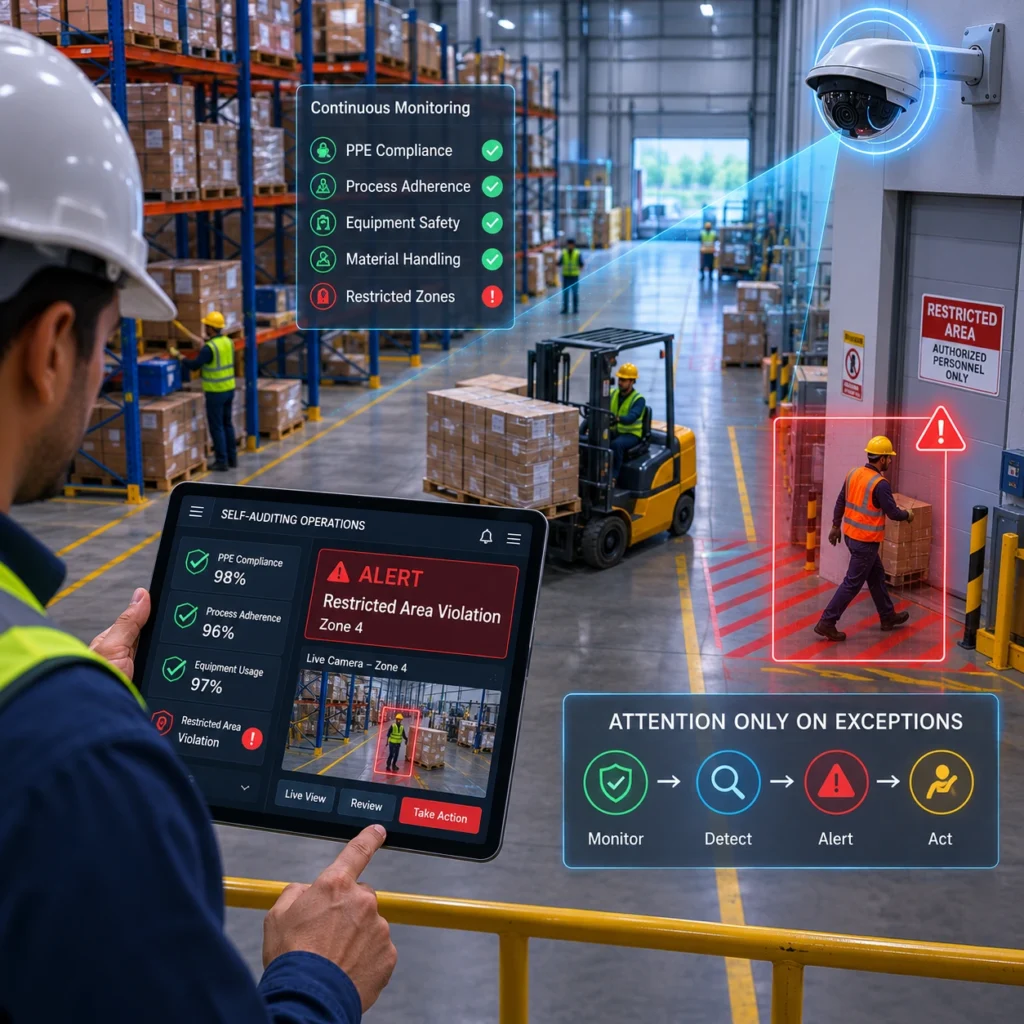
A self-auditing operation continuously validates critical activities against predefined standards.
Rather than waiting for reviews or inspections, the system identifies exceptions as they occur.
Examples include:
- Verifying PPE compliance in production areas
- Confirming process adherence on manufacturing lines
- Monitoring equipment usage procedures
- Validating warehouse safety practices
- Identifying restricted-area violations
- Tracking service standard compliance
Most activities require no intervention.
Attention is directed only toward exceptions that require investigation or corrective action.
The Business Impact of Self-Auditing Operations
Organizations adopting self-auditing capabilities often discover benefits beyond compliance.
Operational teams spend less time searching for issues.
Managers receive earlier visibility into risks.
Compliance programs become more proactive.
Corrective actions can be initiated before minor issues become larger operational problems.
Perhaps most importantly, consistency becomes easier to maintain across multiple locations.
The goal is not to create more reports.
The goal is to create greater confidence in daily operations.
How CAPASai Supports Self-Auditing Operations
CAPASai helps organizations build self-auditing operational environments using AI-powered video analytics, remote monitoring, and real-time alerting capabilities.
By analyzing operational activities through existing CCTV infrastructure, CAPASai can help verify process adherence, identify compliance deviations, and provide actionable visibility across multiple facilities.
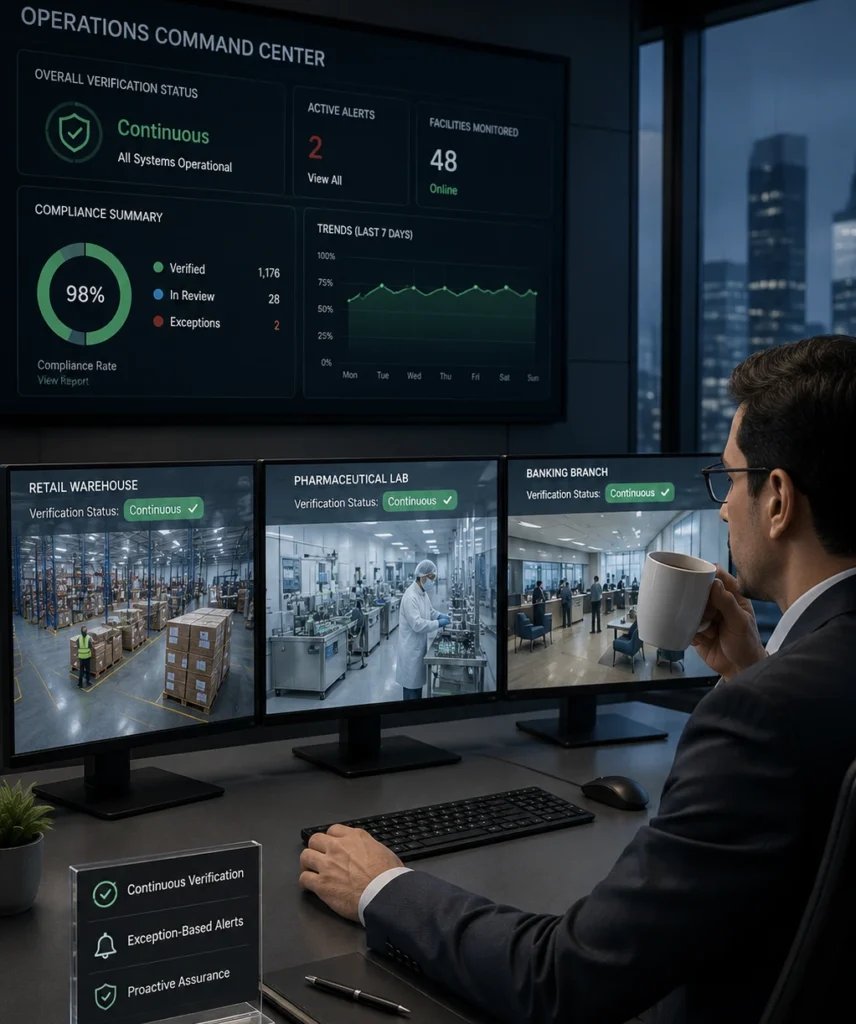
This enables organizations to move from periodic verification toward continuous operational assurance without significantly increasing supervisory effort.
What is a self-auditing operation?
A self-auditing operation continuously verifies operational activities against predefined standards using intelligent monitoring technologies and automated analysis.
How does AI support self-auditing operations?
AI can automatically evaluate operational activities, identify exceptions, and provide alerts when processes deviate from expected standards.
Why are traditional audits becoming more challenging?
As organizations expand across multiple sites and processes, periodic audits may not provide sufficient visibility into daily operational activities.
Can video analytics improve compliance monitoring?
Yes. AI-powered video analytics can help verify process adherence, safety protocols, equipment usage procedures, and other operational requirements.
How does CAPASai enable self-auditing operations?
CAPASai uses AI-powered video analytics and real-time monitoring to help organizations continuously verify operational processes, identify deviations, and improve compliance visibility.