
A decade ago, operational monitoring meant assigning more supervisors, conducting more inspections, and generating more reports. When a business expanded, oversight expanded with it. More locations typically required more people to monitor them.
Today, that equation is beginning to change.
As enterprises grow across multiple sites, facilities, and regions, leaders are discovering that simply adding more layers of supervision does not always improve visibility. In many cases, it increases complexity. Reports accumulate, dashboards multiply, and managers spend more time reviewing information than acting on it.
This challenge has sparked interest in a new approach: autonomous operational monitoring
The Shift From Observation to Autonomous Awareness
Autonomous operational monitoring systems are designed to continuously observe operational environments, identify significant events, and surface actionable insights without requiring constant human supervision.
The goal is not to completely automate decision-making.
The objective is to automate awareness.
Instead of asking teams to manually detect every issue, intelligent systems continuously evaluate operational conditions and notify the right people when attention is required.
This creates a fundamentally different operating model—one where visibility becomes continuous rather than periodic.
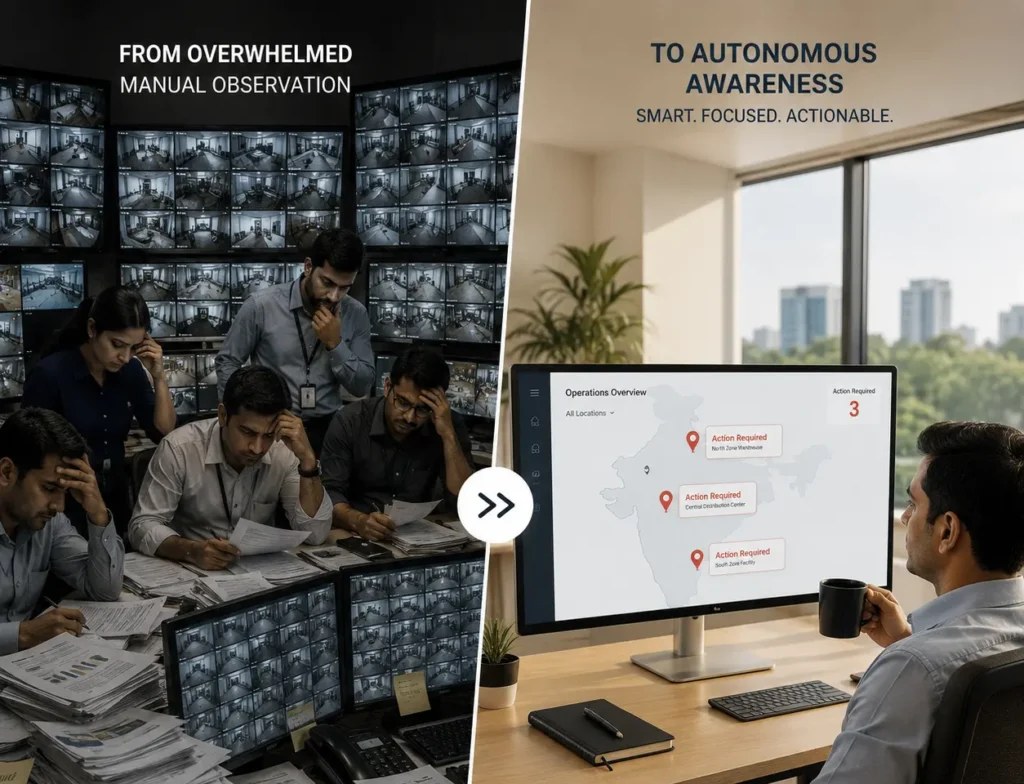
When Monitoring Becomes the Work
Consider a large enterprise operating dozens of facilities. Every day, managers review compliance reports, investigate operational incidents, verify process adherence, and track performance metrics.
The intention is to maintain control.
The reality is often different.
Highly skilled managers can become trapped in a cycle of observation, spending significant time searching for issues instead of solving them. Critical events may still go unnoticed, while operational risks can remain hidden between reporting cycles.
As organizations scale, monitoring itself can become a major operational burden.
What Makes a Monitoring System Autonomous?
Many organizations already collect operational data through cameras, sensors, software platforms, and reporting systems.
An autonomous monitoring system goes further by combining continuous observation with intelligent analysis.
Key characteristics include:
- Continuous operational monitoring
- Automated anomaly detection
- Real-time alert generation
- Compliance verification
- Pattern recognition
- Event prioritization
- Enterprise-wide visibility
Rather than acting as a passive recording tool, the system functions as an active operational intelligence layer.
Why Enterprises Are Moving in This Direction
Several business realities are accelerating the adoption of autonomous monitoring.
First, operational complexity continues to increase. Multi-site organizations must manage more locations, more processes, and more compliance requirements than ever before.
Second, expectations around responsiveness have changed. Organizations can no longer afford to wait hours—or days—to discover operational problems.
Third, labor-intensive monitoring models become increasingly difficult to scale. Adding more supervisors may improve coverage temporarily, but it rarely creates sustainable visibility across large enterprises.
Autonomous monitoring helps address these challenges by providing continuous awareness without requiring continuous observation.
The Building Blocks of Autonomous Operations
Successful autonomous monitoring systems are typically built around four capabilities.
Continuous Visibility
Operational activities are monitored in real time across facilities, departments, and locations.
Intelligent Detection
The system identifies unusual events, process deviations, operational risks, and compliance concerns automatically.
Prioritized Alerts
Rather than overwhelming teams with data, the system highlights events that require immediate attention.
Actionable Insights
Managers receive information that supports decision-making instead of spending time searching through reports and footage.
Together, these capabilities help transform operational oversight from a reactive activity into a proactive process.

How CAPASai Supports Autonomous Operational Monitoring
CAPASai enables organizations to build autonomous operational monitoring capabilities using AI-powered video analytics, remote monitoring, and real-time alerting.
By leveraging existing CCTV infrastructure, CAPASai can continuously monitor operational environments, identify deviations from expected processes, detect compliance concerns, and generate timely alerts for relevant teams.
This helps organizations improve visibility while reducing dependence on manual monitoring activities.
Rather than replacing operational teams, CAPASai allows them to focus on higher-value decisions and corrective actions.
The Next Stage of Operational Excellence
Autonomous monitoring is not about removing people from operations. It is about ensuring people spend less time searching for problems and more time improving performance.
As enterprises continue to grow, the ability to maintain awareness across multiple locations will become increasingly important.
Organizations that successfully build autonomous operational monitoring systems will be better positioned to improve compliance, accelerate response times, strengthen operational consistency, and scale oversight without proportionally increasing management resources.
The future of operational monitoring is unlikely to be defined by more reports or more supervision. It will be defined by systems that can recognize what matters and bring it to human attention at exactly the right moment.