Why Organizations Struggle with Operational Compliance
Across industries, operational compliance has become increasingly difficult to manage. Whether it’s a manufacturing plant, retail chain, hospital, warehouse, bank branch, construction site, or public infrastructure project, organizations must continuously monitor processes, ensure policy adherence, and respond quickly to incidents.
To find operational hazards, many companies still use manual inspections, recurring audits, employee reports, and post-incident investigations. This reactive strategy frequently results in insufficient evidence gathering, delayed actions, persistent compliance problems, and higher operating expenses.
As facilities become larger and more distributed, maintaining visibility across multiple locations becomes even more challenging. Organizations need faster ways to detect issues, document events, and ensure corrective actions are completed before small problems become major operational failures.
The Gap Between Incident Detection and CAPA Closure
Many organizations have CCTV systems in place, but traditional surveillance often serves only as a recording tool. When an incident occurs, teams must manually review footage, gather evidence, interview personnel, and reconstruct timelines.
Common challenges include:
- Delayed incident detection
- Time-consuming investigations
- Incomplete root cause analysis
- Limited multi-site visibility
- Repeated compliance violations
- Manual documentation processes
- Slow corrective and preventive action implementation
The result is a gap between detecting an event and successfully closing the CAPA process. Organizations are increasingly seeking automated solutions that connect incident detection directly to corrective action workflows.
How CAPASai Bridges the Gap
It helps organizations move from reactive monitoring to proactive operational compliance through AI-powered video analytics, remote monitoring, and real-time alerts.
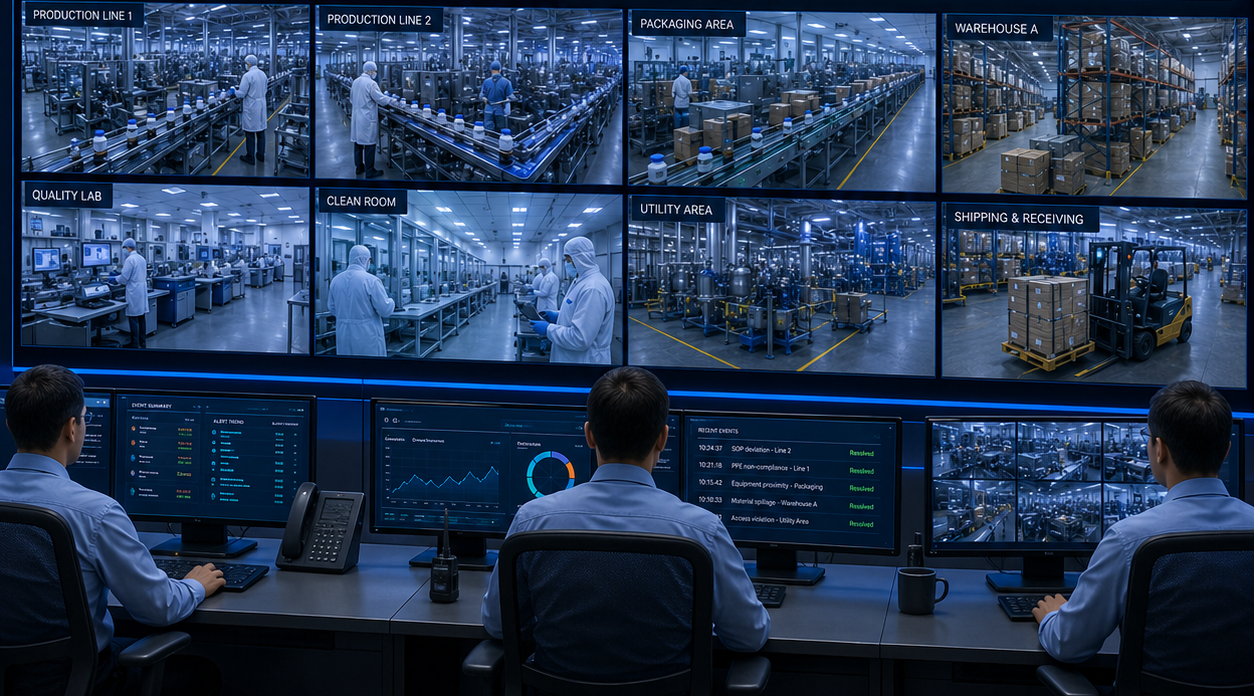
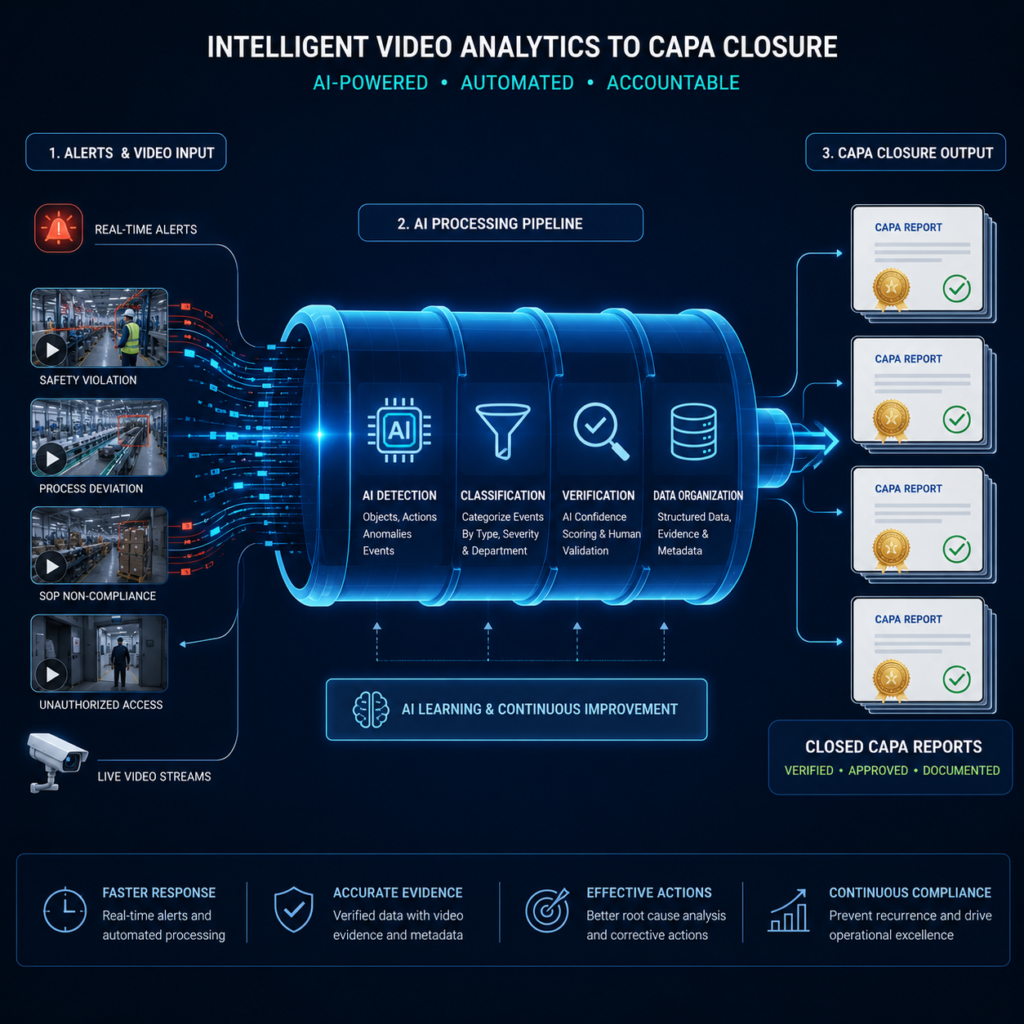
By continuously analyzing CCTV footage, it automatically identifies operational events, compliance violations, safety incidents, process deviations, and unusual activities. Relevant incidents are captured, categorized, and documented in real time, helping teams accelerate investigations and CAPA workflows.
Key capabilities include:
- Intelligent video analytics
- Remote store and facility monitoring
- Real-time incident alerts
- SOP compliance verification
- Process deviation detection
- Safety monitoring and incident tracking
- Centralized multi-site visibility
- Automated evidence collection
- Faster CAPA investigations
This enables organizations to reduce response times, improve accountability, and strengthen operational compliance programs.
Traditional CCTV Monitoring vs AI-Powered Compliance Monitoring
Function | Traditional CCTV | AI Video Analytics |
Incident Detection | Manual review | Automated identification |
Alerting | After-the-fact | Real-time notifications |
Evidence Collection | Manual search | Automatic capture |
Compliance Monitoring | Periodic audits | Continuous monitoring |
Root Cause Analysis | Time-intensive | Faster investigations |
CAPA Support | Limited | Integrated evidence generation |
Industry Applications
Manufacturing & Pharmaceutical Facilities
- SOP compliance monitoring
- Process deviation detection
- GMP compliance verification
- Quality investigations
Retail Chains & Quick Service Restaurants
- Store operations monitoring
- Service compliance verification
- Loss prevention support
- Multi-location visibility
Banking & BFSI
- Branch compliance monitoring
- Security event investigations
- Operational oversight
Healthcare & Hospitals
- Patient safety monitoring
- Restricted area surveillance
- Incident documentation
Construction, Energy & Utilities
- PPE compliance monitoring
- Hazard detection
- Contractor safety verification
Agriculture, Dairy & Meat Processing
- Hygiene compliance monitoring
- Production oversight
- Operational risk management
Education, Hospitality, Smart Cities & Transportation
- Campus safety monitoring
- Public area surveillance
- Fleet operations visibility
- Infrastructure monitoring
E-Commerce Fulfillment & Security Operations
- Warehouse compliance monitoring
- Inventory handling verification
- Centralized security oversight
Example Use Case
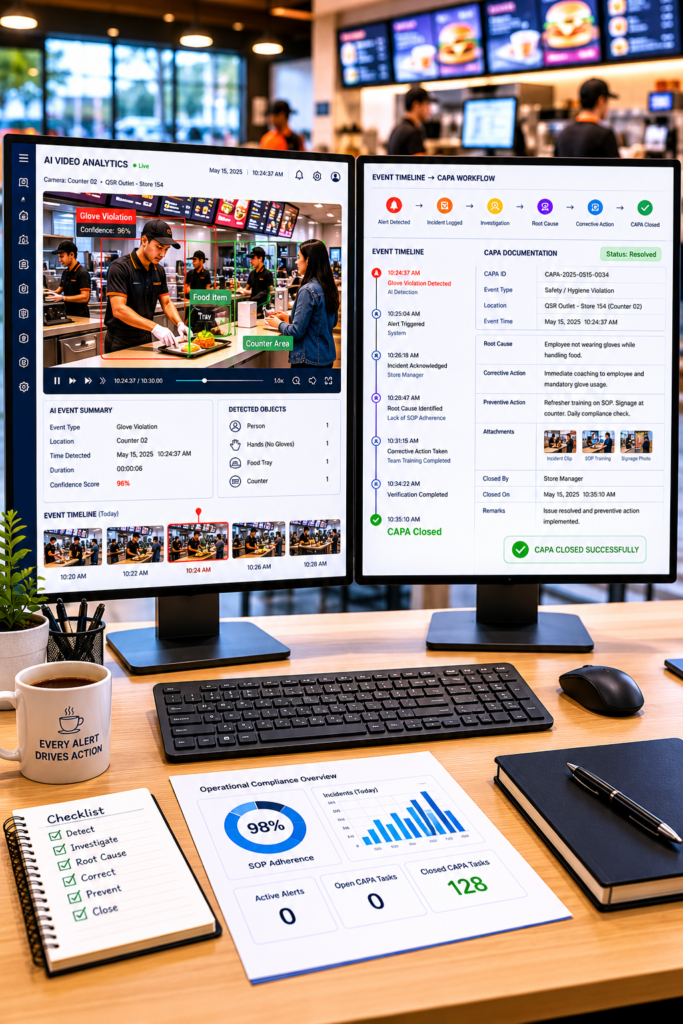
A pharmaceutical manufacturer receives repeated reports of packaging inconsistencies. Instead of manually reviewing hours of CCTV footage, AI video analytics automatically flags a recurring process deviation on a production line. The system captures visual evidence, timestamps the event, and provides investigators with a complete incident timeline. The root cause is identified faster, corrective actions are implemented, and future recurrence is prevented.
Operational Compliance Checklist
Organizations looking to improve compliance performance should:
✔ Monitor critical processes continuously
✔ Configure automated alerts for high-risk events
✔ Capture incident evidence automatically
✔ Maintain centralized investigation records
✔ Track recurring compliance issues
✔ Strengthen CAPA workflows with visual evidence
✔ Use data-driven insights for preventive action planning
Frequently Asked Questions
Real-time alerts enable organizations to respond immediately to safety violations, process deviations, unauthorized activities, and operational disruptions. Faster response times help reduce risks, minimize downtime, and improve overall efficiency
Yes. AI-powered monitoring continuously observes operations and automatically identifies exceptions, reducing the need for frequent manual inspections while improving visibility across facilities.
AI video analytics can detect safety violations, unauthorized access, process deviations, equipment misuse, crowding, restricted area breaches, operational bottlenecks, and other predefined events based on business requirements.
Automated evidence collection captures relevant video clips, timestamps, and event details as incidents occur. This helps investigation teams access accurate information quickly and supports faster root cause analysis
Centralised monitoring helps businesses maintain uniform compliance requirements, spot reoccurring problems, and enhance decision-making throughout the organization by offering a consolidated view of operations across several locations
Indeed. Retail chains, quick service restaurants, manufacturing, pharmaceuticals, banking, healthcare, agriculture, education, hospitality, transportation, utilities, construction, smart cities, and e-commerce fulfilment centers are just a few of the many industries it services
Key Takeaways
To preserve compliance, enhance operational visibility, and lower recurrent events, organisations now require more than just traditional surveillance. Automated evidence gathering, quicker operational risk identification, and more effective corrective action procedures are all made possible by AI-powered video analytics. Businesses may improve decision-making, bolster compliance programs, and develop a more proactive approach to operational excellence across many locations and industries by integrating real-time monitoring with investigation procedures.
The future of operational compliance is moving beyond passive surveillance toward intelligent, automated monitoring. By transforming CCTV footage into actionable operational insights, organizations can close the gap between incident detection and CAPA closure. CAPASai helps businesses achieve this through AI-powered video analytics, remote monitoring, and real-time alerts that improve visibility, accelerate investigations, and support continuous operational improvement.