Introduction
For decades, businesses have relied on manual monitoring—security guards, supervisors, and CCTV operators—to manage operations, ensure compliance, and prevent losses. While this approach has been the norm, it comes with hidden inefficiencies, escalating costs, and significant blind spots.
Today, AI-powered video analytics platforms like CAPASai are transforming how organizations monitor their operations. Instead of reactive human observation, businesses now have access to proactive, real-time intelligence that prevents problems before they escalate.
But the key question decision-makers ask is:
“Is AI monitoring really more cost-effective than manual monitoring?”
This blog breaks down the true cost comparison—beyond salaries—to reveal where businesses are losing money and how AI delivers measurable ROI.
The Reality of Manual Monitoring
Manual monitoring typically involves:
- Security guards
- CCTV operators
- Floor supervisors
- Audit teams
At first glance, this seems sufficient. However, the limitations are significant.
1. Human Limitations
No matter how experienced, humans:
- Cannot watch multiple screens continuously
- Miss events due to fatigue or distraction
- React after incidents, not before
Studies show that human attention drops drastically after 20 minutes of continuous monitoring.
2. Limited Coverage
A typical operator:
- Monitors 8–16 cameras at once
- Focuses only on visible events
- Misses subtle anomalies (e.g., SOP violations, minor theft)
3. Reactive Nature
Manual monitoring:
- Identifies issues after they occur
- Relies on incident reporting
- Lacks real-time intervention
4. High Recurring Costs
Let’s look at a basic cost structure:
Role | Monthly Cost (USD) | Annual Cost |
Security Guard (per location) | $250–$400 | $3,000–$4,800 |
CCTV Operator | $400–$700 | $4,800–$8,400 |
Supervisor | $600–$1,000 | $7,200–$12,000 |
For a 50-location business, this easily exceeds:
👉 $500,000+ annually
And this doesn’t guarantee:
- Theft prevention
- SOP compliance
- Operational efficiency
The Hidden Costs of Manual Monitoring
Beyond salaries, businesses incur invisible losses:
🔻 Shrinkage & Theft
- Retail shrinkage: 1.5%–3% of revenue
- Warehouse theft often goes unnoticed
🔻 SOP Violations
- Staff skipping processes
- Hygiene breaches in QSR/Pharma
- Improper handling of goods
🔻 Operational Inefficiencies
- Long queues
- Idle staff
- Poor customer experience
🔻 No Data or Insights
Manual systems:
- Don’t generate analytics
- Don’t provide trend insights
- Don’t support decision-making
What is AI Monitoring?
AI monitoring uses:
- Computer vision
- Machine learning
- Real-time video analytics
Platforms like CAPASai convert standard CCTV systems into intelligent monitoring systems that:
- Detect anomalies automatically
- Trigger instant alerts
- Provide actionable insights
How AI Monitoring Changes the Game
1. 24/7 Continuous Monitoring
AI:
- Never sleeps
- Never gets distracted
- Monitors 100+ cameras simultaneously
2. Proactive Detection
Instead of reacting, AI:
- Detects suspicious behavior
- Flags SOP violations instantly
- Prevents incidents before escalation
3. Real-Time Alerts
- Instant notifications via mobile/dashboard
- Enables immediate intervention
- Reduces damage and losses
4. Data-Driven Decisions
AI provides:
- Trend analysis
- Heatmaps
- Performance insights
Cost Comparison: Manual vs AI Monitoring
Scenario: 50 Locations Retail Chain
Manual Monitoring Costs
Component | Annual Cost |
Security Staff | $200,000 |
CCTV Operators | $150,000 |
Supervisors | $180,000 |
Total | $530,000+ |
AI Monitoring Costs (CAPASai Model)
Component | Annual Cost |
AI Platform Subscription | $120,000–$180,000 |
Minimal Monitoring Staff | $50,000 |
Total | $170,000–$230,000 |
Direct Cost Savings
👉 Savings: $300,000+ annually
But that’s only part of the story.
Loss Prevention Impact
Retail Example
Factor | Without AI | With AI |
Shrinkage | 2% of revenue | 0.8%–1.2% |
Annual Loss (on $10M revenue) | $200,000 | $80,000–$120,000 |
Savings | — | $80,000–$120,000 |
Warehouse Example
Factor | Without AI | With AI |
Damage Rate | 3% | 1.5%–2% |
Loss Value | $150,000 | $75,000–$100,000 |
Savings | — | $50,000–$75,000 |
Productivity Gains
AI monitoring improves:
🔹 Staff Efficiency
- Detects idle time
- Tracks productivity
- Ensures accountability
🔹 Customer Experience
- Queue detection reduces wait time
- Improves service levels
🔹 Compliance
- Ensures SOP adherence
- Reduces audit failures
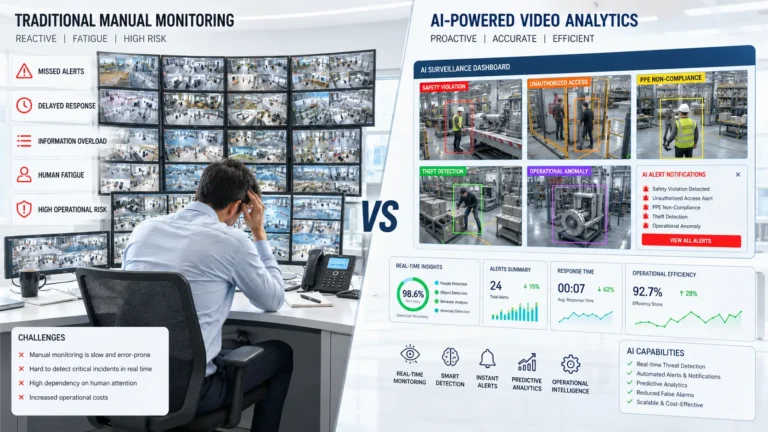
Before vs After: Operational Reality
Before (Manual Monitoring)
- Incidents detected late
- Heavy manpower dependency
- No centralized visibility
- High operational costs
- Inconsistent performance
After (AI Monitoring with CAPASai)
- Real-time detection & alerts
- Reduced manpower
- Centralized dashboard
- Lower operational costs
- Standardized performance across locations
ROI Calculation: A Practical Example
Business Profile:
- 50 retail outlets
- Annual revenue: $10 million
Without AI:
- Monitoring cost: $530,000
- Losses (shrinkage + inefficiency): $300,000
👉 Total cost: $830,000
With AI:
- AI monitoring cost: $200,000
- Reduced losses: $150,000
👉 Total cost: $350,000
Net Savings
👉 $480,000 annually
ROI:
Return = 2.4x in Year 1 alone
Why Businesses Are Switching to AI Monitoring
1. Scalability
AI systems scale across:
- 10 locations
- 100 locations
- 1000 locations
Without linear cost increase.
2. Consistency
Unlike humans:
- AI applies the same standards everywhere
- No variability
3. Faster Decision-Making
Real-time data enables:
- Faster interventions
- Better planning
4. Competitive Advantage
Businesses using AI:
- Reduce losses
- Improve efficiency
- Deliver better customer experiences
When Should You Switch to AI?
You should strongly consider AI monitoring if:
- You operate multiple locations
- You experience frequent shrinkage or theft
- SOP compliance is inconsistent
- Monitoring costs are rising
- You lack visibility into operations
Final Notes: Manual vs AI Monitoring
Criteria | Manual Monitoring | AI Monitoring |
Cost | High | Lower |
Accuracy | Low–Moderate | High |
Coverage | Limited | Unlimited |
Alerts | Delayed | Real-time |
Insights | None | Advanced analytics |
Scalability | Poor | Excellent |
Key takeaway
Manual monitoring is no longer sufficient for modern, multi-location businesses. While it may seem cost-effective on the surface, hidden inefficiencies and losses make it far more expensive in the long run.
AI monitoring platforms like CAPASai offer a smarter, scalable, and cost-efficient alternative—delivering not just savings, but complete operational transformation.
CTA (High Conversion)
See the ROI in your business within 14 days
- Book a free demo
- Get a customized cost-saving report
- Identify hidden losses instantly
👉 Schedule Your Demo Now