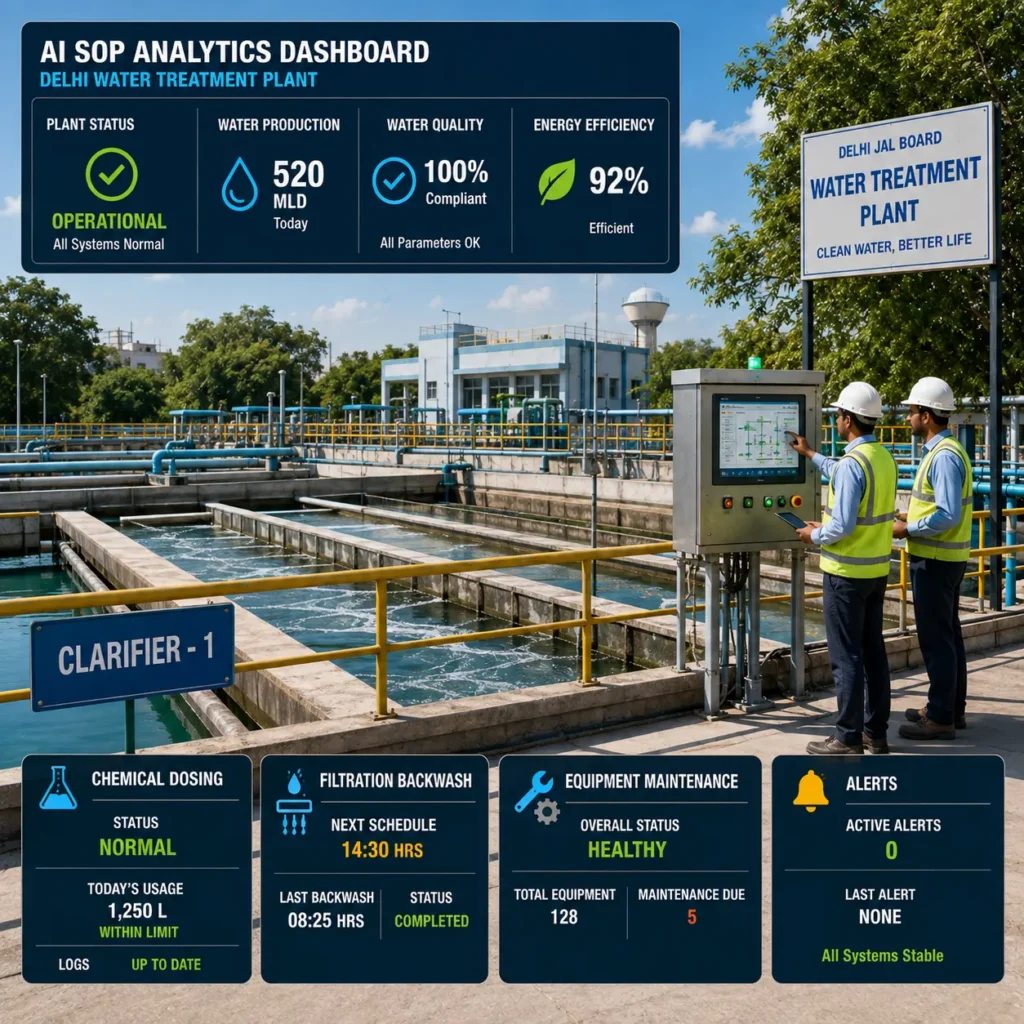
For a water utility serving a city as large and infrastructure-intensive as Delhi, operational reliability depends on thousands of activities that are easy to overlook individually but significant when repeated. Treatment facilities, pumping stations, reservoirs, pipelines, water distribution points, sewage infrastructure, maintenance teams, and field complaints all generate operational signals. For Delhi Jal Board, AI based SOP analytics and video analytics can help turn these signals into earlier warnings, stronger process control, and better maintenance decisions.
Protecting The Water Service Chain
A useful way to approach AI for Delhi Jal Board is through the assets that keep water and wastewater services functioning. Each asset has procedures around inspection, operation, maintenance, safety, and emergency response.
AI based SOP analytics can evaluate whether these procedures are being completed consistently. It can analyse inspection records, maintenance schedules, work orders, equipment observations, breakdown reports, complaints, corrective actions, and other available operational data.
The purpose is not merely to produce compliance statistics. The larger opportunity is to identify where procedural weaknesses could become service disruptions.
Detecting Early Signs Of Operational Risk
Suppose a particular category of equipment repeatedly generates inspection exceptions before maintenance work is completed. Analytics can identify the pattern and compare it across facilities, equipment types, locations, or maintenance cycles.
This can help Delhi Jal Board distinguish between isolated faults and recurring operational weaknesses. A repeated problem might indicate inadequate preventive maintenance, delayed response, insufficient resources, unclear responsibility, or an SOP that needs revision.
Video Analytics For Infrastructure That Cannot Be Watched Continuously
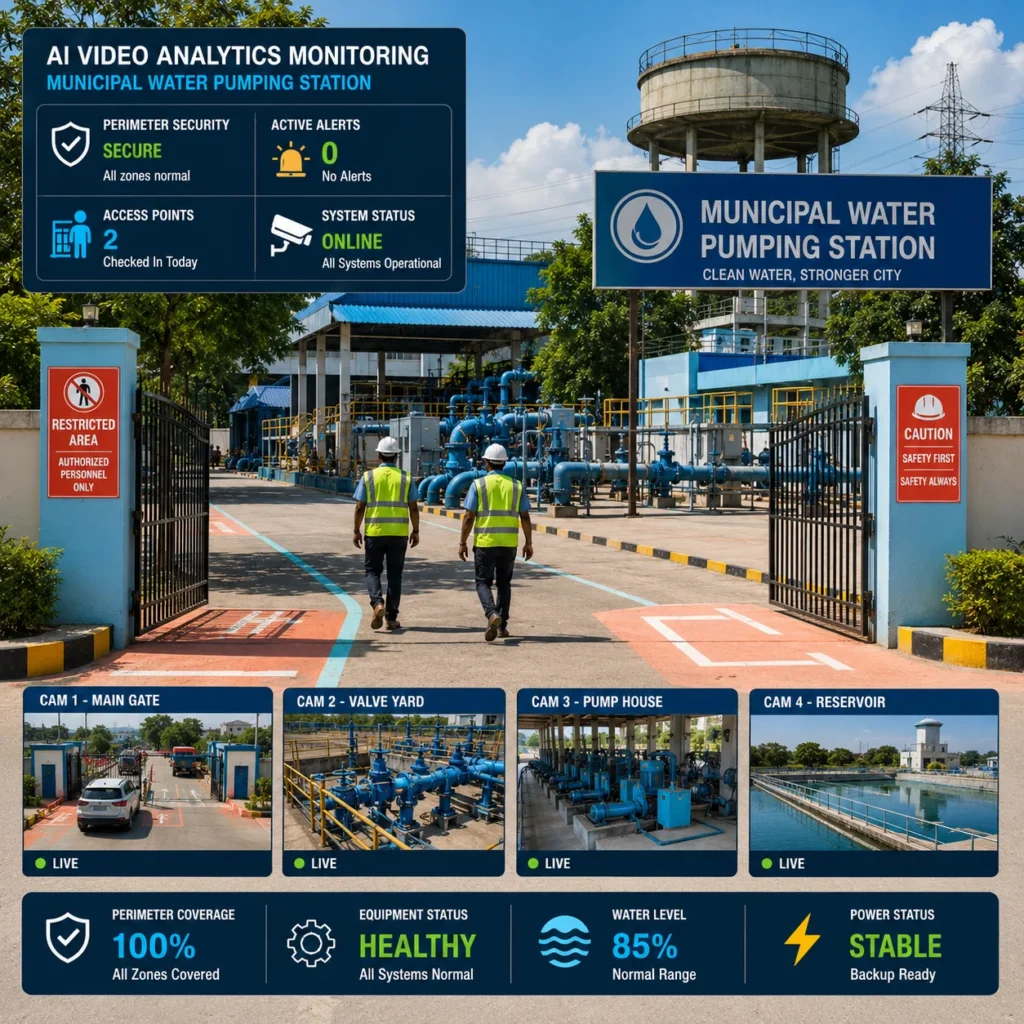
Water infrastructure is distributed across a large physical area, making continuous manual observation difficult. Video analytics can add an event-detection layer at suitable treatment plants, pumping stations, reservoirs, service facilities, and other monitored locations.
Potential applications include detecting unauthorised access, identifying people entering restricted operational zones, monitoring vehicle movement around facilities, and supporting awareness of selected safety conditions.
In maintenance environments, video analytics can also help identify defined events around equipment or work areas. Alerts can direct staff toward locations requiring inspection rather than requiring operators to watch every camera continuously.
The system should support human supervision rather than automatically determine whether an incident has occurred or who is responsible.
Managing Water And Wastewater Facilities Differently
Different facilities present different operational priorities. A water treatment facility may require attention to access control, equipment areas, chemical-handling zones, and inspection procedures. Pumping stations may place greater emphasis on equipment condition, personnel access, and maintenance activity.
Wastewater facilities introduce another set of operational environments, including treatment processes, pumping infrastructure, sludge-handling areas, and restricted work zones.
AI applications should therefore be configured around the operational context of each facility. A single generic detection rule across every Delhi Jal Board location would be less useful than facility-specific analytics.
Connecting Complaints With Infrastructure Performance
Consumer complaints can provide another source of intelligence when combined with operational records.
If a particular locality repeatedly generates complaints related to water availability, pressure, quality, or service interruption, SOP analytics can examine the associated maintenance and response history. It may reveal recurring delays in inspection, unresolved corrective actions, repeated asset interventions, or other process patterns.
Video analytics may provide additional context at selected facilities where physical conditions are relevant.
The aim is to move from complaint-by-complaint response toward understanding why certain categories of problems recur.
Making Field Response More Targeted
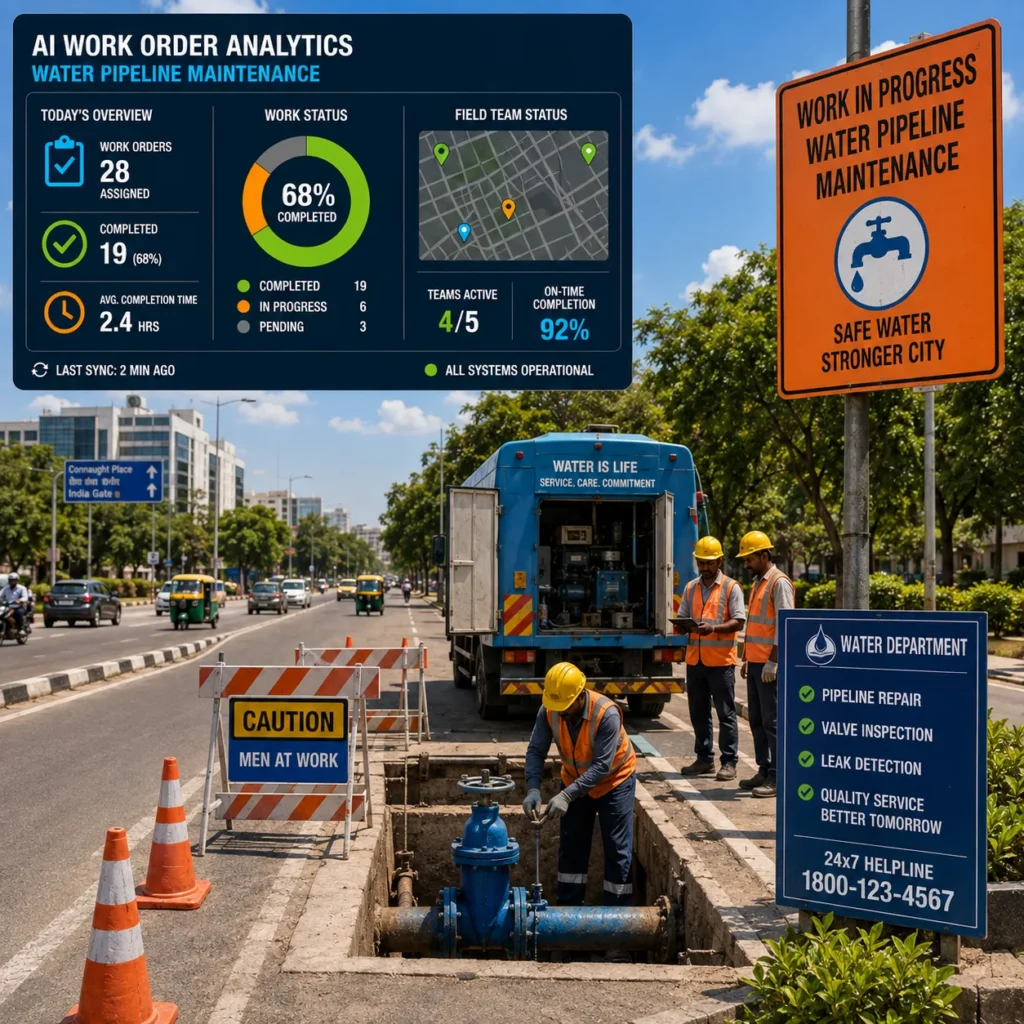
Analytics can help prioritise work by combining recurrence, operational impact, asset importance, and procedural history. A frequently recurring issue affecting a critical facility may deserve faster attention than an isolated low-impact exception.
This creates an opportunity for maintenance and operations teams to use their time more strategically.
Turning Maintenance Records Into Predictive Insight
SOP analytics can also contribute to a more proactive maintenance culture. When inspection deviations, maintenance history, equipment-related incidents, and corrective actions are analysed together, recurring patterns may become visible before a major failure occurs.
AI does not need to predict every breakdown to be useful. Even identifying assets or processes with unusually high levels of repeated exceptions can help maintenance teams prioritise investigation.
The same principle can be applied to safety procedures. Repeated gaps in access controls, inspection routines, or work-permit processes can be treated as signals requiring preventive action.
Building A Controlled AI Deployment
For Delhi Jal Board, implementation can be organised around operational risk rather than technology coverage. A pilot could focus on a selected treatment facility, pumping network, maintenance workflow, or recurring service problem.
The pilot should establish baseline performance and define measurable outcomes such as fewer repeated SOP deviations, faster maintenance response, reduced repeat complaints, improved inspection completion, or quicker incident investigation.
Data governance should be designed from the beginning, including access controls, retention periods, cybersecurity, privacy safeguards, alert escalation, and human validation.
For a water utility, the strongest value of AI is not the volume of data it can process. It is the ability to identify operational patterns early enough for engineers, maintenance teams, and managers to act. By combining SOP analytics with carefully targeted video intelligence, Delhi Jal Board can strengthen the connection between infrastructure management, field operations, and dependable public water services.
FAQs
It can identify recurring inspection gaps, maintenance exceptions, delayed corrective actions, and asset-related patterns that may warrant earlier engineering attention.
Potential locations include treatment facilities, pumping stations, reservoirs, maintenance areas, access points, and other sites where suitable camera coverage supports defined operational or security objectives.
Yes. Operational analytics can compare complaints with maintenance, inspection, response, and corrective-action records to identify recurring process or infrastructure patterns.
It can potentially detect defined events such as unauthorised access or entry into restricted operational zones, allowing personnel to review and respond to relevant alerts.
Useful measures could include inspection compliance, repeated SOP deviations, maintenance response time, repeat complaints, incident investigation time, and the accuracy and usefulness of generated alerts.