Every KSRTC journey begins long before passengers board a bus. A vehicle must be inspected, the crew assigned, fuel and maintenance records verified, schedules confirmed, and the bus dispatched from a depot. By the time it completes its route, dozens of operational decisions have already influenced safety, punctuality, and passenger experience. For Kerala State Road Transport Corporation (KSRTC), AI based SOP analytics and video analytics can strengthen each stage of this operational journey by improving visibility, consistency, and decision-making.
AI Based SOP Analytics For Depot Excellence
Depots are the operational backbone of KSRTC. They generate inspection reports, maintenance logs, attendance records, fuel data, defect reports, and service documentation every day. Much of this information is traditionally reviewed through manual supervision and periodic audits.
AI based SOP analytics can analyse these operational records to identify recurring procedural gaps without waiting for major incidents. Rather than asking whether an inspection was completed, it can highlight patterns such as delayed vehicle readiness, repeated maintenance exceptions, incomplete safety checks, or recurring documentation issues.
This enables depot managers to focus on process improvement instead of manually reviewing thousands of records.
Reimagining The Bus Journey As A Connected Process
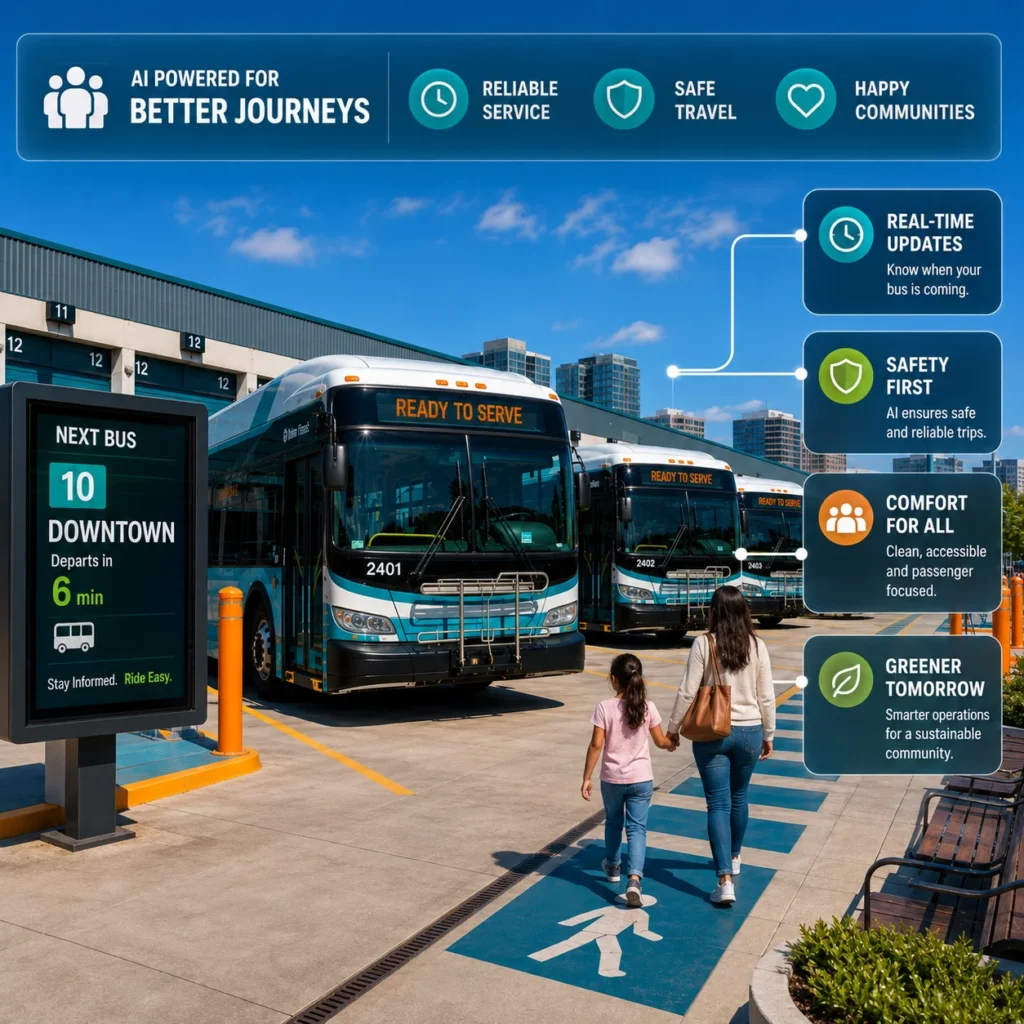
Unlike static infrastructure, KSRTC manages a constantly moving public transport network across cities, highways, hill routes, and rural roads. Every trip involves multiple operational checkpoints rather than a single continuous task.
These checkpoints include:
Journey Stage | Operational Focus |
Depot Preparation | Vehicle inspection, crew allocation, dispatch readiness |
Route Operations | Driving safety, passenger movement, schedule adherence |
Terminal Activities | Boarding, parking, turnaround procedures |
Return To Depot | Maintenance reporting, defect logging, daily closure |
AI becomes valuable when these individual stages are connected instead of being reviewed separately.
Prioritising High-Risk Operational Deviations
Not every deviation carries the same operational impact. AI analytics can classify issues according to frequency and operational significance.
Examples include:
- Repeated delays in pre-trip inspections.
- Frequently recurring maintenance observations.
- Missed documentation during vehicle handover.
- Inconsistent completion of end-of-day reporting.
- Recurring corrective actions that remain unresolved.
This helps supervisors allocate resources where operational improvements are likely to produce measurable results.
Video Analytics Beyond Traditional Surveillance
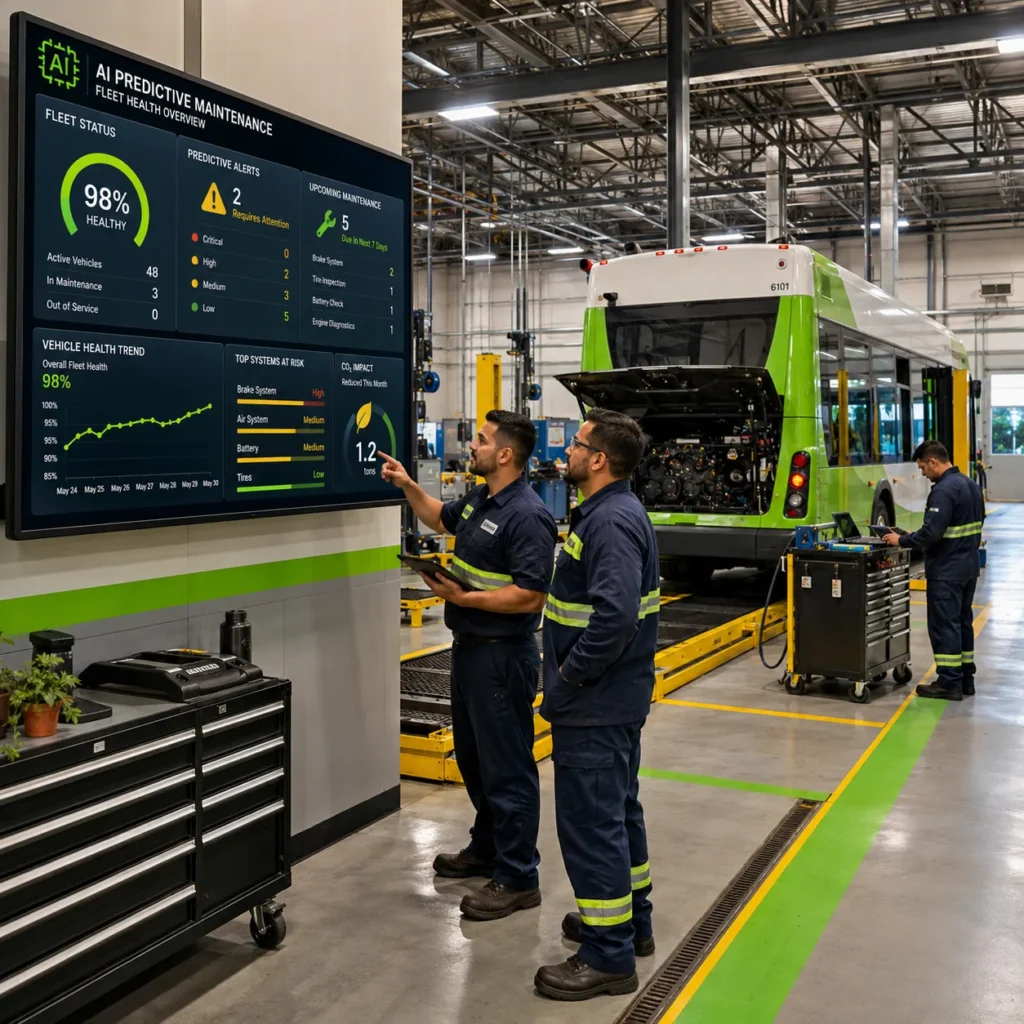
KSRTC operates buses, depots, workshops, terminals, and parking facilities where continuous manual monitoring is difficult. Video analytics can convert camera feeds into event-based operational alerts rather than requiring personnel to observe every screen continuously.
Potential applications include detecting unauthorised access into depot workshops, monitoring pedestrian movement around bus parking areas, identifying unsafe interactions between buses and people, and supporting incident review at terminals.
The emphasis is on improving operational awareness rather than replacing human supervision.
Supporting Passenger-Facing Operations
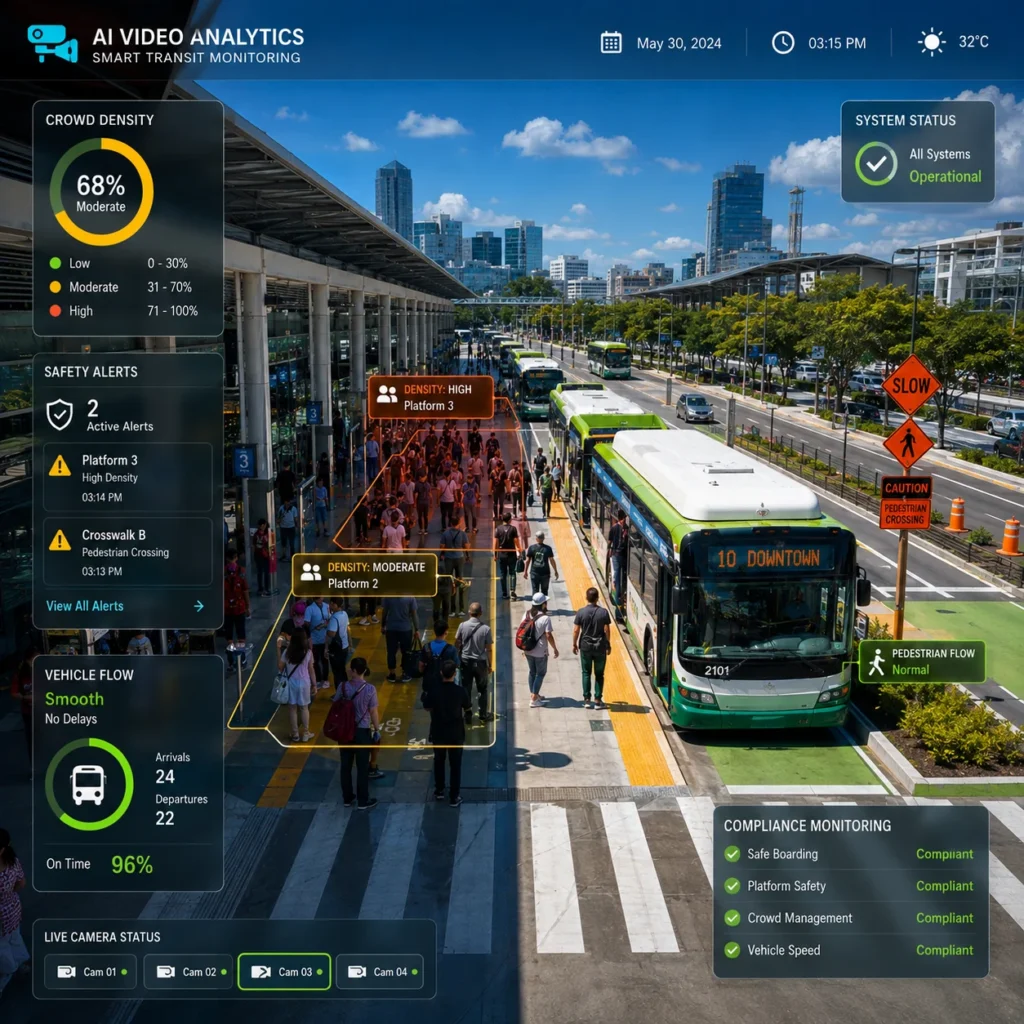
Passenger terminals create challenges that differ from maintenance facilities. Congestion during peak hours, platform movement, boarding activity, and vehicle circulation require different analytical rules.
Video analytics can assist operational teams by identifying unusual crowd build-up, blocked boarding areas, prolonged vehicle occupancy at designated bays, or movement patterns that may require traffic management within terminals.
This allows station supervisors to respond proactively during busy operating periods.
Creating Smarter Driver Support
Drivers operate under changing road, weather, and traffic conditions throughout Kerala. AI should support them with better operational feedback instead of functioning solely as a compliance tool.
When combined with suitable onboard camera systems, video analytics may help identify predefined events such as prolonged distraction, unsafe driving behaviour, or repeated harsh braking. These observations should be reviewed alongside route conditions, vehicle performance, and operational context before conclusions are drawn.
SOP analytics can complement this by examining whether driver briefings, vehicle inspections, and mandatory procedural steps were consistently completed before service.
Together, these technologies encourage preventive safety management instead of reactive investigation.
Measuring Operational Improvement Across KSRTC
A successful AI programme should be evaluated through measurable service outcomes rather than the number of alerts generated.
Useful performance indicators may include:
Operational Area | Example Measure |
Fleet Readiness | Improvement in on-time vehicle dispatch |
Maintenance | Reduction in recurring procedural deviations |
Safety | Faster review of operational incidents |
Passenger Service | Improved terminal flow and reduced congestion |
Governance | Higher completion rate of mandatory SOPs |
By focusing on operational outcomes, KSRTC can determine whether AI is delivering genuine value to public transport services.
Building A Practical Implementation Strategy
A phased deployment is often more effective than organisation-wide implementation. KSRTC could begin with one depot, a selected terminal, or a specific operational challenge such as vehicle readiness or terminal safety. After establishing baseline performance, the corporation can validate detection accuracy, refine SOP analytics, and develop governance policies covering data access, privacy, cybersecurity, and human oversight.
The objective is not to automate decision-making but to provide managers, depot engineers, safety officers, and operational teams with better evidence for improving reliability, safety, and passenger service across Kerala’s public transport network.
FAQs
It can identify recurring procedural gaps in inspections, maintenance, documentation, and vehicle readiness, allowing depot managers to address operational issues more systematically
Yes. It can help monitor pedestrian movement, boarding areas, vehicle circulation, and restricted zones, enabling quicker responses to potential safety concerns.
No. AI provides operational insights and alerts, while supervisors and transport officials remain responsible for reviewing information and making decisions.
A focused pilot at one depot or terminal with clearly defined objectives such as improving vehicle dispatch readiness or terminal safety is a practical starting point.